Africa looks to the Orient for lessons


The report suggests African countries should form industrial and other development policies to promote value-added production and reduce dependence on producing and exporting unprocessed commodities.
Rick Rowden, a development consultant for the UN Conference on Trade and Development, says despite the important gains in services industries and per capita incomes, Africa is still not rising and services alone will not create enough jobs to absorb the millions of unemployed youth in Africa's growing urban areas.
"Instead, steps must be taken to revise WTO agreements, and the many trade agreements and bilateral investment treaties currently being negotiated, so that Africa has the freedom to adopt the industrial policies it needs in order to make genuine progress," he writes in Foreign Policy magazine.
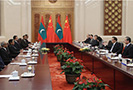
China is at the forefront in arranging bilateral investment and development agreements with African nations, most of whom are impressed and encouraged by China's own spectacular economic rise.
In recent weeks, Kenya's President Uhuru Kenyatta on his first official visit to Beijing echoed the wishes of many other African nations in calling on China to invest more in his country to establish factories, create jobs and boost its economy.
However, according to Arthur Mutambara, deputy prime minister of Zimbabwe, choosing a correct and suitable way for Africa's industrialization is vital. For Africa, it must be value-added, manufacturing and export-based, not import or supermarket-based.
"You can't industrialize as a supermarket," he says. "No country would be industrialized through trade or selling raw materials, buying finished products.
"We just need to be clever as Africans. Sometimes we just sell raw materials for cash, but if you produce value-added products, the profit could be 10 times bigger than it is now."
He says China and Africa have been successful in many fields through bilateral cooperation and this can continue through the process of Africa's industrialization.
"The Chinese could come to Africa to help Africa process raw materials and sell them to China, the US and other parts of the world," he says.
"For instance, we can work with Chinese in Africa to design and make computers and sell them in Africa and China."
Justin Yifu Lin, former chief economist and senior vice-president of the World Bank, said in a conference organized by the China Macroeconomic Research Center in July that China must transfer its manufacturing and labor-intensive industry to other countries to ensure a sustainable and rapid economic development and Africa is one of the best choices.
"Transferring labor-intensive industries overseas is in line with the lessons of history and economics," he says. "Although disparities still remain among China's eastern, central and western regions, moving operations within the country has become quite limited because cheaper labor from the west has moved to the east and the salary gaps among regions are being bridged. So moving overseas is a must."
Japan transferred its labor-intensive textile industry to the Four Asian Tigers (Hong Kong, Taiwan, Singapore and South Korea) in the 1960s and, come the 1980s, these economies moved manufacturing plants to the Chinese mainland.
China has performed an economic miracle with an annual 9.8 percent growth on average over the past 33 years. The Chinese average annual income has reached a high level, much higher than that of Africa, says Lin. "China still has a huge gap compared with other developed countries, but with huge potential to become a high-income country in 2020."
To maintain the momentum of development, Lin believes industries must be updated and structurally reformed, especially labor-intensive manufacturing, which has contributed enormously to China's success.
"The industry must be updated at both ends of the value chain's smiling curve, which are research and development and marketing with more added value," he says. "And the structure needs to be reformed with technology-intensive manufacturing."