New lay of the land


|
 |
|
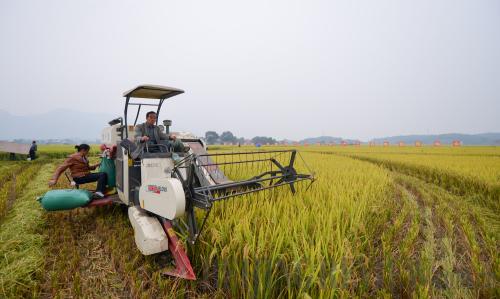
CHERISHING THE FARMLAND: A farmer harvests rice in Yongzhou, Hunan Province [Photo/BAI YU] |
If you go through the brochures that Chinese local governments handed out to attract investment 20 years ago, the most alluring preferential policy might be the free land they promised to companies. Thanks to that, industrialization took off.
However, many local governments now find out they have no land left, especially in eastern coastal cities. A shortage of construction land quotas makes it impossible for their economy to develop as fast as it did before.
Many are pinning their hopes on the Third Plenary Session of the 18th Communist Party of China (CPC) Central Committee, which will be held in November. One of the focal points is expected to be rural land reform.
China's rural land is divided into arable land, which is used to grow crops, and construction land, which is used for rural housing, infrastructure and companies or factories. While urban land is owned by the state, China's rural land is collectively owned by residents. Arable land is leased to residents as farmland, while construction land is managed by the village.
According to current laws and regulations, rural construction land can only become urban construction land and then be used for residential, commercial or industrial purposes after a local government acquires the land from farmers, whom they must compensate. Other than that, all usage of rural construction land is illegal.
A source close to the matter told Beijing Review anonymously that this session will establish a market-oriented land trade market, which will allow rural land to be freely traded based on the willingness of farmers. Regarding rural land reform, the most sensitive area concerns collectively owned construction land, which is about 180,000 square km, three times the area of urban areas, according to an estimation by Dang Jianying, a researcher with the Rural Development Institute of the Chinese Academy of Social Sciences.
Currently, collectively owned rural construction land can only be traded in the market after a government-backed land acquisition. If a free construction land trade regime can be established, it could break up the government's monopoly of land management and greatly boost a city's land availability for housing, thus reducing housing prices and providing potential gains for farmers from the transfer of land ownership. It will also create investment opportunities, provide a huge amount of construction land for the industrial sector and expedite new urbanization focused on the industrial sector and employment.
But some have their doubts. Wang Zhihao, Standard Chartered Bank's chief economist for the Greater China Region, said no radical measures are likely to be taken because there have been prolonged disputes over the low efficiency of land usage and insufficient compensation for farmers. "This means the new round of land reform may only have limited impact in the short run. More effects can only be seen in the long term."
The right time
Experts say the land reforms are coming at the right time given the growing outcry from farmers who say their legal status regarding rights under the collective ownership scheme is unclear.
Many rural residents are reluctant to migrate into cities—a common phenomenon in China for those seeking better paying jobs—because they fear they would lose rights over their leased farmland and miss out on any dividends from collective assets.
Zhou Tianyong, a professor with the Party School of the CPC Central Committee, said the dual system of land ownership and usage in rural and urban areas have greatly impeded China's economic development.
"In rural areas, a large amount of rural construction land is sitting idle because it is non-tradable. While in urban areas, construction land has almost been used up. In order to further develop the local economy, governments would acquire rural construction land, sometimes through forcible land transfers and low compensation.