Comments
  Print
Print  Mail
Mail  Large Medium Small
China has identified 262 resource-dependent cities in its first national framework plan for the sustainable development of those cities, promising targeted measures to guide their development.
Released on Tuesday, the 14,000-word plan placed the cities into four categories based on their resource sustainability: "emerging," "mature," "declining" and "regenerative".
|
 A man rides a bicycle next to a lake in Ordos in the Inner Mongolia autonomous region. "Emerging" resource-dependent cities, such as Ordos, are plagued by over-mining issues and environmental damage problems, leading to government policies that focus on regulating excessive mining. [Photo provided to China Daily] |
The idea behind the plan is that different resource-dependent cities have different problems and require differentiated development strategies.
For instance, "emerging" resource-dependent cities, such as Ordos in the Inner Mongolia autonomous region, are plagued by over-mining issues and environmental damage problems, while "declining" resource-dependent cities such as Fushun, Liaoning province, are haunted by their declining industrial sector, high unemployment levels and deteriorating communities.
Thus for "emerging" cities, the policy focus will be to regulate excessive mining; for "declining" cities the policy emphasis will be to foster alternative industries and safeguard residents' living conditions; while for "mature" cities, it will be to increase the resource-utilization efficiency and improve the quality of their urbanization processes.
To tackle these problems from an institutional perspective, the plan pledged to set up five key mechanisms.
For example, the government will increase the requirements for mining companies to curb over-mining, and it will improve pricing mechanisms to make the prices better reflect the scarcity of resources, adding environmental restoration and pollution reduction costs into the final cost of the products.
The government also vowed to reform the current taxation system to leave more of the benefits of the region's development to local people. In the future, for instance, resource taxes on coal will be collected on the basis of price, not on the basis of volume. The reform is expected to beef up local governments' fiscal revenues as all of the resource tax will go to local governments' coffers. The current environment fee will also be converted into an environment tax.
As for "declining" cities, those whose resources have been depleted, the plan promised more funding support. Xu Hongcai, an official with the Finance Ministry, said that centrally allocated funds will mainly be used for local social security, healthcare, education and environmental restoration projects. Also, an annual rating system will be established, and those who fare poorly will be punished and will get less funding.
However, the task is daunting. In the 67 "declining" cities, a total of 70 million square meters of shanty towns have to be redeveloped; 140,000 hectares of land that is sinking due to extraction processes has to be restored; more than 600,000 unemployed people need jobs; and 1.8 million people rely on minimum living allowances.
Dongchuan district in Kunming, the capital of Yunnan province, is one of the two cities in the province that have been categorized as "declining" cities.
Lu Ping, Party secretary of Dongchuan, said the new policy will significantly benefit the district.
He added the district has received about 600 million yuan ($98.5 million) in subsidies since 2009, when it was put on the list. The central and provincial governments have also supported technological and research projects.
"When we lost our competitive advantage in the metal industry, new industries had to arise to help the residents, especially the 60,000 people who were relocated from their original communities where the soil was damaged due to mining activities," Lu said.
Hu Yongqi in Kunming contributed to this story.
 Model with German luxury cars
 Getting in the mood
 Models at Mercedes pavilion at 2013 Auto Guangzhou
 Buick Riviera concept car at 2013 Auto Guangzhou
 FAW-VW all-new Golf at Guangzhou auto show
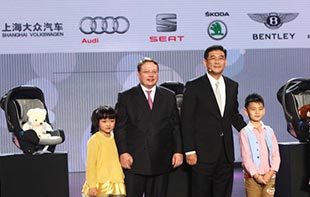 VW donates more than 5k child safety seats
 Honda models at 2013 Guangzhou auto show
 Honda Jade at the 2013 Guangzhou auto show
Copyright 1995 - . All rights reserved. The content (including but not limited to text, photo, multimedia information, etc) published in this site belongs to China Daily Information Co (CDIC). Without written authorization from CDIC, such content shall not be republished or used in any form. Note: Browsers with 1024*768 or higher resolution are suggested for this site.
License for publishing multimedia online 0108263 Registration Number: 20100000002731