For too long, China's housing market hasn't served as a reliable indicator of its overall economy. This shouldn't be the case in a country which is undergoing rapid and, perhaps more complex, demographic change than any other country - around 200 million rural migrants and their families are to be resettled in cities in the next decade.
But press commentators, in China and outside, have seldom discussed how the housing market is related to the rest of the economy, and how housing markets in different cities are related with each other.
People raise the alarm of an economic bubble, based on housing assets, when home prices are seen as rising too fast.
Leaders have even promised policy critics that they would make sure that housing prices are brought down (fortunately they didn't specify by how much).
When prices come to a standstill, or show a widespread fall as is happening now, people raise another alarm - about a general setback to the Chinese economy.
Recent reports say almost all cities that placed strict price caps and home ownership requirements have relaxed those measures. Controls are likely to be further loosened if price declines continue into later this year and early next year.
There is a strong feeling that it's the government's duty to prevent housing prices from falling too much and too fast as it would affect the entire economy, although there is little agreement on how much is too much.
Little is discussed as to why price rises and falls come about, and what the contributing factors are. Nor is there a reasonable comparison between the housing market, say in mid-2009, and the housing market now.
Back then, prices soared primarily because of two factors: local governments' lack of channels to raise capital for their own development plans, and domestic investors' lack of choice to reap good returns.
If local governments had a reasonable level of financial independence, they would not have had to rely so much on land auctions for revenue.
And if the domestic A-share stock market had generated some healthy returns, there would not have been so much investment flooding the property market, in second- and third-tier cities as well as the four first-tier cities of Beijing, Shanghai, Guangzhou and Shenzhen.
The situation now is that investors can have a wider choice when the A-share market connects with the Hong Kong stock market later this year, although it is hard to say that it will lead to healthy returns.
In the meantime, laws are being made or amended to lay down the terms for many local governments to develop proper financial programs, such as bond issues in the centrally regulated market.
These two developments are likely to redirect some speculative money, which would have been committed to the housing market in the old days, to other channels.
One can hardly overestimate the amount of speculative money in China: witness all the properties that Chinese nouveaux riche have bought overseas. So there could be a third factor added as the nation's housing market continued its transition.
Some mayors can continue to see a housing boom as long as they can manage to attract more business investment and high-skilled staff to their cities.
Most of the present ghost towns won't be resurrected, for sure. The most promising cities are the ones that boast good logistics and e-commerce infrastructure, good schools, relatively simple and clean government services, and a good environment.
These are the areas where smart city governments can compete with old and too-large-to-manage cities like Beijing and Shanghai. Driven away by prohibitively high housing prices and even worse, terrible levels of pollution and the prospects of raising their children in dirty smog, Beijing is already losing its young professionals.
With all the above factors taken into account, we can say while housing development will remain a sizable industry, its overall importance relative to the whole economy and to other industries is unlikely to be as strong as before - when its political function (as local governments' fund-raising vehicle) and investment function (where people seek speculative returns) begin to diminish.
The author is editor-at-large of China Daily.
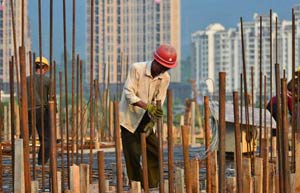

Slack property market takes toll on services

Copyright 1995 - . All rights reserved. The content (including but not limited to text, photo, multimedia information, etc) published in this site belongs to China Daily Information Co (CDIC). Without written authorization from CDIC, such content shall not be republished or used in any form. Note: Browsers with 1024*768 or higher resolution are suggested for this site.
License for publishing multimedia online 0108263 Registration Number: 20100000002731