|
 |
|
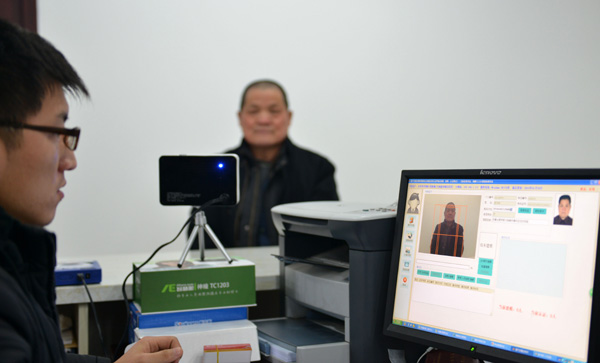
A retired employee has his identity verified at a social security fund office in Hefei, Anhui province. The number of Chinese older than 60 accounted for 15.5 percent of the population at the end of 2014. [Photo/China Daily] |
Enterprises would have to pay more to bridge rising income-expenditure gap, say experts
China is likely to increase the contribution by State-owned enterprises to social security funds to bridge the income-expenditure gap in the sector.
The government has already set up an inter-ministerial working group to finalize the plan to convert shares of SOEs into social security funds, the Economic Information Daily, a newspaper affiliated to Xinhua News Agency, reported, citing people familiar with the matter.
The plan has entered the "implementation" phase, the report said, without saying what the specific plan was and how it would be implemented.
Li Zhong, spokesman for the Ministry of Human Resources and Social Security, said last month that a working group, which includes the Ministry of Finance and other ministries such as State-owned Assets Supervision and Administration Commission, the MOHRSS and China Securities Regulatory Commission, has been established and would work on an overall plan on the issue.
Lou Jiwei, the minister of finance, had said in a speech that the fair way to address the gap between income and expenditure in social security funds is to convert the shares in SOEs.
"It is unfair to ask this generation to increase their social security payments to plug the financial gap left by the previous generation," Lou said.
China began to establish a modern social security system in 1997. Before that, SOEs were responsible for employee pension after retirement. The government admitted these old employees into the system by asking them to pay a certain portion of their salaries after the new system started to operate. It treated them as having paid the money in previous years while actually they have not. Newly recruited members had to pay the money from the beginning.
With most of the old employees, the equivalent of baby boomers in the United States, retired or approaching retirement, there has been tremendous pressure on working people to increase their contributions to support baby boomers' pension and other securities. The only other alternative is to boost SOE payments to these funds.
At the end of 2014, the number of Chinese older than 60 accounted for 15.5 percent of the population. The ratio is expected to surge in the following years, as birth rates in the 1960s and 1970s were much higher.
According to the latest data from the Finance Ministry, total revenue of various social security funds, excluding fiscal subsidies, is expected to reach 3.16 trillion yuan ($508.9 billion) this year. The total expenditure in 2015 is expected to be about 3.85 trillion yuan. That leaves a 683 billion yuan deficit. The deficit for the corporate employees' pension is 302.5 billion yuan, widening from 156.3 billion yuan in 2014 and 95.9 billion yuan in 2013.
At the same time, China's working population and employers are paying the highest rate of social security in the world. Employees and employers together pay 40 to 50 percent of the average salary to these funds, according to estimates from Bai Zhong'en, an economics professor with Tsinghua University. The social security contributions have risen steadily in recent years.
A grand reform roadmap in 2012 promised to replenish social security funds with contributions from SOE shares.
The SOEs already pay a small portion of their annual earnings to social security funds, an amount that is minimal. Last year, 18.4 billion yuan of SOEs' earning were transferred to social security funds and 215 million yuan of shares were cashed out-by comparison SOEs' earnings in that year were 156.3 billion yuan.
It remained unclear in the new plan how much shares could be converted, given the stiff resistance from SOEs. Yang Yansui, a social security professor with Tsinghua University, said the minimum requirement is 10 percent while many advocate 30 percent.

Copyright 1995 - . All rights reserved. The content (including but not limited to text, photo, multimedia information, etc) published in this site belongs to China Daily Information Co (CDIC). Without written authorization from CDIC, such content shall not be republished or used in any form. Note: Browsers with 1024*768 or higher resolution are suggested for this site.
License for publishing multimedia online 0108263 Registration Number: 130349