Global growth in 2016 will be disappointing and uneven. The global economy's medium-term growth prospects have weakened as well, because potential growth is being held back by low productivity, aging populations, and the legacies of the global financial crisis. High debt, low investment, and weak banks continue to burden some advanced economies, especially in Europe; and many emerging economies continue to face adjustments after their post-crisis credit and investment boom.
This outlook is heavily affected by some major economic transitions that are creating global spillovers and spill-backs, particularly China's transition to a new growth model and the normalization of US monetary policy. Both shifts are necessary and healthy. They are good for China, good for the US, and good for the world. The challenge is to manage them as efficiently and as smoothly as possible.
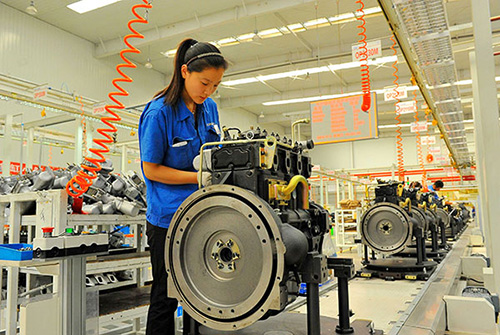
China has launched deep structural reforms to lift incomes and living standards, seeking a "new normal" of slower, safer, and sustainable growth that relies more on services and consumption and less on commodity-intensive investment and manufactur-ing. But China's policymakers are confronting a delicate balancing act: they need to implement these difficult reforms while preserving demand and financial stability.
One spillover effect of this transition was seen this past summer, when investors' fears about the pace of the Chinese economy's slowdown put further pressure on commodity markets and triggered sizeable currency depreciations in a number of commodity exporters that rely on Chinese demand. As it invests less, China's appetite for commodities - it currently consumes 60 percent of the world's iron ore, for example - will decline. This will contribute to what could be a prolonged period of low commodity prices, which policymakers - particularly in large commodity exporters like Australia and Brazil - will need to manage carefully.
The second major transition concerns the Federal Reserve's determination to raise interest rates. Although the Fed has clearly indicated that rates are expected to remain low for some time, this transition reflects better economic conditions in the US, which is also good for the global economy.
Low interest rates contributed to a search for yield by investors, which supported financial risk-taking and higher valuations for equities, sovereign bonds, and corporate credit. So the Fed also faces a delicate balancing act: to normalize interest rates while minimizing the risk of financial-market disruption.
There are potential spillovers here, too. Even before the Fed's interest-rate hike in December, the prospect of tighter US monetary policy had already contributed to higher financing costs for some borrowers, including emerging and developing economies.
This is part of a necessary adjustment in global financial conditions. The process, however, could be complicated by structural changes in fixed-income markets, which have become less liquid and more fragile - a recipe for market overreactions and disruptions.
Outside the advanced economies, countries are generally better prepared for higher interest rates than in the past. And yet I am concerned about their capacity to buffer shocks. Many emerging and developing economies responded to the global financial crisis with bold counter-cyclical fiscal and monetary measures. By using these policy buffers, they were able to lead the global economy in its time of need. And over the past five years, they have accounted for almost 80 percent of global growth.
But these policy initiatives were generally accompanied by an increase in financial leverage in the private sector, and many countries have incurred more debt - a significant portion of which is in US dollars. So rising US interest rates and a stronger dollar could reveal currency mismatches, leading to corporate defaults - and a vicious contagion that spreads to banks and sovereigns.
And yet we know that these transitions' downside risks can be managed, by supporting demand, preserving financial stability, and implementing structural reforms. All advanced economies should fully incorporate spillover risks in their decision-making and ensure that their communications are clear in this regard.
The eurozone, meanwhile, can upgrade its prospects by fully tackling nonperforming loans worth some ?900 billion ($978 billion) - one of the major unresolved legacies of the financial crisis. Doing so would enable banks to increase the supply of credit to companies and households, thereby enhancing the potency of monetary accommodation, improving the outlook for growth, and bolstering market confidence.
Emerging economies need to improve the monitoring of major companies' foreign-currency exposures. They should also ensure financial stability by using macro-prudential tools to strengthen banks' resilience to the buildup of corporate leverage and foreign debt.
At the global level, there is a pressing need to complete and implement the regulatory reform agenda - with a special focus on improving the transparency and oversight of non-banks, or shadow banks. And we have another major task ahead of us as well: upgrading the still-inadequate resolution framework for systemic, globally active financial institutions.
On the fiscal side, countries should use policies that are as flexible and growth-friendly as possible. The IMF continues to recommend that advanced economies with room for fiscal stimulus use it to boost public investment, especially in quality infrastructure. Credible medium-term fiscal plans also remain a priority, especially for the US and Japan.
Commodity-exporting countries that have room for fiscal-policy maneuver should use it to smooth their adjustment to lower prices. Others should rely on growth-friendly fiscal rebalancing - by, for example, implementing tax and energy-price reforms and reprioritizing spending, including to protect the most vulnerable.
Commodity exporters such as Chile, Colombia, Norway, and Botswana used the commodity boom to strengthen their fiscal frameworks against shocks. This has given them greater control over the pace of necessary fiscal adjustment, thereby enabling them to preserve growth. There is a useful lesson here for others.
Finally, all countries need to upgrade their economic structures by reforming their labor and product markets, infrastructure, education and healthcare systems, and trade policies. Implementation of course requires skillful and savvy policymaking, especially in this phase of lower growth and higher uncertainty. And, given the collective nature of many of the issues involved - like climate change, trade, migration, and the global financial safety net - increased international cooperation is more urgent and essential than ever.
Yes, the challenges confronting the world in 2016 are great. But with the right policies, leadership, and cooperation, we can manage them to the benefit of us all.
The author is managing director of the International Monetary Fund.
Project Syndicate

Copyright 1995 - . All rights reserved. The content (including but not limited to text, photo, multimedia information, etc) published in this site belongs to China Daily Information Co (CDIC). Without written authorization from CDIC, such content shall not be republished or used in any form. Note: Browsers with 1024*768 or higher resolution are suggested for this site.
License for publishing multimedia online 0108263 Registration Number: 130349