|
|
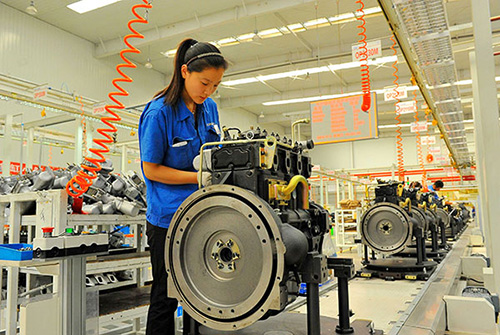
A woman looks at a 3D bioprinter, developed by Revotek, at the launch of the product last October.[Provided to China Daily] |
Holed up in a shiny glass building in the Chinese city of Chengdu, Y. James Kang spends his days researching ways to repair damaged hearts, livers and brains-with the help of stem cells and 3D printers.
The Chinese-born and US-trained biologist set up his healthcare startup, Revotek, in this southwestern city in 2014. At the time, he was attracted by the region's rich local supply of monkeys that were ideal for testing human treatments. In Chengdu, the company has drawn 215 million yuan ($33 million) in funding from a local real estate company seeking to diversify.
A few miles from Kang's lab, AllTech Medical Systems has developed and is selling MRI systems intended to compete with multinational giants such as General Electric Co, Royal Philips NV and Siemens AG, which have dominated the market. Its MIT-trained founder, Zou Xueming, chose Chengdu to start his second company after selling his Cleveland-based startup to GE in 2002. AllTech hopes to submit an application to go public by the end of next year, with Zou planning to raise $50 million to $100 million.
They are among a string of local businesses that stand to benefit from a push by the Chinese city to attract researchers and venture capital investors. Known for its spicy cuisine and leisurely lifestyle, Chengdu has in recent years attracted the likes of Intel Corp and IBM, which have set up research and manufacturing bases there. More recently, the flurry of investment activity is in response to Chinese Premier Li Keqiang's call for innovation and entrepreneurship.
China's leaders are seeking new engines of growth as the country's economic expansion hits its slowest pace in 25 years. That's encouraged provinces across the country to create special zones where new ventures can tap funding opportunities and other incentives. While technology startups have been some of the biggest beneficiaries, medical research firms are also getting a boost-giving new life to a Chinese industry that lagged the West for years.
Since it was launched in 2014, China's campaign to encourage entrepreneurship has helped create tens of thousands of small companies. In Chengdu, the local government has set up seven start-up focused funds backed by private capital totaling 700 million yuan to promote industries like telecommunications, health and biotech.
The science and technology bureau has a dedicated team to help banks assess startups based on the value of their technology and patents. It also has incubators that provide office space and training to new businesses. "There are strong driving forces," in Chengdu, said AllTech founder Zou. "Policies to attract talent, land and tax policies are very favorable."
Like Kang's firm, most of Chengdu's startups are many years away from making big profits from their businesses. That means Chengdu's government also has a long wait before it sees major benefits to the local economy.
Dozens of Chinese cities are launching similar programs, and these new ventures also offer a window into the rising ambitions of Chinese researchers, many of whom have trained overseas. Kang was among the first batch of Chinese to go back to college in 1977 after the Cultural Revolution, eventually earning his PhD at Iowa State University. His primary research focus now is 3D bioprinting, a new frontier of medicine aimed at creating replicas of human organs.
His team has been developing techniques to repair damaged skin, hearts, livers and brains in animals including pigs and monkeys through regeneration-a process that involves creating 3D printed structures that can replicate, for example, a layer of skin or a blood vessel. For organs like a damaged heart, a specialized catheter is used to deliver "bio-ink" or stem cells mixed with nutrients and other growth factors.


Copyright 1995 - . All rights reserved. The content (including but not limited to text, photo, multimedia information, etc) published in this site belongs to China Daily Information Co (CDIC). Without written authorization from CDIC, such content shall not be republished or used in any form. Note: Browsers with 1024*768 or higher resolution are suggested for this site.
License for publishing multimedia online 0108263 Registration Number: 130349