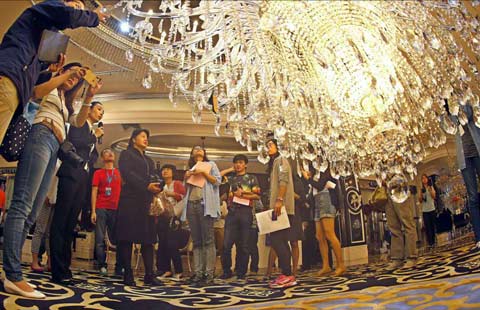
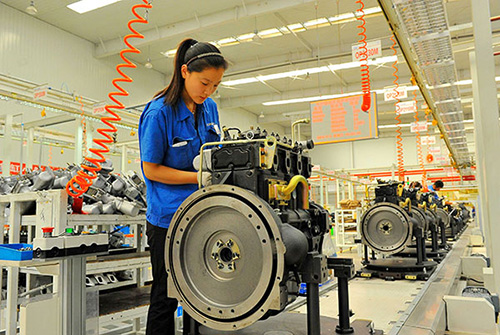
When Chinese president Xi Jinping visited the University of Manchester in October, he was shown the world's first graphene light bulb. Manufactured by BGT Materials in China, this light bulb is being launched globally in the UK this month, carrying with it the potential to change the lighting industry.
With a longer lifespan and cheaper production costs, the graphene light could become a strong rival to the popular LED lights. Graphene's ability to dissipate heat quicker will also give manufacturers more flexibility in designing lighting systems. BGT estimates sales will reach 300,000 to 500,000 bulbs in this year.
Graphene is one of the most interesting inventions of modern times. As a thin layer of pure carbon, it is tougher than a diamond, yet very lightweight and easily conducts electricity and heat. It has been used for a wide variety of applications, from strengthening tennis racket to building semiconductors.
Graphene was first isolated from the graphite mineral at The University of Manchester by Andre Geim and Kostya Novoselov in 2004, earning them the Nobel Prize for Physics in 2010. Due to its short history, its commercial potential is yet to be unlocked.
It is used by the Austrian sports equipment firm Head to strengthen tennis rackets, and the Italian firm Vittoria uses graphene to strengthen bicycle tyres.
Thanks to Xi's October visit to BGT, which is located in the University of Manchester, the university's National Graphene Institute (NGI) has signed deals with two Chinese firms, telecommunications firm Huawei, signed during Xi's visit, and the Beijing Institute of Aeronautical Materials and Aviation Industry Corporation of China.
"The level of interest from Chinese companies keen to work with has really took off since the state visit, and we received so many enquiries," said James Baker, Graphene Business Director at the NGI.
The cooperation project with Huawei currently focuses on research into graphene's thermal management properties, which can be useful to enhance Huawei's products. The cooperation with BIAM and AVIC is to conduct research of how to incorporate graphene into materials used in the aviation and other transport sectors.
Robert Young, a Professor of Polymer Science and Technology, who leads the NGI's cooperation with BIAM and AVIC, says the use of graphene in the transport industry can lead to significant benefits. "Graphene is a strong light weight material and in the transport industry it's important to save weight and become fuel efficient," says Young.
China has already invested heavily and made it a strategically important new material in its 13th five year plan, which sets out the country's development objectives from 2016 – 2020.
China has also established 5 graphene industrial parks to accelerate the industrialization of the material, in Changzhou, Wuxi, Ningbo, Qingdao, and Chongqing. Currently 70 percent of graphene's raw material, graphite, is found in China, giving Chinese graphene manufacturers a big advantage.
According to statistics from the UK's National Physical Laboratory, China has applied 47 percent of the world's total graphene patents, and is currently the world's biggest applicant country.
All these efforts are aimed at unlocking the country's huge graphene market potential. The Beijing-based intelligence firm ResearchInChina estimates that China's graphene market will grow to 200 million yuan ($30.6 million) in 2018, compared to the global market of $65 million. In comparison, the global market in 2015 was only worth $24.4 million.
"China's high technology manufacturing industry, ability to investment heavily into the graphene sector and its abundance of highly qualified graphene industry talents all contribute to its advantages in the graphene industry," says Young.
China has also placed a big emphasis on the implementation of high quality graphene standards domestically to help unlock this industry's potential, with the help of British expertise.
In March 2015, NPL signed an agreement with the Beijing based Zhongguancun Fengtai Science Park and Beijing Fengtai New Materials Inspection Institute. Under the MoU, NPL will help the Chinese organizations adapt global graphene standards to China's specific needs'
Hao Ling, NPL's Principal Research Scientist, said the establishment and enforcement of graphene standards internationally is of vital importance for this industry's growth, especially as it helps companies that use graphene as a raw material in their products to be assured of the material's quality.
"By having a national standard in China in line with international standards, we can certify graphene outputs in China, so that international importers would want to buy from Chinese graphene manufacturers. This would allow China's graphene manufacturing industry to grow."
Currently global standards are developed by two major international bodies, the International Organization for Standardization and International Electrotechnical Commission. There are six major areas of standards to be established, of which graphene definition will be the first to be announced.
"Graphene has become increasingly high on the Chinese government's agenda, shown by the government's recognition of graphene as a key new material in its 13th five year plan and also the establishment of the International Graphene Centre in Beijing last year. Given these investments, China's graphene research will grow and China could contribute more to discussions on international graphene standards in the future," said Hao.
Meanwhile, cooperation between private graphene firms in the UK and China is also picking up pace, and one example is Haydale Graphene Industries, based in South Wales.
In April Haydale established a partnership with the Taiwan-based Dowton Electonic Minerals, to manufacture graphene-enhanced screen printable ink for the Asian market.
Its graphene ink has a number of applications, with the key one being a high and consistent performing conductive Graphene ink aimed as an alternative to the silver based biomedical sensors. Haydale's CEO Ray Gibbs sees China and other Far East countries as a key potential market.
"China has a very big potential market for graphene application products, especially because of the prominence of China's internet of things technologies, and graphene is an important component that can improve the IoT sensors' functions," Gibbs says.
To contact the reporter: cecily.liu@mail.chinadailyuk.com


Copyright 1995 - . All rights reserved. The content (including but not limited to text, photo, multimedia information, etc) published in this site belongs to China Daily Information Co (CDIC). Without written authorization from CDIC, such content shall not be republished or used in any form. Note: Browsers with 1024*768 or higher resolution are suggested for this site.
License for publishing multimedia online 0108263 Registration Number: 130349