The G20 Hangzhou Summit will take place in the midst of rising global political, military, economic and cultural tensions. Tensions are as much a product of changing political, economic paradigms, as they are about clashing national interests.
Beijing's challenge will be to revive and reinvigorate the G20 into an organization that can be a smaller and more focused forum for world order, than the inclusive but ponderous United Nations, or the increasingly irrelevant G7.
To accomplish this Beijing must:
Demonstrate it can play an effective leadership role, in the face of any efforts by Washington or its allies to undermine its new means and methods for economic development and conflict resolution.
Figure out a working relationship with Washington, which does not involve gunboat diplomacy and proxy attacks by the US or its allies, on China's sovereign and economic interests.
Decide how it will handle the contradictions between its Belt and Road Initiatives and its territorial posture.
Reinvigorate and implement the Regional Comprehensive Economic Partnership (RCEP), as an alternative to the faltering Trans Pacific Partnership (TPP).
Politically and economically, the tensions within the G20 involve three distinct groups-- developed, emerging and developing nations, and are about voices, needs and power.
Developed nations have been sliding sideways economically for years. Middle and lower class inflation adjusted incomes are at the same levels they were almost a half century ago, while the wealth of the top 1% has grown exponentially. While fear and discontent pushes protectionism, isolationism, sectarianism and Xenophobia, the financial markets and the institutions are mired in scandals and increasingly ignore their real market purposes, in favor of quick money speculation.
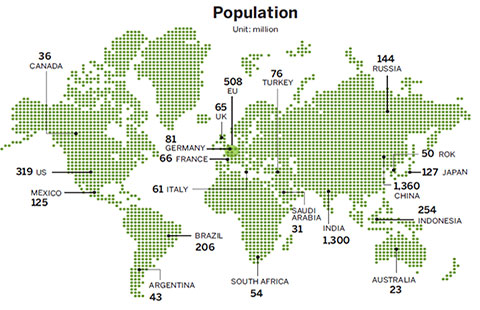
Emerging nations, like the BRICS, despite setbacks, are no longer content to play second fiddle to a mono-polar US. They are looking to advance their political and economic interests and want a say at the global bargaining table. With over 23% of the world's GDP and over 53% of its population, they have different interests from the developed nations they sell their resources and goods. For China in particular, there is an interest in emerging and developing countries as markets for their goods and services.
Developing nations, beset with governance issues, starved for infrastructure investment and humanitarian aid, are less prone to see the Washington Consensus, or the American Exceptionalism based on liberal democratic capitalism, as a model they can emulate and are turning their gazes increasingly to China's centrally-guided and individually-motivated system. Even in light of China's "slow down," China's dramatic rise and 6.6% growth rate, is a powerful model.
The visible edge of this political battle is being played out, in the domestic and global media, as a contest between the US and China. The reality is that the world is no longer a mono-polar monopoly of the US, but an emerging multi-polar reality with competing interests and challenges.
Economically, developed countries are faltering due to changing competitive dynamics; there is more competition from emerging nations like China, for markets. Unsustainable social benefit programs and the political inability of democracies to push through needed economic structural reforms have failed to address these issues.
In developing and emerging nations depending on resource export, China's massive growth distended the supply chains for resources, resulting in a consolidation of resource ownership, a fact which is poising them for profit during the next economic cycle.
In high growth areas like China, Southeast Asia and India, there are concerns about hot money flows and the need for infrastructure investments to drive job creation and growth. The want of infrastructure is the reason that developing nations, which could feed themselves and export the rest, see their products rot before they can get to market. Lack of roads, rail, ports, airports, potable water, sewers and reliable energy are holding these countries back. The need for infrastructure in Asia alone is over US$ 8 trillion and worldwide US$ 13 trillion over the next five years, a figure which glosses over the needs of Africa and South America. The economic multiplier for an additional US$ 1 trillion in infrastructure, estimated to be US$ 3 trillion for every US$ 1 trillion spent, would increase yearly world GDP by more than 5%.
In 2008, I questioned the usefulness of the G20, which despite sober hopes, managed only a lukewarm joint statement of principles, in reaction to the U.S. market meltdown.
It seemed improbable that a group of 20 finance ministers, no matter how well intentioned, or how urgent the need, could address a financial crisis which had exposed a massive Ponzi scheme. The scheme was an indictment of the entire developed world's financial industries. Unfortunately, that has not stopped, as continuing revelations about manipulations by major players indicate.
Eight years later, the world is more economically, politically and socially fragmented than it has been since the height of the Cold War. The structures put in place after WWII, the IMF, the World Bank, the Asian Development Bank, the United Nations and the World Trade Organization are showing their age. In the meantime, America's political, military, economic and cultural mono-polar dominance is slowly giving way to a multi-polar reality, highlighted by a rising Asia centering around China's development.
Today, the world faces a changing paradigm, previously mono-polar U.S. is trying to retain its spheres of influence. It perceives the rising tide of emerging economies, at the center of which is China, as a threat to its previous areas of influence. Each day we see the real life soap opera played out in the international media; so far the US has been copying Great Britain's strategy with Germany, prior to WWI, by trying to contain China using proxies and alliances. As we know, it did not end well.
The emerging multi-polar world is still taking shape. For this to be a China Moment, Beijing will have to take the initiative in Hangzhou and start outlining a consensus process for how to drive infrastructure development worldwide, as a means of creating markets that can afford its goods and services. It will have to internally resolve its ideas of territory and trade, and Beijing will have to indicate how its trade and development proposals, non-intervention and consensus models are the future not just the past.
The author Einar Tangen is now an economic and political affairs commentator for China Central Television (CCTV).


Copyright 1995 - . All rights reserved. The content (including but not limited to text, photo, multimedia information, etc) published in this site belongs to China Daily Information Co (CDIC). Without written authorization from CDIC, such content shall not be republished or used in any form. Note: Browsers with 1024*768 or higher resolution are suggested for this site.
License for publishing multimedia online 0108263 Registration Number: 130349