After the Second World War, the international community was faced with the urgent need to establish a new world order, and the birth of the United Nations (UN) heralded the quest for global governance.
Over the past 70 years, different types of international organizations have sprouted up, accompanied by corresponding rules, mechanisms and arrangements, such as the International Monetary Fund (IMF), the World Bank (WB), the World Trade Organization (WTO), the Asian Infrastructure Investment Bank (AIIB) and the BRICS Development Bank. And of course, in light of its upcoming summit to be held in Hangzhou, the G20.
The G20, counting from the birth of its predecessor-G7, has been around for two decades. Over the years, G20 has gained a growing amount of attention from the international community, as it has played a unique role in tackling financial crises, seeking cooperation and development and promoting global governance. Among various international organizations and multilateral coordination and cooperation mechanisms, how was the G20 able to establish its unique role and gain worldwide attention?
First, G20 is a product of the times
While peace and development is the common expectation of the human race, differences in national interest, ideology and religious belief pose huge obstacles for cooperation and development among countries, with the notable example of the Cold War - a four decade battle for global supremacy between the US and the former Soviet Union, and between NATO and the Warsaw Pact, which led to a world order characterized by a "worldwide standoff" and "half-globe governance". After the Cold War, peace and development became the mainstream. The world, however, is still overshadowed by frequent economic recessions and financial crises, that time and again sank the world economy to the bottom. Under the context of globalization, the international community was eager to establish a high level dialogue mechanism that is extensive, influential and representative in order to tackle crisis, promote cooperation, and reach the goal of global governance.
Second, G20, a highly flexible mechanism
Unlike the makeup of the United Nations, the G20 is not a de facto international organization but a multilateral informal dialogue mechanism that aims to promote cooperation and tackle challenges. This makes it highly flexible compared to international organizations that have less leeway when faced with real problems; it is a forum for discussion about political, military, economic and financial issues beyond bilateral, multilateral and regional limits. With swift response to the global issues, G20 produced good results in forming long-term plans for specific sectors and adjusting priorities in accordance with current needs.
Third, G20: the authority and influence
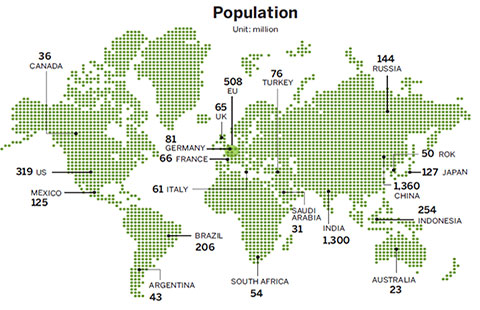
The G20 is made up of major powers that wield much sway in world affairs. It includes the five permanent members of the UN Security Council, the world's top five largest economies, the world's five most populous countries and the five major emerging markets (BRICS).
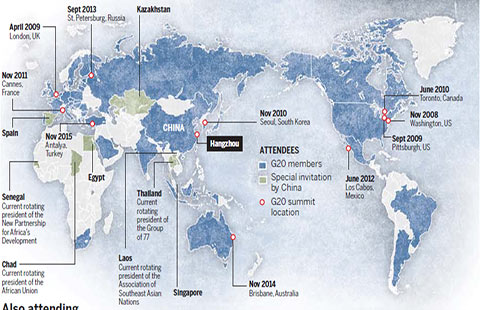
Its member states cover five of the world's continents with its total GDP accounting for 85% of the world's economy and 80% of its trade volume, and its collective population making up two-thirds of the world's total. With those heavyweights, G20 is well-positioned to replace G7 as a major forum for global economic cooperation.
In addition to Sherpa Meetings and Working Group Meetings, the G20 working mechanism also includes Foreign Ministers' meeting, Finance Ministers and Central Bank Governor's Meetings, and above all, the G20 Summit which gathers together heads of state from its 20 members. It can be said without exaggeration that it is a dialogue between the world's 20 most influential leaders, which is bound to have an impact on world finance and trade and to draw worldwide attention.
Fourth, G20: diversity and inclusiveness
With variances in geographical location, income level, political standpoint and economic and demographic structures, participants of the G20 Summit can share diverse ideas and opinions. With different development paths and development stages, they can also learn from each other.
Though not as expansive as the UN or the World Bank, it is nevertheless highly inclusive. The AIIB focuses more on regional development; the BRICS works as a coordination mechanism among some of the world's emerging markets; the Shanghai Cooperation Organization puts regional peace and stability as its top priority; and the Trans-Pacific Partnership (TPP) acts as an exclusive group initiated by the US and a few other countries that aims to shake off the existing rules and mechanisms. Given its extensiveness, wide focus and representativeness, the G20 is the world's most inclusive dialogue mechanism, and that explains why it has attracted so much attention and trust from the international community.
Fifth, the inclusion of emerging markets like China lifts its representativeness and influence
The US, UK, France, Germany, Japan, Italy and Canada, which made up of the G7, are all developed countries with similar growth patterns that are mainly geographically located in the West, making it a virtual "Rich Man's Club" with little global representation. Moreover, under the context of globalization, a few developed countries are not qualified to tackle an international financial crisis and drive world economic development.
The inclusion of new members like China, India and South Africa has boosted the G20's influence in terms of GDP, total trade volume and population. Take China as an example, from 2008 to 2013, China contributed 37.6 percent of GDP growth of the world. In 2014, China contributed 27.8 percent of the world's economic growth, and in 2015, despite slower domestic growth, it still contributed around 30 percent to the world's economy.
Moreover, China and other emerging markets have also provided experience and lessons that can be drawn from while discussing global governance and other issues. As the current G20 president and host of this year's summit, China can also incorporate oriental wisdom and its experience with rapid development over the past 30 years into the meeting's agenda, so as to deliver China's vision on world development and cooperation.
The G20 Summit will open in a few days, putting Hangzhou in the world's spotlight. How can oriental wisdom and China's vision play a greater role for the G20 in the new era? This will surely gain worldwide attention.
The author Wang Xiaohui is editor-in-chief of China.org.cn.


Copyright 1995 - . All rights reserved. The content (including but not limited to text, photo, multimedia information, etc) published in this site belongs to China Daily Information Co (CDIC). Without written authorization from CDIC, such content shall not be republished or used in any form. Note: Browsers with 1024*768 or higher resolution are suggested for this site.
License for publishing multimedia online 0108263 Registration Number: 130349