HANGZHOU - The US Federal Reserve, citing "solid performance" of the US labor market and economy, has been whipping up expectations that it would raise interest rates soon.
The suspense evoked by the central bank of the world's largest economy and sole superpower, however, appears to many to be a sword of Damocles, as any interest rate uptick would suck capital to the United States from other countries, of which many are already struggling.
Given the tight interdependence between economies, experts say, such differences in their needs and concerns demand that closer international coordination be carried out to guarantee sustainable global development.
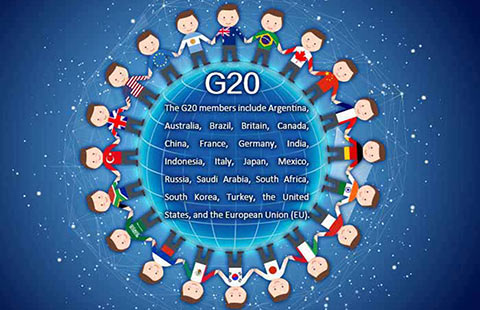
More specifically, that necessitates an upgrade of the world's premier platform of global economic governance -- the Group of 20 (G20).
From crisis to "new mediocre"
G20 leaders met for the first time in November 2008 in Washington in the throes of the worst global financial crisis in decades, and the following series of summits played an indispensable role in pooling international efforts to tide the world over.
The height of the crisis has now passed, but sustainable development remains elusive. The world economy is still reeling from its aftermath and appears that it is sliding into what International Monetary Fund (IMF) chief Christine Lagarde described as a "new mediocre."
Despite improvement in some economies, the IMF has lowered its prediction of the 2016 global economic growth rate from 3.1 percent to 2.9 percent. Should that forecast come true, this year would be the second in a row with a global growth rate of less than 3 percent. The pace was 2.4 percent in 2015.
The IMF has warned that a prolonged period of slow growth has left the global economy more exposed to negative shocks and raised the risk of plunging into stagnation.
"If we don't take action to boost productivity and potential growth, both younger and older generations will be worse-off," said Catherine L. Mann, chief economist of the Organization for Economic Cooperation and Development (OECD).
"The longer the global economy remains in this low-growth trap, the harder it will be for governments to meet fundamental promises," she said.
Lack of coordination
One of the burning issues beleaguering the world economy is a rupture in policy coordination among countries at various stages of development backdropped by resurgent protectionism, nationalism and isolationism, said Zhu Jiejin, a professor with China's Fudan University.
In dealing with the problem, the G20 has an inescapable and significant role to play. As early as at their September 2009 summit, G20 leaders designated the young crisis response mechanism -- more representative than the rich-world club of Group of Seven -- as the premier forum for international economic cooperation.
In order for the world economy to break away from the slow-growth rut and realize sustainable development, many experts agree, the G20 needs to further strengthen international macro-policy coordination and shift its primary function from crisis response to long-term governance.
Noting that the G20 mechanism "has retained most of the features of the crisis response platform in 2008," Zhu pointed out that "a crisis cannot be there forever."
China has been a steadfast champion of this transformation. At the upcoming 11th G20 summit in the eastern Chinese city of Hangzhou, boosting international coordination is an integral element of its theme, which is "Toward an Innovative, Invigorated, Interconnected and Inclusive World Economy."
Forging "a community of common destiny" among developed and developing countries is at the core of "an interconnected world economy," commented Jiang Yuechun, director of the Department for World Economy and Development at the China Institute of International Studies.
Institutional innovation
Recognizing the vital significance of innovation to reinvigorate the global economy, China, first-time host of the G20 summit, has placed innovation high on this year's agenda.
Among others, Beijing has been pushing for an innovative growth blueprint and an action plan for the implementation of the UN-adopted 2030 Agenda for Sustainable Development.
"It is right for China to put forward a blueprint for innovative growth and consider the lack of growth impetus as a key issue at this year's summit," said Zhang Yuyan, director of the Institute of World Economics and Politics at the Chinese Academy of Social Sciences.
Noting that innovation includes not only technological innovation but also the improvement and spread of existing technologies, Zhang also stressed that institutional innovation is also important to realizing sustainable development.
Taking a concrete step in this direction, China has invited the leaders of several developing countries to the Hangzhou summit, making it the most representative of developing countries in G20 history. UN Secretary General Ban Ki-moon noted that Beijing has taken the summit to another level of inclusiveness.
China, as the second largest economy and the largest developing country in the world, is in a unique position to bring together developed and developing countries and promote positive engagement among them, experts say.
John Kirton, founder and co-director of the G20 research group at the University of Toronto, says reaching a general agreement among the G20 members and guests on how to proceed with managing the global economy will be key to China's success as host. China, Kirton says, has the "recurrent strong wisdom to adjust to the overwhelming consensus and the consensus of its partners to produce collective success."


Copyright 1995 - . All rights reserved. The content (including but not limited to text, photo, multimedia information, etc) published in this site belongs to China Daily Information Co (CDIC). Without written authorization from CDIC, such content shall not be republished or used in any form. Note: Browsers with 1024*768 or higher resolution are suggested for this site.
License for publishing multimedia online 0108263 Registration Number: 130349