A look at top emerging technologies selected by WIC


WUZHEN - Technology is changing the world we live in, from supercomputers able to replicate a human's ability to answer questions to ultra-secure communication tools that make wiretapping or interception impossible. The future, it seems, has arrived.
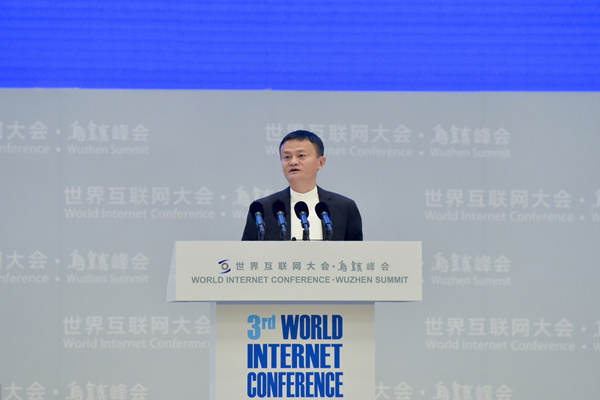
The World Internet Conference (WIC), which was held in eastern province of Zhejiang from Wednesday to Friday, presented 15 emerging technologies that had the potential to fundamentally change our lives.
Headed by foreign chair Bob Kahn, Turing award winner and one of the principle architects of the internet; and Chinese chair Wu Hequan, academician and optic fiber specialist from the Chinese Academy of Engineering, the committee of 33 technologists from home and abroad whittled down the short list to just 15 from about 500 entries, submitted by companies and research institutes over the past year.
Here are some of their choices:
Watson supercomputer, IBM
IBM has been engaged in research into artificial intelligence for six decades.
Big Blue's latest innovation Watson, named after IBM founder Thomas J. Watson, is a cognitive computing machine, which uses machine learning, silicon-based computing and atomic storage to enable it to provide answers to questions like a high-functioning human.
IBM chairman of the Greater China region Chen Liming told the WIC audience that the supercomputer is expected to revolutionize health care as it can be used as a competent diagnostician for patients living in China's remote countryside.
Watson is capable of storing more medical information than doctors, and can make decisions based on data and history without cognitive bias.
AR Headset HoloLens, Microsoft
Microsoft introduced its Augmented Reality (AR) HoloLens this year, a hologram-projecting headset that, with the help of multiple cameras, blends virtual models, environments and holograms with reality.
More appropriately referred to as a mixed reality device, the headset allows the wearer to interact with holograms and digital content overlayed on the real world.
Currently, a number of applications inlucidng Skype are already on Microsoft HoloLens.
"For us, the next big thing is mixed reality," said Microsoft executive vice president Harry Shum. "The integration of the virtual digital world and the physical real world."
Self-Driving Vehicle, Telsa
Telsa in October unveiled its latest Autopilot hardware, which Wired magazine called "insane, but it just might work." The system uses eight cameras to provide 360-degree coverage, one radar, ultrasonic sensors and a new supercomputer, which will eventually support full autonomous driving.
Telsa Vice President Robin Ren explained that the Model S vehicles are able to do enhanced traffic-aware cruise control, auto-steering, lane changes and centering, auto-parking and smart summons, and safety was "guaranteed."
Human error causes 94 percent of road accidents, according to Ren. By using self-driving technology, most of these crashes can be avoided.
Wearable Bio-Processor, Samsung
Samsung wearable device "all-in-one quantified-self solution" can track heart rate and rhythm, body fat, skeletal muscle mass, skin temperature, and even stress level.
The device, designed to help the public live a healthier and happier life, also allows the company's big data center to collect health data, which would support remote medical diagnosis even across borders, lowering the cost and raising the effectiveness of health care.
"Brain," Baidu
The deep learning AI system Baidu Brain uses three core functions of AI algorithms, super computing power, and big data to simulate the human brain.
It is the nerve center of Baidu's autonomous car, facial and voice recognition, and robots that can compose and read poems or comment on a live football match, said Zhang Yaqin, president of Baidu.
"What we see now is just the tip of an enormous AI iceberg," Zhang said. "In the next 20 years or so, there will be many opportunities."
Sunway supercomputer, NRCPC China
Advances in basic computing science may not seem as exciting as other developments, but they are just as -- if not more -- important to future innovation.
China's Sunway Taihulight, designed by the National Research Center of Parallel Computer Engineering & Technology (NRCPC), was the world's fastest supercomputer as of June 2016, said Yang Guangwen, Tsinghua University professor and director of the National Supercomputer Center at Wuxi.
With a Linpack benchmark rating of 93 petaflops, Sunway Taihulight is nearly three times as fast as the prior champion, China's Tianhe-2, which ran at 34 petaflops. The supercomputer was built with the Chinese processor chip ShenWei 26010; a 260-core, 64-bit RISC chip that exceeds 3 teraflops at maximum tilt.
It is expected to support manufacturing, life sciences, computer-aided engineering and weather forecasting.
Quantum Communication, Chinese Academy of Sciences
Chinese quantum physicist Pan Jianwei's offering, quantum communication, has been heralded as the answer to the ever-growing menace of cyber theft.
His lab under the Chinese Academy of Sciences has achieved breakthroughs in metropolitan quantum communication networks by using fiber trusted relay-based inter-city quantum communication, and ultra-long distance quantum communication between satellite and ground.
Devices equipped with these technologies are expected to be ultra-secure as a quantum photon can neither be separated nor duplicated. Scientists say it will be impossible to wiretap, intercept or crack information in quantum communication.
Kirin 960 chipset, Huawei
China is the world's largest handset market, so it will come as no surprise that cellphone technology was present at the WIC.
The next-generation chipset Kirin 960, as described by Huawei vice president Ai Wei, provides faster processing speed, much more secure payment channels, better entertainment experiences, and cameras closer to the vision of the human eye.
It took ten years and a multi-national research team to design the latest chipset, Ai said.
"If we take the smartphone as an external organ, I wish it could first be 'the eye,' helping us to see this world clearer and better," he said.