
Irrigation in desert to go solar
By Shao Wei (China Daily)
2011-11-09 08:02
 |
TAKLIMAKAN DESERT, Xinjiang - Soon only solar power will be harnessed to irrigate the 436-kilometer shelter forest along the desert highway in Taklimakan, the world's largest shifting sand desert located in Northwest China's Xinjiang Uygur autonomous region. A complete reliance on solar energy, with a view to reducing carbon footprints, will be achieved before 2014, local authorities said.
"As part of a central government initiative to go environmentally friendly, the project, once completed, will offset 5,000 tons of carbon emissions a year, thus minimizing harmful human impact on the fragile desert ecology," said Xu Xinwen, director of the Taklimakan Desert Research Institute of Chinese Academy of Sciences, on Monday.
The 562-km north-south highway running across the desert opened in 1995. It cuts the distance between the two important cities of Urumqi and Hotan by 500 km, and functions as a lifeline, transporting oil and gas out of the desert.
Based on scientific research and experiments conducted since 1991, a 436-km shelter forest was created deep inside the desert, on either side of the highway. The greenery covers an area of 3,128 hectares in which nearly 20 million saplings were planted in 2006.
A total of 108 highway maintenance stations were built along the highway, to pump underground saline water, irrigate and protect the "green corridor".
"Of these stations, 12 have been using solar energy. Once all stations start using clean power, forest workers living in them will have access to the Internet, and their lives will not be boring," said Xu.
Liu Kaiyu, who is posted at station No 6 along the desert highway, is luckier than some of his fellows. His life in "the sea of death" is solitary but comfortable.
About 80 percent of forest workers in the desert are retired people who feel at ease with the solitary and quiet life in the desert. The only entertainment for them is "to watch vehicles passing by", said Liu.
"But for me, solar energy ensures a stable electricity supply, enabling me to chat on the Internet and read books in the evening."
Liu, who is from Dazhou of Sichuan province, lives in a small, thick-walled bungalow along the highway. His daily work involves taking care of desert plants along the road, particularly guarding them against the shifting sands.
"My work involves walking around, opening and closing valves (to regulate the dripping irrigation pipes)." the 24-year-old worker said, with a shy smile. "Simple but time-consuming."
Three days into his new job, Liu experienced a sandstorm. The spectacle was "horrifying", he says.
"I hid inside the room, with doors and windows tightly closed. The sky turned orange and brown, covered entirely by sand. I could smell the sand even indoors although I was wearing a mask," he said.
"It was horrifying. And I began to understand why the local Uygur people referred to it as 'a place you could walk into but never come out of'," he added.
He has to carefully calculate the amount of water for each plant along the 4-km green belts that he is in charge of needs.
"Less or more watering will kill these desert-dwelling shrubs easily," he explained.
The desert plants along the highway are "so precious that they cannot be valued in terms of money," he says.
The penalty for destroying a sapling is 500 yuan ($79). "But that's too light a punishment," says Liu. "The amount is nowhere near the money spent on planting a sapling and keeping it alive in the desert."
"We botanists and scientists have spent 20 years searching and cultivating plants that would adapt well to the desert. And we have strictly controlled the amount of water use to protect the underground water resources in the desert," Xu said.
China Daily

Paper kettle
An Italian designer, Andrea Ponti, designed a recycled paper-made water container for the Milano Expo 2015, according to yankodesign.com.

Bamboo treecycle
The Bamboo treecycle developed by MGT Engineering Ltd is on dispay at the 21th China Int'l Bicycle and Motor Fair.

Charger captures power from Wifi
A US electronics company invented a charger that draws its power from Wifi signals.
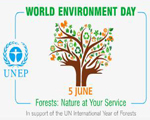
World Environment Day
World Environment Day is an annual event that is aimed at being the biggest and most widely celebrated global day for positive environmental action. The theme this year is Forests: Nature At Your Service.

China International Green Industry Expo 2010
The China International Green Industry Expo 2010 (CIGIE 2010) is an important international green industry exhibition hosted by the Chinese government and held at the Beijing Exhibition Center, Nov 24 to 27.
