|
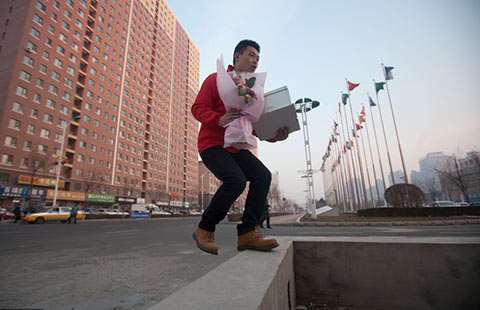
Just 5.7 percent of cars now on the road meet China IV or V emission standards. [Li Shengli / For China Daily] |
Old cars, diesels currently are the biggest offenders
It is not just an anecdote that the sun has not been shining as much as before in most areas of China.
On Jan 30, The Ministry of Environmental Protection released the results of its remote sensing satellite monitoring. It showed that dense winter smog lingered throughout central and eastern China, blanketing more than 1.4 million square kilometers in fog and haze.
Such massive pollution has prompted public concerns about the auto industry, which has been blamed as the biggest source of the pollution.
As Beijing suffered through its fourth bout of heavy smog in January, the municipal government reacted with implementation of the new Beijing V emission standard, which was advanced to take effect Feb 1.
In addition, the Shanghai municipal government also announced it would apply the new China V standard to fuel quality before the middle of this year.
The Beijing V is the pilot version of the China V standard - both are similar to the Euro V standard in Europe.
Tsinghua University once conducted a survey regarding vehicle exhausts in Beijing. It indicated that CO accounted for 84 percent and 85.9 percent of pollutants respectively in 2009 and 2010.
|
|
Estimates say the auto industry will have increased costs of up to 40 billion yuan a year to meet the new China V standard.
A report from Sinopec compared the different costs of fuel products for different standards.
It said producing one ton of gasoline for the China V standard would cost 1,000 yuan more than the China III, and 400 yuan more than the China IV.
Currently, the China IV standard has only been applied in Shanghai, the Pearl River Delta region and Jiangsu province, while the China III is still used in the majority of other provinces and autonomous regions.
Clearly both enterprises and customers will pay more after the implementation of the new China V standard.
Rather than the stricter standards for new vehicles, it seems more important to speed up the elimination of old vehicles.
The Ministry of Environmental Protection revealed the composition of China's vehicles on the roads in 2011. Some 9.5 percent are from the pre-China I period, 17 percent were made in China I, 19.8 percent in China II, 48 percent in China III and 5.7 percent in China IV or above.
But the 9.5 percent of cars from pre-China I account for more than 40 percent of total vehicle emissions. In contrast, the cleaner cars made when China III and higher standards were in effect - 53.7 percent of the total now on the road - only discharge 25 percent of all vehicle emissions.
In addition, a stricter emission standards should be implemented for diesel-fueled vehicles.
According to the statistics in 2011, only 17 percent of the country's vehicles are fueled by diesel, but they contributed 70 percent the total vehicle nitrous oxide fumes. Worse still, almost 90 percent of all fine particulate matter was emitted by diesels.
From 2011 to 2015, the number of new vehicles including motorcycles is estimated to hit 100 million, meaning an increased consumption of gas and diesel fuel totaling 100 million tons - and what tremendous pressure the environment will have to endure.
It is crucial that the auto industry takes targeted measures by raising the emission standards and accelerating elimination of old vehicles still on the road, especially those with diesel engines. Only joint efforts can help curb the air pollution caused by the auto industry.
The writer is the director of LMC Automotive Asia Pacific Forecasting. He can be contacted at JZeng@lmc-auto.com.

Copyright 1995 - . All rights reserved. The content (including but not limited to text, photo, multimedia information, etc) published in this site belongs to China Daily Information Co (CDIC). Without written authorization from CDIC, such content shall not be republished or used in any form. Note: Browsers with 1024*768 or higher resolution are suggested for this site.
License for publishing multimedia online 0108263 Registration Number: 20100000002731