Foreign ownership remains limited in new auto regulation


 |
|
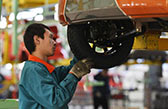
A worker cleans a new car at FAW-Volkswagen's booth at an auto show in Shanghai. International carmakers which want to localize their products are required to establish joint ventures, in which their stake cannot exceed 50 percent. [Photo/China Daily] |
Discussed stake cap lift applies only to international car parts manufacturers
China has made no change to the controversial stake cap applied to foreign automakers in its latest investment guidance, but analysts said this might not be a bad thing, at least for now.
The policy, which was first released in 1994, stipulates that all foreign automakers and spare-parts producers that want to localize production in China must establish joint ventures, in which their stake must not exceed 50 percent.
A faint sign of change emerged in June, when Xu Shaoshi, minister of the National Development and Reform Commission, said that China was looking into lifting the stake cap.
One month later, the State Council, China's cabinet, introduced a pilot policy to allow some kinds of auto-parts producers in several free trade zones to localize production without establishing joint ventures.
Now the move has been extended nationwide in the new guidance issued on Dec 7 to seek public opinions, while the stake cap for automakers remains unchanged.
Yale Zhang, managing director of consulting firm Automotive Foresight, said it is not realistic to expect a sudden removal of the policy, as too many automakers would be affected.
He suggests that China should work out a 10-year scheme, for example, to remove the cap, which will give local automakers a buffer zone and motivate them to step up their efforts.
"With a deadline, they will know they should not rest on joint ventures' revenue and do nothing," said Zhang.
BAIC Motor's financial statement shows a registered net profit of 4.42 billion yuan ($650 million) in the first half of 2016, most of which is derived from its joint ventures with Hyundai Motor and Daimler. Meanwhile, its own brand lost 1.2 billion yuan, 43.3 percent higher than its loss in the same period last year.
FAW Group's joint venture with Volkswagen is a top three passenger car seller in the country, but its own brands are underperforming.
FAW Car, a subsidiary within the wider group, saw its revenue in the first half of the year fall nearly 40 percent year-on-year. FAW Xiali made a loss of 5.3 billion yuan in the same period, due to "less competitive products" and "failure to keep pace with market demands", according to company statements.
Meanwhile, Volkswagen said it would appreciate China's earliest possible efforts to liberalize regulations and the country's economy.
The company's China head, Jochem Heizmann, told China Daily in an earlier interview that removing the cap is the only way to ensure that companies have the freedom to decide how to proceed, and where and how to invest, "as it is the standard all over the world".
However, John Zeng, managing director of LMC Automotive Consulting (Shanghai), said keeping the stake cap unchanged is a good thing for the time being, both for foreign automakers and their partners.
He said as State-owned automakers are part of the government, they can leverage their resources to win government support in many aspects, to which foreign automakers would not otherwise have access.
"So, even if the cap is removed now, I don't think foreign automakers of volume cars will risk losing government support by bargaining with them for a higher stake," he explained.
Zeng said another factor that will prevent partners from changing their current stakes is their dealership network. He explained their quarrels would affect the confidence of the dealers, "which is easy to destroy but difficult to build".
"If that happens, they will find themselves in trouble, as evidenced by Audi's compromise with its dealers," he said.
Analysts and industry insiders have long been divided on whether or not removing the stake cap would be a positive choice for the country's auto industry.
Dong Yang, executive vice-president of the China Association of Automobile Manufacturers, is a firm advocate of the protective policy.
He warned that Chinese brands would be "killed in the cradle" if foreign automakers were allowed to become more independent from their domestic partners, saying that whoever supports removing the cap is "a traitor to the country".
"If joint ventures end up foreign controlled or owned, they might create unfair competition ... and China's drive to upgrade its manufacturing, as well its scientific innovation and even national security, will suffer," Dong wrote in his blog.
Such worries are understandable. Many major international brands, including Volkswagen, Toyota and General Motors, have joint ventures in China, and they have been the dominant players so far in the market.
Statistics from the CAAM show that seven out of the top 10 passenger car producers by sales in the first 10 months this year were joint ventures.
The only State-owned Chinese brand that made it into the top 10, Chongqing Changan Automobile, came fifth.
Despite this situation, many do not think that removing the cap will have disastrous results.
Li Shufu, chairman of Zhejiang Geely Holding Group, has been a longtime advocate for the removal of the cap, saying that the move would encourage competition and thus benefit consumers.
He said the current policy resembles parents who are excessively protective of their children, but such protection will not ensure their successful development and could, instead, weaken their abilities for innovation and competitiveness.
Geely sold 580,000 cars from January to October 2016, making it into the top 10 list of passenger car producers in the country.
Great Wall Motor, another private carmaker in China, is doing an even better job, with its sales totaling 710,000 vehicles in the period.
Its Chairman Wei Jianjun said the reason the company has achieved such success is because "we private carmakers do not have a route of retreat".