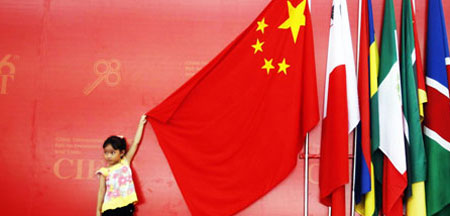
Chinese-made flag symbolizes partnership
Updated: 2012-08-02 11:10


"As the world's largest economy, the US is able to affect the speed and character of the globalization process itself, while many countries can only react to the process," said Wang.
Worldwide production networks are an important aspect of the global economy. Chinese-made flags and clothing are considerably less expensive than their foreign counterparts, so US customers gain from the availability of cheaper products, according to the researcher.
Abe's flag was made by Valley Forge Flag Co of Pennsylvania, one of the top providers of flags and related products to the US government, and cost around $10. A Chinese-made flag of the same size and made from the same poly-cotton material, costs less than $8, according to Shanghai Tongjie Image Production Co, one of the oldest and largest flag manufacturers in Shanghai, whose products are mainly exported to the US. If a different material had been used, the price could be lower than $1.50, according to Shanghai Tongjie's sales staff.
|
|
 |
 |

"It seems you can't get away from buying Chinese-made products," she said. "By importing so much from China, we are naturally taking jobs away from Americans. This is becoming more and more important as our economy sinks." That message was given a deeper resonance by figures showing that the US unemployment rate stood at 8.2 percent in June.
As global economic activity declines, outsourcing - the practice of companies manufacturing their products outside their own countries - has become a target for critics of globalization, who argue that it's responsible for job losses in the domestic manufacturing sector.
"I understand that people are upset when the economic situation is bad, but that won't change by them only buying goods made in their own countries. On the contrary, buying cheaper foreign-made components, along with outsourcing, helps companies to survive, and the savings help to provide more money for the development of US high-tech industries," said Wang Rongjun, who also works as a researcher at the CASS Institute of American Studies.
"As an irreversible trend, global production sharing will, and should, continue," he said, adding that he hopes the US government will not allow the specter of rising unemployment to push it into trade protectionism. "If that happened, both the US and Chinese economies would be damaged."
As the costs of labor and raw materials rise, even Chinese manufacturing jobs are being moved overseas. Xie Weijie, who used to run a factory in Shenzhen, Guangdong province, that supplied digital components for Japanese camera manufacturers, said the price of labor is becoming increasingly uncompetitive in China, a nation of 1.3 billion people, which is supposed have an unlimited labor force.
Wages in Shenzhen have risen by almost 50 percent during the past five years, according to Xie. In 2004, he moved his factory from Shenzhen to Vietnam and hired more than 200 local staff. "In Shenzhen, I have to pay a worker 1,500 to 3,000 yuan per month, but in Vietnam the wage is around 800," he said. "And I can see that costs are rising in Vietnam too, but at a slower rate than in China." In response, Xie is now considering moving production to Thailand or Cambodia, where labor costs are still low.
"The economy is no better than it was during the 2008 global crisis and I believe both Chinese and foreign companies are under great pressure," he said. "We can't control costs, and so we have to migrate, like herdsman chasing water and pastures."
However, labor costs in China are still lower than in most other places, particularly developed economies, according to Wang Rongjun. He said the average wage in the Chinese manufacturing sector is still only around 15 yuan an hour, compared with the minimum hourly wage of more than 40 yuan in the US, even at the lowest level.
China's economic rise has been built first and foremost on the efforts of low-waged workers and the country will continue to benefit from that for a long time to come, according to Wang.
"For most American flag retailers, it is just a practical way of doing business, and the cheaper price, resulting from lower costs for labor and materials, is the main reason Chinese goods dominate shelves around the world," said Wang Rongjun.
Contact the reporter at pengyining@chinadaily.com.cn






- BYD exports three electric cars to Thailand
- Grid gets first jolt of residential solar power
- US now largest buyer of China's exports
- China's outbound M&As on the rise
- Tobacco control may entail price, tax rises
- Quanzhou becomes pilot financial reform zone
- New automobiles shine at Geneva Motor Show
- World's longest high-speed rail 'on track'
- Jiugui Liquor involved in plasticizer scandal again
- Accident reignites school bus safety concerns
- China to revise labor law
- Trademark registration under scrutiny
- Dinner ban takes toll on liquor firms
- CIC tables bid for London's Chiswick Park
- Property buyers eye overseas market
- Call for law to protect personal information
- China to cut train ticket prices
- Christmas business
- Solar industry to get jolt from new policies
- KFC chicken under spotlight
Survey & Comments