BEIJING - Discussion of sovereignty over the Internet has long been a taboo, dismissed in Western media as violation of freedom.
The time has come to drag the issue into the cold, hard light of day, and China, with an online population of 670 million -- more than twice the entire population of the United States -- and more than four million registered domains, has as much right as anyone to raise the debate.
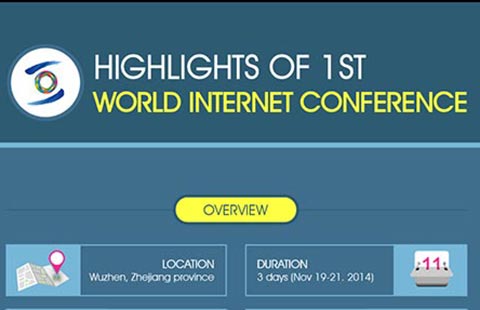
Addressing the second World Internet Conference, President Xi Jinping asserted the right of each country to choose their own path for cyber development, their own system of cyber regulation and to participate in international cyberspace governance on an equal footing.
Legally, it is accepted that countries have the right to set rules for Internet use. The principle of sovereign equality is enshrined in the Charter of the United Nations. It covers all aspects of state-to-state relations, including in cyberspace.
The UN-sponsored World Summit on the Information Society in 2003 defended countries' right to formulate public policies concerning the Internet. And in July 2015, a report by a UN panel on information security again stated that state sovereignty in cyberspace should be respected.
In reality, all nations have exercised cyberspace sovereignty in one form or another. Even now, consensus has been reached over expanding Internet access and safeguarding cyber security.
With so much discussion on the need to better guard cyber sovereignty and security, the criticisms of China's cyberspace sovereignty by media are irresponsible.
Some Western media or tech firms are not allowed in China because they are not willing to abide by Chinese laws. As a result, they may seize the World Internet Conference as another opportunity to show their grudges.
Google, for example, violated a written promise made when entering the Chinese market by not filtering its search services and then blaming China by insinuation for alleged hacker attacks.
In March 2010, the search engine decided to move its search service out of the Chinese mainland.
But, few tech companies and Internet businesses can afford to ignore the burgeoning market in China. Four Chinese Internet giants, including Alibaba and Tencent, are among the top ten in the world. Internet industries are fast growing.
However, furthering policies and laws on Internet development does not mean China is closing its door to foreign investment.
The sovereign nature of cyberspace entails that it is not a domain beyond the rule of law and rules are necessary in cyberspace, as is freedom.
The increasing number of users and the expanding market is the best evidence that China's policies are working. Temporary measures to regulate cyberspace security will be meliorated and institutionalized in the future, regardless of wrong accusations from the outside.

Copyright 1995 - . All rights reserved. The content (including but not limited to text, photo, multimedia information, etc) published in this site belongs to China Daily Information Co (CDIC). Without written authorization from CDIC, such content shall not be republished or used in any form. Note: Browsers with 1024*768 or higher resolution are suggested for this site.
License for publishing multimedia online 0108263 Registration Number: 130349