Comments
  Print
Print  Mail
Mail  Large Medium Small
With its successful discovery of natural gas hydrate samples last week, China's distant energy future might be brighter.
The nation became only the fourth country to make such a technological breakthrough and it did so with the least amount of time and money - 500 million yuan over eight years. Gas hydrate is an ice-like crystalline solid formed from a mixture of water and natural gas, usually methane, found in the ocean seabed.
Because the recent samples were of a rare kind, China now boasts one of the world's purest gas hydrate reserves.
The two sets of samples drilled came in with 99.7 percent and 99.8 percent methane composition.
This is exceptional since carbon dioxide (CO2) - a major contributor to global warming, often makes up a big portion of this potential alternative energy - and diminishes its appeal.
The discovery gives experts reason for optimism. Some have even leaped over initial stages to ask for a utilization schedule. To them, drilling is simple, even if it is 1,000 feet under sea. In their logic, now that scientists have located the hydrates, all that needs to be done is sail there, drill a hole, melt the ice and pipe it out.
That may be. But as deputy director-general of China Geological Survey (CGS), the primary organizer of Chinese drilling expeditions, Zhang Hongtao is well aware of the complexity of his job and prefers a more conservative way to look at things.
In an earlier interview, he told a group of journalists that although developed countries list 2015 as a target to start utilizing gas hydrate, it is still too early to map out a timeline for China.
The main task now at hand is "to figure out the amount of gas hydrates within our waters", he says.
There are reasons for Zhang's pragmatic approach. China's level of gas hydrate research is still low compared with the other three leaders in the field. In addition to the United States and Japan, India has made substantial investment in research and exploration in recent years.
While an official statistics on how much India has spent on gas hydrate research is unavailable, Zhang Haiqi, chief scientist of the recent Chinese expedition, tells China Business Weekly that the country's September 2006 drilling project in the Indian Ocean alone cost "several tens of millions of dollars".
Another, and perhaps most important, difficulty is the limited stability of gas hydrates. Also known as "combustible" or "flammable" ice, gas hydrates are crystallized solids formed only when water, methane and other substances interact under low-temperature and high-pressure conditions.
Those are only found on the seafloor and makes drilling an extraordinarily complicated and costly affair. The existence and distribution of marine gas hydrates are found through seismic data and it takes the finest scientific drilling vessels to extract combustible ice.
But even in the US and Japan, researchers have not found an economically feasible way of recovering gas hydrate, although its estimated global reserves are double that of all the world's coal, oil and natural gas combined.
China will invest 800 million yuan into combustible ice research during the next decade, according to a recent report by the National Reform and Development Commission. But research and development is still in a nascent stage and international collaboration remains critical.
The resource is also costly using current technology. A study by Chen Guangjin, a professor at the China University of Petroleum, found that the cost of flammable ice is equivalent to over $1 per cubic meter for natural gas, a sharp contrast to China's current cost for natural gas of $0.125 per cubic meter.
Apart from economic constraints, another issue challenges the future use of gas hydrate. Zhang notes that CO2 components from the material that would be released during extraction can cause serious pollution unless measures are taken to separate it in the seafloor.
"But costs for these intervening measures are too high to imagine," he says.
Even if China could extract pure gas hydrate every time, there are also concerns about its methane concentration.
Researchers at the University of California, Riverside and Columbia University argued in a 2001 study that it was precisely the massive release of methane into the oceans that led to the end of the ice ages.
Yet as all know, existing exploitable energy reserves will not last forever. Zhang estimates current resources will only last another 70 years, making further research and development efforts necessary by all nations.
China has already made significant progress. In a first-ever Sino-German project in 2004, 14 geologists from each side took part in a joint expedition, which confirmed rich gas hydrate reserves in the South China Sea - but they found it the hard way.
Zhang Haiqi and Erwin Suess, a leading German scientist with the Research Center of Marine Geology at University of Kiel, who was doubtful whether combustible ice existed within the area, were surprised when thick and solid methane-derived carbonate crust smashed their detection equipment.
After that crashing success, China's gas hydrate research program has sailing along smoothly. A year later, another joint expedition from the two countries located in the South China Sea the largest gas hydrate sink in the world. And this year's breakthrough has made China among the world's leaders in known reserves.
Previous expeditions had to employ the German ship Sun and Dutch drilling vessel The Bavenit, but expeditions in the near future will be undertaken with Chinese ships. A Chinese-made ocean-drilling vessel is being built and will be put into use within the next two years.
(China Daily 06/16/2007 page3)

 Night views of Harbin through the lens
 Tibetans take train home after pilgrimage or travelling
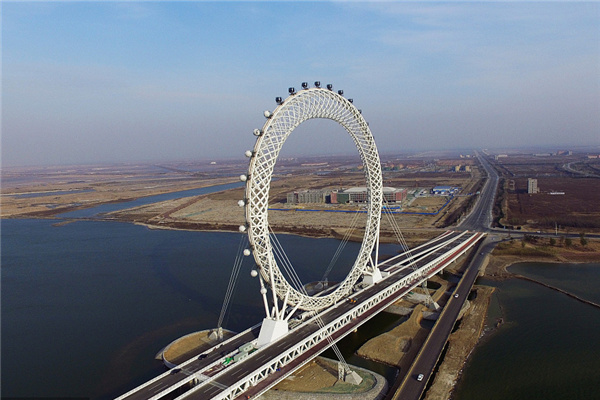 World's largest shaftless Ferris wheel built in China
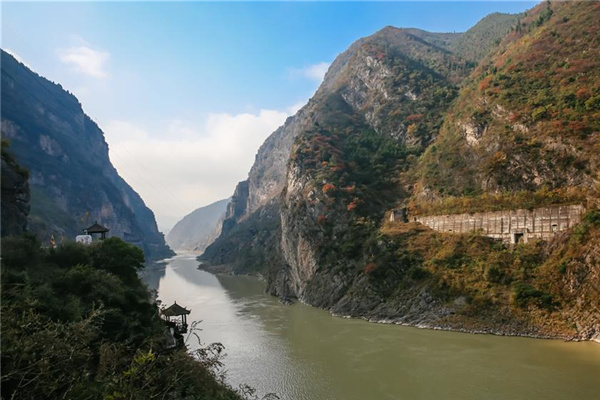 Ancient cities to be connected by Xi'an-Chengdu high-speed railway
 Snow turns Harbin into winter wonderland
 Reed Catkin Festival held in Wuhan
 Is it a building or a bookshelf?
 First flight
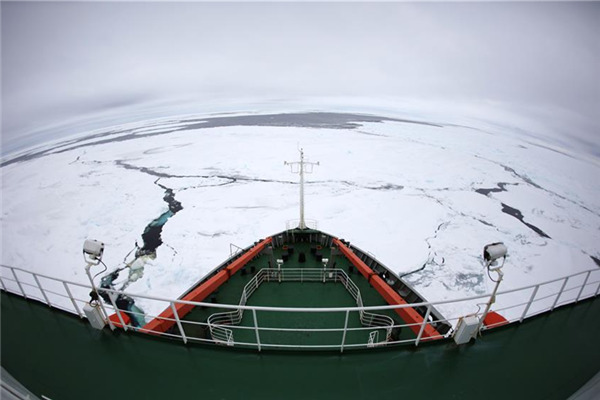 Polar icebreaker Snow Dragon arrives in Antarctic
 Xi's vision on shared future for humanity
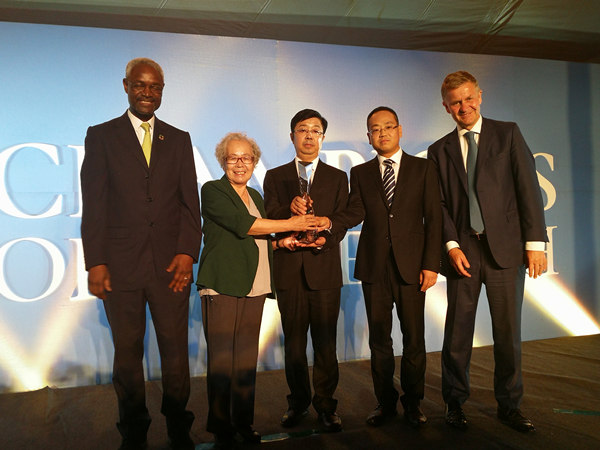 UN's top environmental honors go to three in China
 German trains collide near Duesseldorf, several people injured
 China beats Germany 7-4 in men's curling Olympic qualification
 Bayern beat Paris Saint-Germain 3-1 in UEFA Champions League


Copyright 1995 - . All rights reserved. The content (including but not limited to text, photo, multimedia information, etc) published in this site belongs to China Daily Information Co (CDIC). Without written authorization from CDIC, such content shall not be republished or used in any form. Note: Browsers with 1024*768 or higher resolution are suggested for this site.
License for publishing multimedia online 0108263 Registration Number: 20100000002731