Comments
  Print
Print  Mail
Mail  Large Medium Small
On April 2, 2007, the first four overseas banks - HSBC, Citi, Standard Chartered Bank and Bank of East Asia - launched their locally incorporated entities in Shanghai.
That day might be more meaningful to the banks than December 11, 2006, the day signaling the full opening of the Chinese banking market.
|
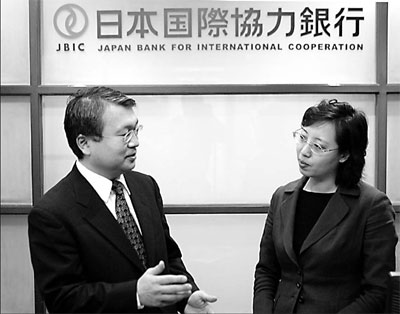
Taiji Nakazato, Beijing office senior representative of Japan Bank for International Cooperation (JBIC), talks with a colleague. The bank is a Japanese governmental financial aid institution created in October 1, 1999, through the merger of the Export-Import Bank of Japan (JEXIM). In 1979, JEXIM was approved to set up the first foreign bank representative office in Beijing. |
For foreign banks in China, local incorporation means they are on an equal footing with their domestic counterparts.
Richard Yorke, president and CEO of HSBC Bank (China) Co Ltd, describes it as "an historic milestone" for the bank, saying it "will allow us to continue to expand both our geographic reach and the product range we can offer our customers".
Figures prove the bank's rapid expansion in the following year. By the end of February, HSBC (China) had 62 outlets on the mainland, including 17 branches and 45 sub-branches. It had only 35 outlets before local incorporation.
The growth is as good or even better for the other three.
Following them, another 17 foreign banks gained local corporation status by the end of last year. Of them, many chose to headquarter in Shanghai, gathering in the Lujiazui financial zone, Pudong.
Among the cluster of skyscrapers in Lujiazui today are HSBC Tower, Citi Tower and the newly built Standard Chartered Bank Tower.
Long history
In the 1920s and 1930s, the Bund, on the opposite side of the Huangpu river, already housed a large number of foreign financial institutions.
The riverfront boulevard at that time was widely referred to as the "Wall Street of the Orient". The HSBC headquarters, a six-floor neo-classical building built in 1923, was the most eye-catching piece of architecture in the Bund.
The building is still there, housing Shanghai Pudong Development Bank.
The first foreign bank, the British-funded Oriental Banking Cop, set up an office in Shanghai in 1847, with booming trade between the UK and China after the First Opium War ended with the defeat of the Qing government.
Other European, American and Japanese banks followed.
By 1935, there were 53 foreign banks with 153 branches in China.
However, most of their businesses stagnated during the Anti-Japan War and many retreated later when China became a communist nation in 1949.
The country re-opened the market to foreign banks under the reform and opening-up policy that began in 1978.
Since then, the foreign banking market has rolled out to the entire country and extended from foreign currency business to local currency activities, from foreign residents and enterprises to local customers.
Opening up

In 1979, Export-Import Bank of Japan was approved to set up the first foreign bank representative office in Beijing.
Two years later, Hong Kong-based Nanyang Commercial Bank established a branch in Shenzhen, becoming the first overseas-funded bank doing business in China since 1949.
In 1985, the first joint venture bank Xiamen International Bank was established. In the following years, more foreign banks and finance companies came to China to do business, expanding from the special economic zones to coastal and major cities.
As of the end of 1993, foreign banks had established 76 operational entities in 13 cities, with combined assets of $8.9 billion and their business scope covering foreign exchange services to both foreign business corporations and foreign residents.
Within years, the policy priority regarding foreign banks was facilitating financial services for foreign business corporations in China.
In 1994, the first comprehensive law governing the nationwide activities of foreign-funded banks - Regulations on the Administration of Foreign-funded Financial Institutions - was approved. It standardized foreign banks behavior in China, including market access requirements and supervisory standards.
Two years later, the government allowed foreign banks to conduct renminbi business for foreign enterprises and residents on a trial basis in the Shanghai Pudong area. Shenzhen, later in August 1998, joined Shanghai Pudong as the second trial city.
From 1994 to 1997, the number of foreign banks in China more than doubled to 175, while their assets quadrupled.
However, after the Asian financial crisis, foreign banks became more cautious in expanding their businesses in the Asia-Pacific region and their businesses in China also slowed down.
Several banks even retreated from the Chinese market. From 1998 to 2001, only 15 new operational foreign banking organizations were established in China.
WTO commitment
The country sped up opening the banking market after it joined the World Trade Organization (WTO) on December 11, 2001.
Upon the WTO entry, the new Regulations on the Administration of Foreign-funded Financial Institutions were published to replace the old law of 1994.
The new rules govern foreign financial institutions' operations of both foreign and local currencies and unify the application procedures for domestic and foreign banks planning to set up new operational establishments.
Also upon WTO entry, the experimental operations of foreign banks' local currency business in Shanghai and Shenzhen became official. Foreign banks in Tianjin and Dalian could also apply for a renminbi business license, which continued to be limited to foreign customers.
A year later, foreign banks in five more cities - Qingdao, Nanjing, Wuhan, Guangzhou and Zhuhai - were allowed to do renminbi business.
On December 1, 2003 and Jinan, Fuzhou, Chengdu and Chongqing joined as cities in which foreign banks are permitted to conduct local currency services.
On Aug 2004, the China Banking Regulatory Commission (CBRC), the banking supervisory body established in late 2003, published revised rules on the administration of foreign financial institutions, significantly reducing capital requirements for their local currency operations and simplifying entry requirements.
The capital requirements for foreign bank branches' corporate and retail renminbi business were reduced to 300 million yuan and 500 million yuan respectively from 400 million yuan and 600 million previously.
A key clause in the old rules which required foreign banks to open no more than one branch a year was also removed.
|
The former HSBC headquarters (left), a six-floor neo-classical building built in 1923, was once the most eye-catching piece of architecture in the Bund. |
From December 1, 2004, foreign banks could enter five more cities to do renminbi business - Beijing, Kunming and Xiamen - in line with the WTO commitment, and Xi'an and Shenyang one year ahead of schedule.
Starting from December 2005, foreign banks were able to offer renminbi business in seven more cities.
Shantou and Ningbo were opened up in accordance with the nation's WTO commitments, while Harbin, Changchun, Lanzhou, Yinchuan and Nanning, which were not on the schedule, were also opened, bringing the total number of cities to 25.
In the five years following the WTO accession, the operational entities opened by foreign banks expanded from 190 to 312, despite of several merger cases.
But what really excited foreign banks was the full opening up of the banking sector in December 2006. As China promised, all the geographic and business restrictions were removed five years after its WTO entry.
The CBRC published new rules on the administration of foreign banks, which encouraged local incorporations for foreign banks that want to offer renminbi retail business to local residents under the principle of "prudential supervision".
After the official release of the new rules, several major banks rushed to hand in applications for local incorporation.
At the time, Katherine Tsang, CEO of Standard Chartered Bank China, told reporters proudly: "We submitted the application immediately early this morning."
The following year witnessed a rapid growth of foreign banks, either locally incorporated or as foreign bank branches.
A latest report of the central bank shows by the end of 2007, total assets of overseas banks stood at $171.46 billion, 47 percent up from a year earlier and accounting for 2.4 percent of total assets of all financial institutions in the country.
Outstanding loans of overseas banks stood at $95.16 billion, a year-on-year increase of 54.7 percent. Outstanding value of deposits increased 68.8 percent to $60.66 billion.
Equity investment
Foreign banks have been active in forging business and equity partnership with local banks, although a foreign institution can only own up to 20 percent of the equity of a Chinese bank, and the total ownership of foreign equity investors is restricted to 25 percent.
In the case of ICBC, a Goldman Sachs-led consortium including Allianz and American Express acquired a 10 percent stake for $3.8 billion in 2005 before ICBC went public.
But their interest has not only focused on the largest banks, but also on joint-stock commercial banks and selected city banks, like Citi's investment in Shanghai Pudong Development and ING's investment in Bank of Beijing.
Equity investment seems to be beneficial for both sides, with local banks getting capital and expertise they need during their changes and foreign banks gaining a stronger foothold in the Chinese market.
(China Daily 05/12/2008 page2)

 Night views of Harbin through the lens
 Tibetans take train home after pilgrimage or travelling
 World's largest shaftless Ferris wheel built in China
 Ancient cities to be connected by Xi'an-Chengdu high-speed railway
 Snow turns Harbin into winter wonderland
 Reed Catkin Festival held in Wuhan
 Is it a building or a bookshelf?
 First flight
 Polar icebreaker Snow Dragon arrives in Antarctic
 Xi's vision on shared future for humanity
 UN's top environmental honors go to three in China
 German trains collide near Duesseldorf, several people injured
 China beats Germany 7-4 in men's curling Olympic qualification
 Bayern beat Paris Saint-Germain 3-1 in UEFA Champions League


Copyright 1995 - . All rights reserved. The content (including but not limited to text, photo, multimedia information, etc) published in this site belongs to China Daily Information Co (CDIC). Without written authorization from CDIC, such content shall not be republished or used in any form. Note: Browsers with 1024*768 or higher resolution are suggested for this site.
License for publishing multimedia online 0108263 Registration Number: 20100000002731