Comments
  Print
Print  Mail
Mail  Large Medium Small
The coming two decades, for sure, will witness China's growing demand for more energy sources to drive its fast economic growth. But 2018 should be a pivotal year.
Before that, the energy demand growth rate will keep rising and after the year, it could ease off if China realizes the peak of its industrialization and urbanization.
Chen Jiagui, vice-president of China's top think-tank the Chinese Academy of Social Sciences, made the prediction during a recent interview with China Business Weekly. The economist also warned of the "severe energy supply shortage" China may encounter if this coal-dependent country doesn't speed up exploration of coal reserves and other energy sources.
"We will encounter another decade of a tight supply and demand balance of energy," Chen says. "Total energy consumption will continuously increase at a higher speed in China because more provinces will accelerate their speed of industrialization."
Compared with international standards, out of China's 31 provinces, municipalities and autonomous regions, 24 are still in the mid-phase of industrialization or just starting to become industrialized.
In China's energy consumption mix, industrial development accounts for 70 percent of the total.
"At the early stage of industrialization, the provinces will unavoidably consume more energy because they have to take off by developing heavy industry," says Chen.
In addition, energy demand will be intensified, Chen adds, because more rural Chinese have been urbanized. The country has aimed to increase its urbanization rate to 60 percent by 2020 from the current 45 percent.
Chen urges the country to take further measures to encourage the enterprises to conserve energy and stresses that the basic theme of China's energy strategy should give priority to thrift and relying on domestic resources.
Statistics show domestic sources provided more than 90 percent of the country's energy needed, and its self-sufficiency rate is higher than OECD (Organization for Economic Cooperation and Development) countries' and the US' by 20 and 30 percentage points.

Chen even warns if China continues its development model adopted before 2007, it will double its energy consumption to 5 billion tons of standard coal equivalent by 2020 from last year's 2.65 billion. Last year's consumption increased 7.8 percent from the year before, even as consumption growth slowed 1.81 percent year-on-year.
However, if tougher energy-saving measures are put in place, China's energy consumption is forecast to reach 2.9 billion tons of standard coal equivalent in 2010 and 3.8 billion in 2020.
"We cannot sustain the energy supply if the former scenario comes true," Chen warns. "And we also cannot pay the environmental cost while burning increasing amounts of coal."
The latest research from another think-tank research organization has shown that China's energy consumption is very likely to reach 3.1 billion tons of standard coal equivalent by 2010, 100 million tons more than the earlier ceiling set by the government. And by 2020, when China is expected to realize its goal of becoming a well-off society, the country's energy consumption will reach 4.3 billion tons of standard coal equivalent, according to the think tank.
Lu Zhongyuan, vice-president of the Development Research Center of the State Council, describes the numbers as "the most likely scenario" for China's energy consumption.
Energy efficiency has long been regarded as a way to reduce production costs as China moves forward to becoming a market economy despite the fact that before 2006 the notion was not as high on the government agenda as it is today.
Figures show that China's energy consumption density per unit of GDP has been falling. In 1980-90, the annual pace was 3.6 percent and dropped to 3.6 percent in 1991-2005. However, China made great strides from 1991 to 1995, when the energy density was cut by 5.8 percent annually.
Partly based on these impressive achievements, China's top legislative body, the National People's Congress, has approved a goal of cutting energy consumption in 2006-10 by 20 percent.
In 2006 and 2007, China reached a little more than 5 percent of that goal. To achieve the overall goal, the country will have to cut energy density by a minimum average of 5 percent a year from 2008 to 2010.
The government has taken various measures in recent years, such as linking energy-saving performance to decide the career futures of officials and the leaders of State-owned enterprises.
In addition, as the world's second largest energy producer, China has a relatively strong foundation in energy generation and supply, helping maintain its economic growth at an average annual rate of 9.8 percent from 1980 to 2006.
To complement these measures, the government is determined to increase the output of hydropower, nuclear and renewable energy in a big way. China has planned that renewable energy will account for 10 percent of the total consumption in 2010, and the figure will rise to 15 percent in 2020.
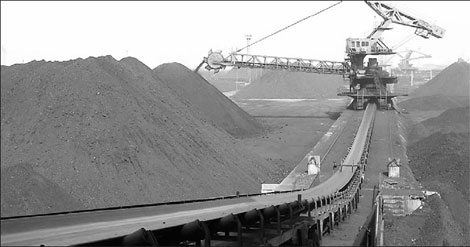
Coal accounts for about 70 percent of the total consumption in the country's energy mix. Currently, only 145 billion tons of coal reserves can be extracted immediately, despite that official figures show the country's coal reserve may reach 1 trillion tons.
What's more, Chen says, the current mining methods can only help extract 30 percent of 145 billion tons, which means the immediate reserves can only sustain 20 years of China's coal consumption if no further exploration efforts are not made.
"We will not avoid an even more severe energy supply shortage," says Chen. "Unless we accelerate our steps to find the exact locations where the coal be buried and at the same time we improve our mining skills."
(China Daily 09/22/2008 page5)

 Night views of Harbin through the lens
 Tibetans take train home after pilgrimage or travelling
 World's largest shaftless Ferris wheel built in China
 Ancient cities to be connected by Xi'an-Chengdu high-speed railway
 Snow turns Harbin into winter wonderland
 Reed Catkin Festival held in Wuhan
 Is it a building or a bookshelf?
 First flight
 Polar icebreaker Snow Dragon arrives in Antarctic
 Xi's vision on shared future for humanity
 UN's top environmental honors go to three in China
 German trains collide near Duesseldorf, several people injured
 China beats Germany 7-4 in men's curling Olympic qualification
 Bayern beat Paris Saint-Germain 3-1 in UEFA Champions League


Copyright 1995 - . All rights reserved. The content (including but not limited to text, photo, multimedia information, etc) published in this site belongs to China Daily Information Co (CDIC). Without written authorization from CDIC, such content shall not be republished or used in any form. Note: Browsers with 1024*768 or higher resolution are suggested for this site.
License for publishing multimedia online 0108263 Registration Number: 20100000002731