Comments
  Print
Print  Mail
Mail  Large Medium Small
|
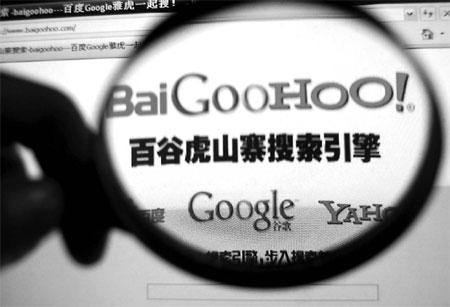
A Chongqing citizen reads about the "BaiGooHoo"website, a popular "Shanzhai" website at present. |
How many Kaixin websites, a Chinese copycat Facebook and a buzzword for millions of Chinese office workers, exist in cyberspace?
The answer is "beyond calculation". Google kaixin in Chinese, and numerous websites pop up, with kaixin part of their domain names, like kaixinwang.com, 52kaixin.com, kaixinwang.org.
In these worlds of kaixin (literally "joyful"), it's not easy for the original edition, Kaixin001.com, to feel joyful.
Kaixin001.com entered the market in 2008, when social networking sites were already flourishing in China. But it quickly won white collars' hearts by a lot of easy-to-play games, which helped it soar in the Alexa rankings, a widely accepted system based on the sites' visitor numbers.
As the fame of Kaixin001.com soared, its copycats mushroomed. But the most threatening one didn't come until October 14 when ChinaInterActiveCorp, its biggest rival, bought the domain name Kaixin.com and put it in test operation.
As the owner of Xiaonei.com, the most popular social networking site among college students, ChinaInterActiveCorp has long coveted Kaixin001's white-collar market, as its ambitious expansion in white-collar market had not been very successful.
"At first, I suggested registering Kaixin007," Chen Yizhou, CEO of ChinaInterActiveCorp, recalled when interviewed by Hexun.com. "But we soon found that a set of domain names, from Kaixin001 to Kaixin100 had been registered."
"We had to buy one in any case, so we decided to buy a good one" said Chen, who reportedly bought Kaixin.com at a high, undisclosed cost.
Netizens found that not only did Kaixin.com share a very similar name with Kaixin001.com, but also eight out of its 12 functions were exact clones of Kaixin001.com.
Kaixin.com soon was mocked by netizens as a "shanzhai" edition of Kaixin001.com. The word "shanzhai", literally meaning "remote village" in Cantonese, became a popular name for fakes when "shanzhai cell phones", churned out by small-scale manufacturers in southern China, quickly seized a considerable chunk of the mainland market during the past two years. The slang now refers to anything that steals ideas or styles from already well-known products, personalities or concepts.
However, Chen didn't seem to care at all. He dispersed all the doubts and criticism by saying "if you say it is a shanzhai edition, then baidu.com is also a shanzhai edition." (Baidu.com is China's most popular search engine and bears a distinct resemblance to google.com.)
"(Kaixin001) didn't buy Kaixin.com, which demonstrated they are not serious enough," Chen added, "If we don't buy it, someone else will buy it. If you are not serious enough, the market will deliver the consequences."
At its launch, domain name experts criticized Kaixin001.com because kaixin001 didn't exactly correspond with its Chinese name and its Chinese name was not registered as a trademark.
Thanks to its well-known name, Kaixin.com climbed the Alexa ranking board at a surprising speed, from far behind 10,000 to currently around 1,200. And Kaixin001.com hasn't filed any IP infringement lawsuit against ChinaInterActiveCorp, and has refused to comment on the issue.
Ironically, Xiaonei.com didn't escape from the copycat syndrome, either. A site called Xiaonei001.com jumped out, imitating Xiaonei.com exactly as Xiaonei.com imitated Kaixin001.com.
The shanzhai virus expanded beyond social networking sites, as both baidu and google have also been affected.
Log into Baigle.com, type in a word, and you will get two search results in the same page, one from baidu, the other from google. Creative? Try baigoohoo.com to get three results simultaneously from baidu, google and yahoo.
Even government websites have been affected. In mid December, a fake edition of a branch of the central government's website shocked some netizens with a domain name and homepage exactly resembling the authentic one. Following a warning from the real deal, the fake was shut down.
IP concern
The shanzhai syndrome on the Internet has raised concern about intellectual property protection in cyberspace. Is it OK to register a twin domain name of well-known sites? Is it OK to clone other sites' designs, logos and functions?
Justin Yu with Sam & Partners, a Beijing-based law firm, says that without an accurate definition, "shanzhai" is not a legal expression. He sums up the phenomenon as two problems, the registration of domain names and the content of the websites.
According to Yu, the Anti-Unfair Competition Law could be cited as a shield to protect domain names, which defines "using a similar name, package, decoration of the famous or noted commodities, which may confuse consumers distinguishing the commodities from the famous or noted commodities" as a kind of unfair competition.
And according to the Supreme People's Court's judicial interpretation regarding domain name disputes, "domain names that confuse consumers distinguishing them from the well-known trademarks, commodities and service could be judged to be revoked, halted or changed".
"In practice, there are examples where domain name dealers who rushed in to register were told to revoke or change their domain names," said Yu. "We can say with certainty that there are legal problems with the hoard of domain names that resemble noted websites."
Yu said that the social recognition level, reputation and the scale of ad input should be examined to determine whether a certain commodity, service or domain name is "well-known".
There are both differences and connections between the trademarks and the names of certain commodities and services. Well-known commodities and services are not required to own registered trademarks, but they are subjected to great subjectivity since different people may have different judgments.
Therefore, Yu said, it is suggested that well-known companies register related trademarks.
As for website content, a possible approach for protection is a copyright. According to Yu, originality is the first concern in determining if a work should be protected by the copyright law.
"Take Kaixin.com for example. Considering the mode of social networking sites didn't originate with Kaixin001.com, and its format can be traced to similar formats developed by overseas companies, we have to analyze the originality of these formats under specific condition." said Yu.
However, Yu said the copyright law only protects the specific expression of a work, not the rules and methods by which the work is created. This means if two games or operational modules share a similar mode, but differ in code, there is no copyright infringement.
"So if a website intends to protect its functions it is better to resort to a patent approach, rather than a copyright approach," Yu said.
In contrast to the scrupulousness of the IP lawyer, Wang Ran, CEO of China eCapital, a private investment bank, and a famous blogger known for his Internet business comment, expressed his contempt explicitly, "No company in the world builds its greatness on the base of hoarding noted websites' twin domain names.
"Though according to the philosophy of 'what is actual is rational', we have to admit that some shanzhai material offer its consumers more or less value. But in general, shanzhai fever is not so much the proliferation of the innovative grassroots spirit, but the relentless exposure and irony of the lack of IP awareness in China," Wang wrote in a blog post, titled "The Flood of Shanzhai Culture is a Shame".
Editor's note: The IPR Special is sponsored by the State Intellectual Property Office and published by China Business Weekly. To contact the Intellectual Property Office, the IPR Special hotlines are 8610-64995422 or 8610-64995826, and the e-mail address is ipr@chinadaily.com.cn.
(China Daily 01/12/2009 page9)

 Night views of Harbin through the lens
 Tibetans take train home after pilgrimage or travelling
 World's largest shaftless Ferris wheel built in China
 Ancient cities to be connected by Xi'an-Chengdu high-speed railway
 Snow turns Harbin into winter wonderland
 Reed Catkin Festival held in Wuhan
 Is it a building or a bookshelf?
 First flight
 Polar icebreaker Snow Dragon arrives in Antarctic
 Xi's vision on shared future for humanity
 UN's top environmental honors go to three in China
 German trains collide near Duesseldorf, several people injured
 China beats Germany 7-4 in men's curling Olympic qualification
 Bayern beat Paris Saint-Germain 3-1 in UEFA Champions League


Copyright 1995 - . All rights reserved. The content (including but not limited to text, photo, multimedia information, etc) published in this site belongs to China Daily Information Co (CDIC). Without written authorization from CDIC, such content shall not be republished or used in any form. Note: Browsers with 1024*768 or higher resolution are suggested for this site.
License for publishing multimedia online 0108263 Registration Number: 20100000002731