Comments
  Print
Print  Mail
Mail  Large Medium Small
|
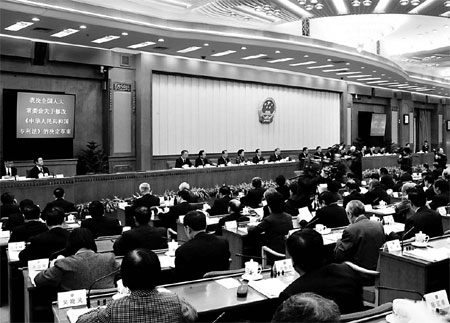
The amendment to the Patent Law was passed on Dec 27, 2008, at the sixth session of the 11th NPC Standing Committee. Asianewsphoto |
China's top legislature approved a revision of the Patent Law on Dec 29, 2008, and made a number of amendments to the patent application process and expanded patent protection.
From 2001 to April 2008, State Intellectual Property Office processed 9,571 cases of patent disputes and investigated 11,639 cases of patent infringement. To better protect intellectual property rights of patent holders, the newly revised law contains more detailed and specific patent protection measures than the old ones.
The amendment applies to all inventions completed in China.
The revised law, which takes effect on Oct 1, 2009, was adopted by 154 votes and four abstentions at the closing meeting of the sixth session of the 11th National People's Congress (NPC) Standing Committee.
This was the third revision to the law promulgated some 25 years ago. The previous two amendments were enacted in 1992 and 2000. The first added pharmaceutical compositions to the list of patentable items and inaugurated China's membership in the Patent Cooperation Treaty ("PCT"). The second amendment brought China's Patent Law into compliance with the Trade-Related Aspects of Intellectual Property Rights ("TRIPS") Agreement.
The changes were aimed at encouraging innovation and improving China's "international competitiveness", Chen Guangjun, a senior official with the NPC's Education, Science, Culture and Health Committee, said before the revision came out.
At the LexisNexis Advisory Committee meeting, a United States-based information and business solutions provider to law firms, journalists and others, member Cheng Yongshun, former vice president of intellectual property law court of the higher people's court of Beijing, told China Business Weekly in an interview that the Patent Law made several important changes to application process and enforcement of the law.
The revision of the Patent Law enhanced the protection standard of a patent. An important change involves the adoption of the so-called "absolute novelty" standard that is applied internationally. Under this standard, patent examiners are required to consider public use evidence both inside and outside China when processing patent applications.
"Adoption of an absolute novelty standard will have the effect of reducing patent infringement. In the past some Chinese companies purchased the products from foreign expos that were not published overseas, and manufactured them in China. But this situation was no longer legal in China, and the new revision regarded those activities as illegal and increased the ceiling of punishment," said Cheng.
Another change was the extent of protection becoming clearer. In the amendment, similar designs can apply to the patent as long as they are owned by the same owner, while under the old Patent Law the owner only can apply one.
And the application of design patent will become stricter than before. Designs such as beer or soft drink bottles or wine labels can no longer be awarded design patents.
Another important change is the removal of the requirement for all Chinese individuals and entities to first file applications in China for inventions made in China. The revision allowed Chinese individuals and entities to file their patents for the first time in other countries, not necessarily China. In other words, applicants can apply for foreign patents even before obtaining Chinese patents.
But the applicants are supposed to go through a security check held by patent authorities of the State Council, China's Cabinet, said Tian Lipu, director of the State Intellectual Property Office. Inventions which have not undergone security checks will not be granted Chinese patents, according to the new law.
The checks are intended to block the leak of some foreign applicants or foreign-owned research labs in China applying for patents to outside of China and circumventing the foreign filing requirement of the current Chinese patent law. This foreign filing license regime is the same as the system in the United States.
The amendment raised the penalty and damage payments in cases of patent infringement. The amendment increased the penalty for IPR infringement to 400 percent from 300 percent of the illicit profits and raised the damage payment from 50,000 yuan to 200,000 yuan even if there was no profit from infringement.
And the draft for first time contains a statute that the people's court can fine the infringer between 10,000 yuan to 1 million yuan in compensation when the damage cannot specifically identified.
The process of a patent lawsuit had a change, too. The revision permits protecting evidence before prosecution. The protection will be overseen by the court and applied by the plaintiff. The applicant should provide guarantee, and court should make the protection decision within 48 hours. "This new article can effectively protect the patentee's legal rights and the evidence," said Cheng.
According to Cheng, there are still some problems not solved in the amendment. "Some problems in dispute were not covered in the amendment, like indirect infringement and the process of the intellectual property right identification. It's a pity these unsolved problems are not resolved in this revision."
Editor's note: The IPR Special is sponsored by the State Intellectual Property Office and published by China Business Weekly. To contact the Intellectual Property Office, the IPR Special hotlines are 8610-64995422 or 8610-64995826, and the e-mail address is ipr@chinadaily.com.cn.
(China Daily 02/09/2009 page9)

 Night views of Harbin through the lens
 Tibetans take train home after pilgrimage or travelling
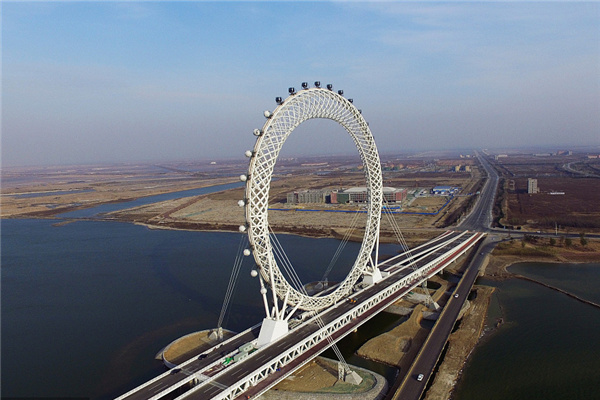 World's largest shaftless Ferris wheel built in China
 Ancient cities to be connected by Xi'an-Chengdu high-speed railway
 Snow turns Harbin into winter wonderland
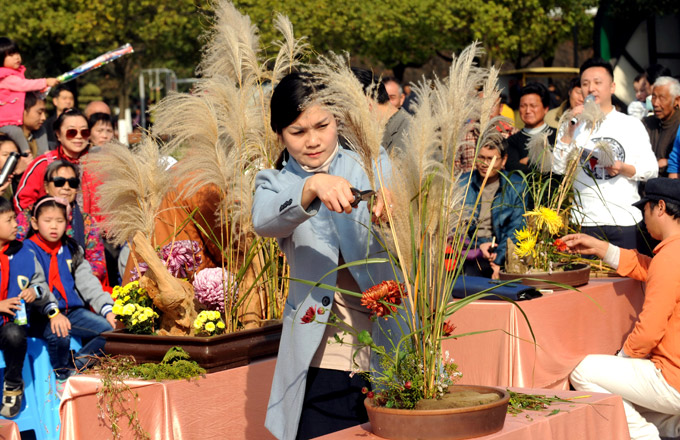 Reed Catkin Festival held in Wuhan
 Is it a building or a bookshelf?
 First flight
 Polar icebreaker Snow Dragon arrives in Antarctic
 Xi's vision on shared future for humanity
 UN's top environmental honors go to three in China
 German trains collide near Duesseldorf, several people injured
 China beats Germany 7-4 in men's curling Olympic qualification
 Bayern beat Paris Saint-Germain 3-1 in UEFA Champions League


Copyright 1995 - . All rights reserved. The content (including but not limited to text, photo, multimedia information, etc) published in this site belongs to China Daily Information Co (CDIC). Without written authorization from CDIC, such content shall not be republished or used in any form. Note: Browsers with 1024*768 or higher resolution are suggested for this site.
License for publishing multimedia online 0108263 Registration Number: 20100000002731