Comments
  Print
Print  Mail
Mail  Large Medium Small
|
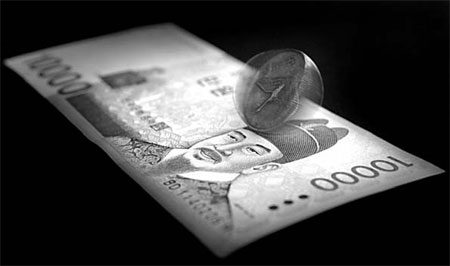
South Korean won coins and bills are displayed in Seoul, South Korea. South Korea's won, Asia's worst-performer last year, weakened to the lowest since 2004. Bloomberg News |
Foreign direct investment in developing nations will drop by $180 billion, or 31 percent, this year as a global recession prompts multinationals to cut spending on factories and mines, according to the World Bank.
The decline will put renewed pressure on emerging-market currencies, even as asset sales by fund managers slow, according to Mansoor Dailami, manager of international finance in the global development prospects group. Rallies in the South Korean won, Brazil's real and the Polish zloty have all faltered since the end of 2008 as companies including Rio Tinto Group and Honda Motor Co put expansion plans on hold.
"This is the most serious reaction so far to the global recession, the factory level," Dailami, who joined the bank in 1986, said in an interview in Washington. "Most emerging-market currencies are already under pressure and this tendency will continue. In 2008, it was a stocks and portfolio story. This year, it will be an FDI story."
Foreign direct investment fell an estimated 10 percent in the developing world in 2008 and will cool further this year, the United Nations said in its 2009 outlook. FDI, which typically involves spending on plant and machinery or the purchase of a controlling interest, accounted for 38 percent of inflows into emerging markets in recent years, compared with 10 percent for investment by funds and 54 percent for loans, according to Morgan Stanley estimates.
Investment delays
Bloomberg-JPMorgan indexes tracking currencies in Asia, Latin America and Eastern Europe in 2008 posted declines of 5.9 percent, 19 percent and 11 percent, respectively, and have since dropped further. The won is down 8.3 percent versus the dollar so far this year following a 17 percent jump in December. The real is 2.6 percent weaker and the zloty has lost 12 percent.
Rio, the third-largest mining company, this month postponed a $2.15 billion expansion of an iron-ore mine in Brazil. Honda, Japan's No 2 automaker, delayed construction of a $100 million factory in Argentina and has shelved expansion plans in Turkey and India. Hitachi Construction Machinery Co, the world's largest maker of giant excavators, froze a $1 billion plan to expand production in China and other emerging markets.
"We've never before experienced seeing sudden, simultaneous drops in worldwide demand," Hitachi Chief Executive Officer Michijiro Kikawa said this month in an interview in Tokyo. "New investment won be implemented until we can foresee how the market will recover."
As recently as Oct 28, the Tokyo-based company was predicting 26 percent growth in China sales for the current financial year. The nation's excavator market shrank 50 percent from year-earlier levels in November and 37 percent in December.
Weaker currencies
The World Bank estimates that foreign direct investment in developing countries will shrink to $400 billion this year from an estimated $580 billion in 2008 and $500 billion in 2007, according to Dailami, author of the lender's annual Global Development Finance report.
The outlook is "pretty grim," said Peter Elston, a Singapore-based strategist at Aberdeen Asset Management Plc, which is Scotland's largest independent money manager and oversees $154 billion. "Given that exports have fallen off a cliff, you would expect FDI to do the same."
Tumbling exports
The World Bank predicts global trade will contract this year for the first time since 1982 and Brazil, Latin America's biggest economy, forecast its exports will drop as much as 20 percent. Germany, the world's biggest goods exporter, reported a record slide in shipments for November and China, the second-largest, last month had its worst decline in a decade.
Net flows to Brazil, the second-biggest, slid 14 percent to $2.18 billion in November and the country's central bank last month cut its 2009 estimate for foreign direct investment to $30 billion from $33 billion.
"If we start seeing very severe cutbacks for more than a year, then you start moving into a world where shortage of FDI will become an issue for currencies,"said Richard Urwin, head of asset allocation at BlackRock Inc, the largest publicly traded US asset manager with $1.26 trillion of funds. "Emerging currencies have already been weak due to the slower capital inflows from stocks."
Fund exodus abates
Some $67 billion was pulled out of emerging-market equities and bonds funds in 2008, after net inflows of $62 billion the previous year, according to EPFR Global, a Cambridge, Massachusetts-based research company. The outflows eased this year as the funds took in $4.29 billion in the first 14 days of 2009, the data show.
So far this year, 22 of 26 emerging-market currencies tracked by Bloomberg have weakened versus the dollar. Hungary's forint was the worst performer, sliding 14 percent, as Europe's recession crimps demand for products assembled in the country such as Audi cars and Nokia phones.
Eastern European countries are the most vulnerable among developing regions to a slide in foreign investment as they have relatively large overseas debt, the World Bank's Dailami said. The International Monetary Fund has already offered emergency funding to Belarus, Latvia, Hungary, Iceland, Serbia and Ukraine.
Banks bailing out
Government-led bailouts of finance companies in the US and Europe are forcing lenders there to pull funds back from emerging markets, forcing the sale of "prized jewels" such as stakes in Chinese banks, David Bloom, global head of currency strategy at HSBC Holdings Plc, said in Hong Kong.
Royal Bank of Scotland Plc, the biggest government- controlled bank in the UK, sold its $2.3 billion stake in Bank of China Ltd. last week to replenish capital and Zurich-based UBS AG raised some $900 million by selling shares in the Chinese lender. Bank of America Corp., the largest US lender by assets, this month sold part of its stake in China Construction Bank Corp for $2.8 billion.
"The flow of money and the cross-border flows will slow," said Bloom, who predicts the world's economic output will decline this year for the first time since World War II.
Agencies
(China Daily 02/09/2009 page11)

 Night views of Harbin through the lens
 Tibetans take train home after pilgrimage or travelling
 World's largest shaftless Ferris wheel built in China
 Ancient cities to be connected by Xi'an-Chengdu high-speed railway
 Snow turns Harbin into winter wonderland
 Reed Catkin Festival held in Wuhan
 Is it a building or a bookshelf?
 First flight
 Polar icebreaker Snow Dragon arrives in Antarctic
 Xi's vision on shared future for humanity
 UN's top environmental honors go to three in China
 German trains collide near Duesseldorf, several people injured
 China beats Germany 7-4 in men's curling Olympic qualification
 Bayern beat Paris Saint-Germain 3-1 in UEFA Champions League


Copyright 1995 - . All rights reserved. The content (including but not limited to text, photo, multimedia information, etc) published in this site belongs to China Daily Information Co (CDIC). Without written authorization from CDIC, such content shall not be republished or used in any form. Note: Browsers with 1024*768 or higher resolution are suggested for this site.
License for publishing multimedia online 0108263 Registration Number: 20100000002731