Comments
  Print
Print  Mail
Mail  Large Medium Small
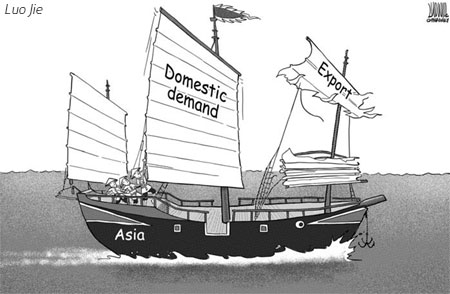
The shock is violent. After six to seven years of exceptionally strong growth in Asia, the economic situation in the region has deteriorated very quickly over the past three to six months. It has been all the more brutal since Asia had been doing rather well until mid-2008. Despite the global financial crisis and the US economy becoming more and more depressed, Asian exports, in particular, were still growing remarkably strongly. This is over. What has happened over the past six months?
Two things.
Europe has followed the US on the path to recession. This, together with the weakening of the euro, has strongly impacted Asian exports to Europe, which had previously been a key support for the region.
Large emerging markets, which had also previously been a key support for Asian exports, also began to slow down strongly after mid-2008. In particular, they had to face two shocks: the sharp correction in commodity prices, which has hurt commodity exporters since July, and the speculative attacks as risk aversion increased rapidly after September.
As a result, Asia found it much more difficult to find demand for its manufacturing products after the third quarter of last year. The situation worsened during the very last months of 2008, as exports suddenly collapsed with an intensity not seen in a generation.
For instance, Taiwan island's exports dropped by 42 percent year-on-year in December. South Korea's exports shifted from a robust 20-30 percent year-on-year growth in the third quarter to a nearly 20 percent decline year-on-year only three months later.
The shock on exports is stronger than in 2001, and it is happening much more quickly as well.
Asian policymakers have tried to save their economic growth since September. Thanks to powerful disinflation, most Asian central banks have been able to lower interest rates aggressively. On top of that, most Asian governments have some fiscal leeway and should unveil additional fiscal packages in the short term. This swift policy response may help buffer the slowdown to some extent but will it be enough to save economic growth across the region?
In my view, it will be far from sufficient. Asia is going to pay the price in 2009 for its over-reliance on exports. Over the past few years, Asia has relied to a large extent on external demand. The corollary has been the well-known accumulation of foreign exchange reserves, which is actually a way to recycle domestic savings by investing abroad. As a result, a significant part of Asia's savings - which could have been used to strengthen domestic demand and fuel Asia's autonomy - has instead been used to finance foreign economies, including the US imbalances.
China has been no exception to this rule, and it has accumulated a record amount of foreign currency reserves. Chinese exports amounted to an estimated 37 percent of GDP in 2008. This is almost twice as much as in 2000. A weaker contribution of net exports will have stripped about 4 percentage points from GDP growth between the beginning of 2008 and mid-2009.
As a result of the region's vulnerability, Asia will decelerate strongly in 2009, from 7.3 percent last year to 4.7 percent in 2009. China itself may decelerate from 9 percent last year to 6.5 percent in 2009. Between one-third and one-half of the main economies in the region will likely post negative growth figures in 2009.
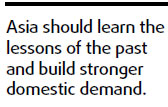
Will Asia learn the lessons of the past and work to build stronger domestic demand and stop recycling such a large part of its savings by investing abroad? It is possible, but it is unlikely to happen in the very short term.
Right now, most policymakers are in damage control; they are busy trying to avoid too strong a recession. They do not really have the time or energy to cope with structural matters. The question may become more topical once the global economy stabilizes and Asia can think again about its medium-term outlook.
This may happen at the end of 2009, but it is unlikely to occur before.
The author is a senior economist/strategist for Asia at Calyon, the corporate and investment banking arm of the Crdit Agricole Group, the world's seventh-largest and Europe's third largest bank
(China Daily 03/09/2009 page2)

 Night views of Harbin through the lens
 Tibetans take train home after pilgrimage or travelling
 World's largest shaftless Ferris wheel built in China
 Ancient cities to be connected by Xi'an-Chengdu high-speed railway
 Snow turns Harbin into winter wonderland
 Reed Catkin Festival held in Wuhan
 Is it a building or a bookshelf?
 First flight
 Polar icebreaker Snow Dragon arrives in Antarctic
 Xi's vision on shared future for humanity
 UN's top environmental honors go to three in China
 German trains collide near Duesseldorf, several people injured
 China beats Germany 7-4 in men's curling Olympic qualification
 Bayern beat Paris Saint-Germain 3-1 in UEFA Champions League


Copyright 1995 - . All rights reserved. The content (including but not limited to text, photo, multimedia information, etc) published in this site belongs to China Daily Information Co (CDIC). Without written authorization from CDIC, such content shall not be republished or used in any form. Note: Browsers with 1024*768 or higher resolution are suggested for this site.
License for publishing multimedia online 0108263 Registration Number: 20100000002731