Comments
  Print
Print  Mail
Mail  Large Medium Small

The year 2009 may well be remembered as the Year of Climate Cooperation. Shortly after the New Year, the inauguration of Barack Obama heralded a new effort to reduce America's greenhouse gas emissions, and to place special emphasis on working with China on climate issues. In a few more months, the world's nations will gather in Copenhagen, Denmark, to try to forge a global agreement to prevent catastrophic climate change.
The tide of history is shifting towards a belated but crucial effort to reduce global greenhouse gas emissions. China has a uniquely important opportunity to help shape this momentous new chapter in history, one that can be grasped by taking a new look at its national policy on climate change.
The Chinese government's 2008 "White Paper on China's Policies and Actions on Climate Change," together with the 2007 National Climate Change Program, outlines substantial efforts to improve energy efficiency and reduce emissions. China has an opportunity to build on this effort by formulating a visionary policy that will enhance its national security, promote sustainable economic development and position it as a full partner in one of the most important global efforts of our era.
A visionary national climate change policy should be forward-thinking - too much time has been wasted in debates over the carbon that is "embedded" in China's exports and the responsibility of developed nations for the majority of historical global emissions.
These arguments are not wholly without merit but miss the point at a time when all nations, including China, must act quickly to build energy-efficient, low-carbon economies or risk runaway climate change.
A national climate change policy should also express China's willingness, in time, to commit to greenhouse gas emissions reductions, focusing initially on specific industrial sectors and, eventually, on economy-wide "caps" on total emissions. This step is necessary since battling climate change requires the decrease of absolute emissions of each nation, as opposed to merely decreasing energy consumption per unit of GDP, which is China's current policy.
The policy should use a mixture of incentives and mandates, to place China on the road to an energy transformation, away from conventional fossil-fuel power generation and towards the use of renewable energy sources and energy conservation measures.
China will benefit from a bold and visionary climate policy in several areas including enhanced security since the country will be in an increasingly precarious position as a result of changing climate, particularly in terms of water availability.
Most of the major river systems that feed and water China, India, and Southeast Asia depend on meltwater from the Himalayan region. Climate change is endangering this vital source of water for 60 percent of the human population. Himalayan glaciers, which provide some 70 percent of the flow of major Asian rivers, are melting at an extremely rapid rate; one study, published in the prestigious journal Nature, predicts that the Himalayan-Hindu Kush region will start to "run out of water" during the dry season. Besides disrupting agricultural activities and destabilizing massive and volatile populations, such a situation would imperil China's economic growth.
Additionally, the aggressive pursuit of a truly low carbon economy can help establish an era of unparalleled innovation and economic prosperity. A study by CERNA, for example, shows that countries that committed themselves to mandatory emissions reductions under the Kyoto Protocol experienced increased levels of innovation in green technologies over those that did not.
The depth and diversity of these economic development opportunities are enormous; China can create millions of urban, high-tech jobs in the manufacture, installation, operation and maintenance of renewable power systems. It can also revive rural economies through the development of sustainable agriculture practices. In all regions, huge amounts of money can be saved as citizens breathe cleaner air and drink cleaner water, reducing the incidence of some diseases.
Action on climate change is also an important sign of membership in the international community. Climate change has emerged as a global issue of paramount importance and by demonstrating that it is prepared to act boldly to combat climate change , China can help to reinforce its image as a responsible nation. Two Hunan University professors wrote in a recent China Daily editorial that "developing a low-carbon economic is a must as China continues to industrialize, not only for the nation's energy security but also as part of an urgent international responsibility to address global climate change."
By embracing this responsibility, China can gain recognition as a full partner in one of the most important global efforts in human history, while also ensuring it has a seat at the table as a global agreement to reduce greenhouse gas emissions is forged.
The fundamental value in a bold, visionary national climate policy is that it builds the foundation for a sustainable future. China stands to gain a great deal from becoming a leader in green technologies, a resource-efficient economy, and a largely self-sufficient energy consumer. China's current policy on climate change is significant and a step in the right direction, but hopefully it represents merely a rough draft of a strategy equal to the challenge of climate change.
Scott Moore is a Fulbright Fellow with the Environmental Economics and Policy Study Group at Peking University. Julian Wong is an independent energy analyst, founder of the Beijing Energy Network, and author of the blog GreenLeapForward.com. The views expressed in the article are their own
(China Daily 04/13/2009 page3)

 Night views of Harbin through the lens
 Tibetans take train home after pilgrimage or travelling
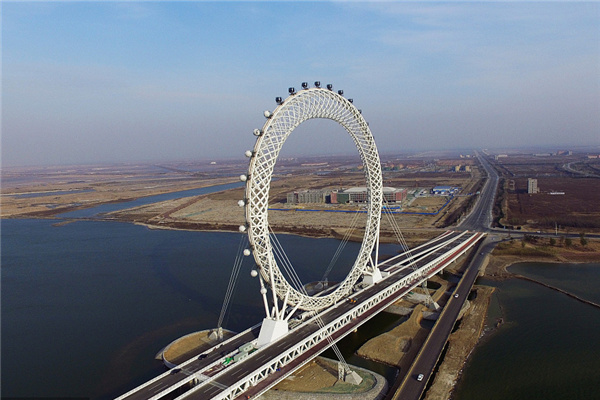 World's largest shaftless Ferris wheel built in China
 Ancient cities to be connected by Xi'an-Chengdu high-speed railway
 Snow turns Harbin into winter wonderland
 Reed Catkin Festival held in Wuhan
 Is it a building or a bookshelf?
 First flight
 Polar icebreaker Snow Dragon arrives in Antarctic
 Xi's vision on shared future for humanity
 UN's top environmental honors go to three in China
 German trains collide near Duesseldorf, several people injured
 China beats Germany 7-4 in men's curling Olympic qualification
 Bayern beat Paris Saint-Germain 3-1 in UEFA Champions League


Copyright 1995 - . All rights reserved. The content (including but not limited to text, photo, multimedia information, etc) published in this site belongs to China Daily Information Co (CDIC). Without written authorization from CDIC, such content shall not be republished or used in any form. Note: Browsers with 1024*768 or higher resolution are suggested for this site.
License for publishing multimedia online 0108263 Registration Number: 20100000002731