Comments
  Print
Print  Mail
Mail  Large Medium Small
|
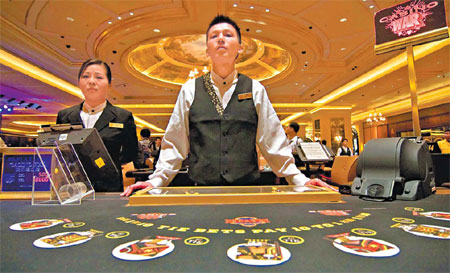
Fierce competition has produced a surplus of gambling facilities, but has not increased the demand for their services. File photo |
Macao residents feeling the pinch of recession are pinning their hopes on a recovery of the global economy. But analysts say that Macao needs much more than that - the gaming city needs to diversify its economy.
Like businesses around the world, casino operators have been hit hard by the global financial crisis. But Macao's once booming gaming industry, which accounts for about 50 percent of the city's GDP, has fundamental problems beyond the current global economic downturn.
These include a glut of gaming facilities, fierce competition among operators, and the mainland's recent curbs on visiting Macao. Potential competition from Singapore, Malaysia, Cambodia, North Korea, and even Taiwan province also threaten to cut into Macao's share of the gambling pie.
The number of visitors to Macao declined sharply amid the economic crisis. Gaming revenues totaled $6.26 billion in the second half of 2008, down 15 percent from $7.34 billion in the first half of the year.
This dip forced many casino operators to suspend or postpone their new projects.
In November 2008, Hong Kong-listed Galaxy Entertainment Group Ltd announced that "after careful consideration of the prevailing local market conditions" it was postponing the opening of its $375-billion project in Macao's Cotai Strip to 2010. The mega resort was initially set to open in mid-2009.
In the same month, Las Vegas Sands Corp, the world's largest gambling group, suspended the construction of its $11-billion project in the same area, citing financial stress.
But analysts say it will take more than a quick fix of the global financial system to solve Macao's problems. Even before the slowdown, some practices in Macao's gaming industry were already raising concerns about its sustainability.
Macao's gaming industry enjoyed an unprecedented boom after gaming king Stanley Ho's 40-year casino monopoly came to an end in 2002 and China introduced the Individual Visit Scheme (IVS) in 2003. Gaming revenues hit new records and in 2006 Macao replaced Las Vegas as the world's top gaming and entertainment hub, with revenues of $7.2 billion, compared to the latter's $6.6 billion.
The gaming boom triggered a war for market share. Demand for equipment like gaming tables and machines has increased tenfold in the past three years. The glut of new gambling facilities resulted in an excess of supply, while demand remained the same.
"Macao's gaming industry has been plagued by vicious competition. The hefty rebates paid by casino operators to middle men have eroded their profit margins," said Matthew Kwok, research head at Tanrich Securities Ltd in Hong Kong.
Ricardo Siu, associate professor at the University of Macao's department of finance and business economics, noted in an article published in Game Time International that commissions offered by casino owners to junket operators for VIP players have reached unreasonably high levels.
In mid-2008, the Chinese government imposed stricter restrictions on permits for visitors from the Chinese mainland. These included closing the loophole that allowed mainland residents to travel to Macao on Hong Kong visas and curbing the number of visits to one per month. These restrictions put more pressure on Macao's gaming revenue.
The recession in Macao's gaming industry contributed significantly to the downturn in the city's tiny economy. Siu estimated that the gaming industry alone accounts for nearly 50 percent of Macao's GDP and could reach 60 percent if revenues from related sectors such as hotels, recreation resorts, and exhibitions are included.
The city's economic growth decelerated rapidly toward the end of 2008, with the growth rate tapering to 22.2 percent in the third quarter and 11.3 percent in the fourth, after peaking at 32.3 percent in the second quarter.
The dominance of the gaming industry has been of particular concern, given Macao's sensitivity to the mainland's travel policy. "There are undoubtedly some concerns over the growing dominance of the gaming industry in the economy," said Siu.
Francis Lun, general manager at Hong Kong's Fulbright Securities Ltd, agreed, saying that the economic structure of Macao is "unhealthy". The working population in Macao totals around 400,000, of whom about 160,000 work in the gaming, tourism, hotel, and construction sectors, according to latest estimates.
Early last year, the local Macao government ordered a halt to the addition of new gaming tables and machines. Meanwhile, the central government is studying measures to help the gaming enclave diversify its economy.
At the recent Boao Forum for Asia in Hainan, Chinese Premier Wen Jiabao acknowledged the unique position of Macao's gaming industry, but said the government supports the city's diversification moves. "Given its small area, Macao's economic development will face certain limitations. So we are studying a long-term development plan for the Pearl River Delta region, which will give due attention to Macao," Wen said.
Analysts speculate that the measures could include an ambitious plan for Macao and Zhuhai, the neighboring city on the mainland, to jointly develop Hengqin Island.
The governments of Macao and Zhuhai have been discussing the possibility of jointly developing the island, which is situated near Macao but belongs to Zhuhai, into a region that will house research centers, hi-tech industries, conference and exhibition centers, and recreation resorts. There are also reports that the central government may include Hengqin Island in the Macao Special Administration Region.
"The attempt to jointly develop Hengqin Island is the right choice for Macao's future economic development," said Tanrich Securities' Kwok.
Another challenge for Macao is competition from Cambodia, North Korea and Malaysia, as well as Taiwan province.
Singapore recently awarded gaming licenses to many operators and local Taiwan's legislature passed a bill to legalize gambling on Penghu Island, located off Xiamen city on the mainland.
"The addition of new casinos in the region will definitely make competition fiercer. More casinos will not create more gamblers. It is an illusion to think that way," said Lun.
(China Daily 04/27/2009 page7)
 Night views of Harbin through the lens
 Tibetans take train home after pilgrimage or travelling
 World's largest shaftless Ferris wheel built in China
 Ancient cities to be connected by Xi'an-Chengdu high-speed railway
 Snow turns Harbin into winter wonderland
 Reed Catkin Festival held in Wuhan
 Is it a building or a bookshelf?
 First flight
 Polar icebreaker Snow Dragon arrives in Antarctic
 Xi's vision on shared future for humanity
 UN's top environmental honors go to three in China
 German trains collide near Duesseldorf, several people injured
 China beats Germany 7-4 in men's curling Olympic qualification
 Bayern beat Paris Saint-Germain 3-1 in UEFA Champions League


Copyright 1995 - . All rights reserved. The content (including but not limited to text, photo, multimedia information, etc) published in this site belongs to China Daily Information Co (CDIC). Without written authorization from CDIC, such content shall not be republished or used in any form. Note: Browsers with 1024*768 or higher resolution are suggested for this site.
License for publishing multimedia online 0108263 Registration Number: 20100000002731