Comments
  Print
Print  Mail
Mail  Large Medium Small
|
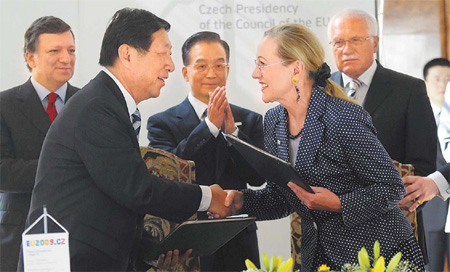
Zhang Ping ( second from left), the minister for China's National Development and Reform Commission, signs the Clean Energy document with Benita Ferrero-Waldner (second from right), the European Union's commissioner of external relations, during the EU- China summit in Prague, Czech Republic, on May 20, 2009. Bloomberg News |
If you compare modern photographs of colleges in the English university city of Oxford, with those taken little more than 50 years ago, you will instantly notice a remarkable difference.
Today the picturesque sandstone buildings are a near pristine golden yellow in color, but, before the passing of the Clean Air Act in the UK in 1956, they were more or less uniformly black.
Years of choking fumes from open fireplaces in thousands of closely packed rooms, plus the filthy emissions of motor vehicles had caked exterior walls in a thick carapace of black carbon. The country had been the cradle of the industrial revolution but, alongside the giant strides made in mechanization and manufacturing using coal as the primary source of energy, came consequent damage to the environment and to health.
One of those consequences for a particular life form can be found in the history of the peppery moth, as taught in biology classes to schoolchildren learning about the theory of natural selection.
Before the industrial revolution began in earnest, in the 18th century, most of these moths in Britain were a light color. However, some possessed mutated genes that made them much darker. These latter were fewer in number, it has been suggested, because it was easy for birds to spot and eat them.
Then the environment changed and soot blackened the trees so that the lighter moths were more easily spotted and eaten while the darker moths blended in better. The latter soon started to outnumber the former.
This story illustrates the dilemma in which China now finds itself. No nation yet has managed to boost its economic growth substantially without a consequential effect on the environment. With economic growth as the new global God, and with much of China's plentiful resources untapped, the big question the nation - and the world at large - is asking is, "Is there a way forward that does not have unwanted side effects?"
As global pollution levels get critically high, as greenhouse gases bring about more climate change and as carbon-based fuels decline to a point where some are predicting the date on which they will run out, the United States says it wants China to show the way to a greener yet more prosperous future.
That is why mayors and executives from State-owned enterprises in some 25 Chinese cities gathered in Beijing for a joint US-China Cooperation for Clean Energy (JUCCCE) training course on energy policy-making. They attended a series of lectures and discussion groups that started last Monday and finished yesterday. They are in the vanguard of a new approach to a problem some alarmists argue threatens the future of the human race.
The focus of the conference was on creating "energy smart" cities. While Government leaders have been quite content to set targets, getting the message down the line to local levels has been less successful. The quick buck all too often shines brightest.
Nobody is under the illusion that there are immediate solutions but everybody in attendance was acutely aware that a start had to be made.
Other countries began taking on board green issues after they had developed and their new, middle class inhabitants began to insist on access to clean drinking water and streets free of smog.
But China's middle class is an ongoing and comparatively recent creation, developing alongside a rapidly changing infrastructure that requires a rapidly increasing amount of energy and a rapidly growing number of homes.
Peggy Liu, who chairs JUCCCE and who attended the mayoral training course, estimates that 350 million people in China will move to cities over the next 20 years. That would entail building 50,000 skyscrapers, 170 new public transport systems and creating 12 megatropolises of 60 million people or more, she said.
In some ways that creates a blank canvas which authorities with a real commitment to the green cause could embrace.
Her message has been construed as apocalyptic if nothing is done but she insists there is hope and there is a plan.
Lectures at the mayoral training course included topics such as "Creating eco-cities - theory and practice" by Stanley Yip, director of planning and development, Arup China; "Financing solutions to develop and deploy green technologies" by Haimeng Zhang, associate principal, McKinsey and Co, and "Theory of waste management and international and domestic best practices" by John Williams, an engineering consultant and lecturer at Columbia University in the United States.
JUCCCE is a non-profit organization that brings together international expertise and technologies to accelerate the use of clean and efficient energy in China. It hopes to create visible change within 10 years of its conception, which was two years ago. One of its fundamental principles is encapsulated in a quote by Bjorn Stigson, president of the World Business Council: "Without a sustainable China, there can be no sustainable world".
Liu and colleague professor Stephen Hammer of Columbia University said their aim was to convince the authorities that good economic growth can be maintained while implementing green technology and that environmentalism makes sound business sense. It was imperative that every company, no matter what it produces, should now regard itself as an energy company and that every individual needs to be a green person.
JUCCCE targeted key decision makers to get its message across and both Liu and Hammer said the sessions met with excellent response. Hot air, it wasn't. They feel sure the delegates will return to their home cities inspired to act and confident in the knowledge they will have powerful back-up from JUCCCE's resources.
It is impossible to predict how green China is willing to get and what kind of effect that may have on the global environment. But will we be around to see whether what emerges will have the same impact as the Clean Air Act of 1956 had in the UK? Or will humanity face the fate of the lighter-colored peppery moth?
(China Daily 05/25/2009 page3)
 Night views of Harbin through the lens
 Tibetans take train home after pilgrimage or travelling
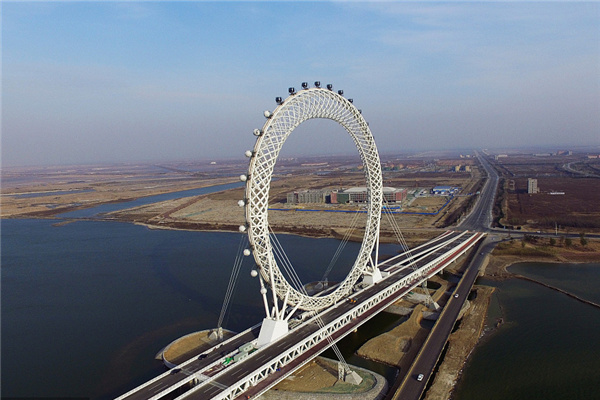 World's largest shaftless Ferris wheel built in China
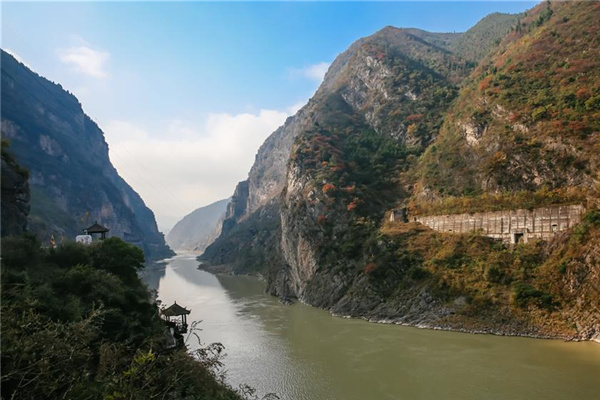 Ancient cities to be connected by Xi'an-Chengdu high-speed railway
 Snow turns Harbin into winter wonderland
 Reed Catkin Festival held in Wuhan
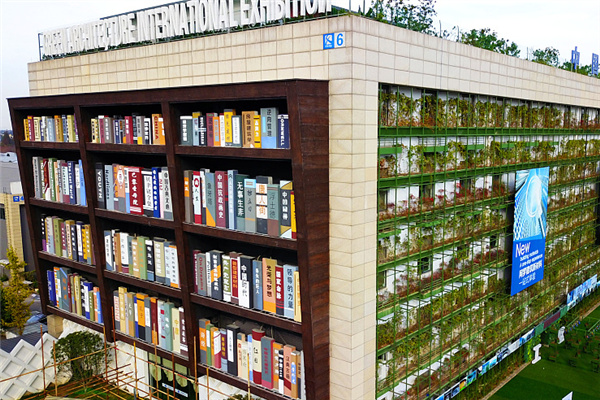 Is it a building or a bookshelf?
 First flight
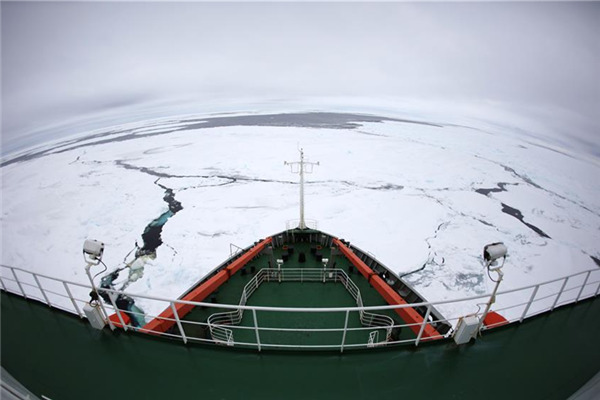 Polar icebreaker Snow Dragon arrives in Antarctic
 Xi's vision on shared future for humanity
 UN's top environmental honors go to three in China
 German trains collide near Duesseldorf, several people injured
 China beats Germany 7-4 in men's curling Olympic qualification
 Bayern beat Paris Saint-Germain 3-1 in UEFA Champions League


Copyright 1995 - . All rights reserved. The content (including but not limited to text, photo, multimedia information, etc) published in this site belongs to China Daily Information Co (CDIC). Without written authorization from CDIC, such content shall not be republished or used in any form. Note: Browsers with 1024*768 or higher resolution are suggested for this site.
License for publishing multimedia online 0108263 Registration Number: 20100000002731