Comments
  Print
Print  Mail
Mail  Large Medium Small
|
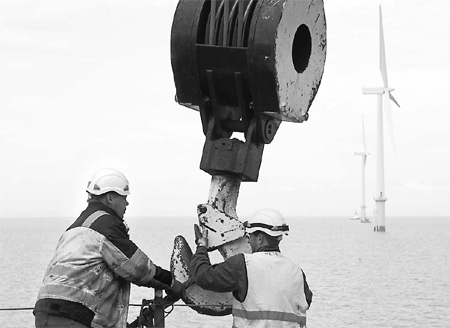
Burbo Bank Offshore Wind Farm in Liverpool Bay, England, has 25 wind turbines supplied by Siemens Energy. With a 581 million yuan wind power equipment project in Shanghai, the German company has begun its entry into China's wind power market. File photo |
It was a sunny and windy afternoon in Beijing. Richard Hausmann, president and CEO of Siemens China, could hear the wind whistling outside his office located in the northern part of the city.
"China has rich wind energy resources, and Siemens is now taking an active role in the country's wind power sector," said Hausmann, who is also CEO of Siemens Northeast Asia.
The German company started construction on a 581 million yuan wind power equipment factory in Shanghai in May. The move marks its entry into China's wind power market.
The plant will first produce blades for wind turbines with capacities of 2.3 megawatts and 3.6 megawatts. The plant is expected to begin operations in the second half of next year.
With the plant, Siemens has gained a foothold in China's booming wind energy market, Hausmann said.
Besides providing equipment to domestic customers, Siemens can also supply a full range of services in the wind power area, he added.
Although wind power still accounts for a small part of Siemens' portfolio in China wind power, Hausmann said he is confident about the future.
"Wind power will continue to see rapid growth in China in the future, as the government is encouraging the use of more clean energy in total energy consumption," Hausmann said.
"As a market leader, we will bring our most advanced products and solutions to the Chinese market," he said.
Siemens began wind turbine production through its acquisition of the Danish wind power developer Bonus Energy in 2004. The company has since developed into the leading company in the offshore wind power arena, Hausmann said.
"We are now also talking with some Chinese companies on some offshore wind power projects," he said.
Solar energy
In addition to wind power, Siemens is also looking closely at investment opportunities in solar energy in China.
The company's recent acquisition of an Israeli solar power company can further facilitate its entry into the domestic market, Hausmann said.
The company agreed to buy the solar thermal power company Solel Solar Systems Ltd (Solel) for about $418 million earlier this month.
Solel, based in Beit Shemesh, Israel, develops and builds solar thermal power plants and makes solar receivers. The receivers are main components for the facilities that collect sunlight with mirrors to generate steam to power turbines.
"With the deal, we have strengthened our portfolio in solar energy. We are also very interested in the sector in the Chinese market," Hausmann said.
To develop more renewable energy business is in line with Siemens' strategy to place more focus on energy-efficient and environmentally friendly technologies, Hausmann said.
"The percentage of our company's revenue generated by our green portfolio will increase significantly," he told reporters at a recent press conference.
"China's demand for environmentally friendly technologies will remain robust. This will continue to be a strong growth area for Siemens in China," he said.
The company earlier announced it expected to receive orders totaling 20 billion yuan from China's economic stimulus package in the next three years.
Of those expected orders, half would go to energy-efficient and environmentally friendly technologies, the company said.
Green business
As Europe's largest engineering company, Siemens has reorganized its portfolio into three business groups: industry, energy and healthcare.
In addition to energy, the company's industry divisions also have accelerated their pace in doing green business in China.
For instance, Siemens' home appliances division launched its 3D air-drying washer-dryer in the Chinese market last month.
Compared with traditional washer-dryers, the new product can save 30 liters to 90 liters of water during the drying processes.
"Water conservation has become an important issue for China. With this product, we will help our customers better conserve the natural resource," said Roland Gerke, president and CEO of BSH Home Appliances (China) Co Ltd, a 50-50 venture between Siemens and Bosch.
BSH since 1990 has succeeded in cutting the average energy consumption of its products by more than 40 percent, Gerke said.
Gerke said the company is also developing a refrigerator that uses solar power. The product, a hybrid, can use solar power and also electricity when there is no sun.
BSH began research and development work for the product last year. It will be launched first in China, Gerke said.
Siemens' metals technologies division is also expanding its presence in the Chinese market with green solutions.
It has provided a new technology, called Corex C-3000, to Baosteel, China's leading steel company. The technology can eliminate the need for coking plants in the production process, significantly reducing raw material costs and environmental emissions.
It has also signed another agreement with Ma'anshan Iron & Steel Co Ltd (Masteel) in Anhui province to build a MEROS (Maximized Emission Reduction Of Sintering) plant to reduce emissions. Sintering is a method for making objects from powder by heating the material until its particles adhere to each other.
Today, energy and raw materials account for 70 percent of the total costs incurred by steel plants. Reducing operating costs and making more efficient use of input materials are attracting an increasing amount of interest, said Richard Pfeiffer, CEO of Siemens VAI metals technologies.
Siemens China CEO Hausmann said more than 50 percent of the future growth of Siemens China would be related to green technology.
Siemens' green portfolio of business in China will generate orders valued at $6 billion for Siemens next year -- 40 percent of the company's total orders in China for 2010, the company said.
(China Daily 10/26/2009 page4)

 Night views of Harbin through the lens
 Tibetans take train home after pilgrimage or travelling
 World's largest shaftless Ferris wheel built in China
 Ancient cities to be connected by Xi'an-Chengdu high-speed railway
 Snow turns Harbin into winter wonderland
 Reed Catkin Festival held in Wuhan
 Is it a building or a bookshelf?
 First flight
 Polar icebreaker Snow Dragon arrives in Antarctic
 Xi's vision on shared future for humanity
 UN's top environmental honors go to three in China
 German trains collide near Duesseldorf, several people injured
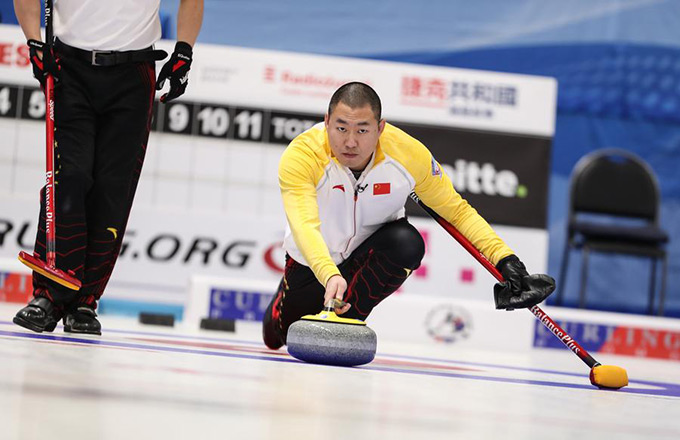 China beats Germany 7-4 in men's curling Olympic qualification
 Bayern beat Paris Saint-Germain 3-1 in UEFA Champions League


Copyright 1995 - . All rights reserved. The content (including but not limited to text, photo, multimedia information, etc) published in this site belongs to China Daily Information Co (CDIC). Without written authorization from CDIC, such content shall not be republished or used in any form. Note: Browsers with 1024*768 or higher resolution are suggested for this site.
License for publishing multimedia online 0108263 Registration Number: 20100000002731