Comments
  Print
Print  Mail
Mail  Large Medium Small
|
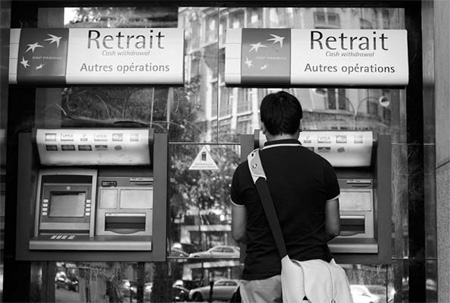
A customer uses a BNP Paribas ATM at one of the bank's branches in Paris. The bank is among at least 353 European lenders that have increased in size since 2007. Bloomberg News |
LONDON: European banks are emerging from the credit crisis bigger than before, posing more risk to their national economies.
BNP Paribas SA, Barclays Plc and Banco Santander SA are among at least 353 European lenders that have increased in size since the beginning of 2007, according to data compiled by Bloomberg. Fifteen European banks now have assets larger than their home economies, compared with 10 lenders three years ago.
While the European Union has grabbed headlines for breaking up bailed-out banks, regulators haven't reined in firms that shunned state aid and are too big to fail. European bank assets have grown 25 percent since the start of 2007, compared with a 20 percent increase at US lenders, Bloomberg data show.
"We are sowing the seeds for the next crisis," said David Lascelles, senior fellow at the London-based Centre for the Study of Financial Innovation, a research group. "What we have been doing in the last two years is making banks much bigger. It really goes against the currents of the time."
Banks expanded their balance sheets during the credit bubble, borrowing cheap money in the wholesale market to fund loans and investments. Royal Bank of Scotland Group Plc's assets ballooned 2,914 percent in the 10 years through 2008 as it made acquisitions, boosted trading and increased lending. Edinburgh-based RBS spent $140 billion on takeovers during the period, culminating in the purchase of ABN Amro Holding NV in 2007 that triggered the world's biggest bank bailout.
BNP Paribas
Paris-based BNP Paribas, the world's biggest bank by assets, increased its balance sheet by 59 percent to 2.29 trillion euros ($3.5 trillion) since the beginning of 2007, an amount equal to 117 percent of France's gross domestic product. Assets at London-based Barclays jumped 55 percent to 1.55 trillion pounds ($2.6 trillion), or 108 percent of UK GDP. Santander's rose 30 percent to 1.08 trillion euros, about the size of Spain's GDP.
RBS has pledged to reduce its balance sheet by 40 percent over the next five years, and the European Commission, the executive arm of the EU, has ordered banks including Commerzbank AG, ING Groep NV and Lloyds Banking Group Plc, to sell assets as a condition of approving state aid.
The EU doesn't have authority over banks that weren't bailed out, many of which continued to expand as European economies contracted. Banks such as BNP Paribas and Santander have taken advantage of their rivals' woes to make acquisitions. Thirty-eight of Europe's 100 biggest financial institutions have more assets now than they did at the beginning of the year, according to Bloomberg data.
Exposing weakness
Deutsche Bank AG, Banco Bilbao Vizcaya Argentaria SA and UniCredit SpA, all of which expanded over the past three years, have below average risk-adjusted capital ratios, a measure of their ability to withstand losses, according to a Nov 23 report by Standard & Poor's.
More weak banks may be exposed as the European Central Bank withdraws cheap loans that propped up the financial industry last year. Commerzbank, based in Frankfurt, and Dexia SA fell as much as 4.4 percent on Nov 20 after central bank President Jean-Claude Trichet explained the need to slow the flow of cash.
The credit crisis shows that large institutions pose too great a risk to their home countries, especially in Europe's relatively small economies, said Tom Kirchmaier, a fellow at the London School of Economics, who lectures on finance and corporate governance.
"Breaking up banks that are too big to fail has, in my view, a lot of merit," Kirchmaier said. "If we were to have another systemic shock and one or more of these very large banks would fail, I have serious concerns whether some of the smaller countries would be in a position to absorb the losses for a second time."
Britain, with an economy one-fifth the size of the US, faces widening budget deficits, rising unemployment and increased taxes after four bank bailouts, including the 45.5 billion-pound rescue of RBS.
The damage was even greater in Iceland, which had to seek emergency assistance from the International Monetary Fund after the country's banking system collapsed. The island is now struggling to recover from the deepest recession among the world's advanced economies, according to the IMF, after the stock market plunged 98 percent.
European governments overall have provided $5.3 trillion of aid to banks in the past two years.
Bailed-out banks are the nine worst performers in the 64- member Bloomberg European Banks Index since Lehman Brothers Holdings Inc filed for bankruptcy on Sept 15, 2008. RBS plunged 85 percent for the biggest decline. Lloyds dropped 63 percent, Commerzbank 58 percent and Dexia 43 percent, compared with the 18 percent decline in the index.
The increasing complexity of banks makes it difficult for regulators and governments to monitor risks, even at firms that appear transparent and stable, said Johannes Wassenberg, managing director of European banking at Moody's Investors Services in London.
"UBS was understood to have very good management, but that failed dramatically," Wassenberg said. "The market is placing an enormous amount of faith in banks to regulate themselves, and it is hard to know whether they're doing it properly. From that perspective, smaller banks are a safer bet."
Zurich-based UBS AG has reported 57.5 billion Swiss francs ($57.8 billion) of losses and writedowns since the credit crisis began, the most in Europe, and received a 6 billion franc bailout from the Swiss government. The bank has reduced its assets by 37 percent since the start of 2007.
Bloomberg News
(China Daily 12/05/2009 page11)
 Night views of Harbin through the lens
 Tibetans take train home after pilgrimage or travelling
 World's largest shaftless Ferris wheel built in China
 Ancient cities to be connected by Xi'an-Chengdu high-speed railway
 Snow turns Harbin into winter wonderland
 Reed Catkin Festival held in Wuhan
 Is it a building or a bookshelf?
 First flight
 Polar icebreaker Snow Dragon arrives in Antarctic
 Xi's vision on shared future for humanity
 UN's top environmental honors go to three in China
 German trains collide near Duesseldorf, several people injured
 China beats Germany 7-4 in men's curling Olympic qualification
 Bayern beat Paris Saint-Germain 3-1 in UEFA Champions League


Copyright 1995 - . All rights reserved. The content (including but not limited to text, photo, multimedia information, etc) published in this site belongs to China Daily Information Co (CDIC). Without written authorization from CDIC, such content shall not be republished or used in any form. Note: Browsers with 1024*768 or higher resolution are suggested for this site.
License for publishing multimedia online 0108263 Registration Number: 20100000002731