Comments
  Print
Print  Mail
Mail  Large Medium Small
|
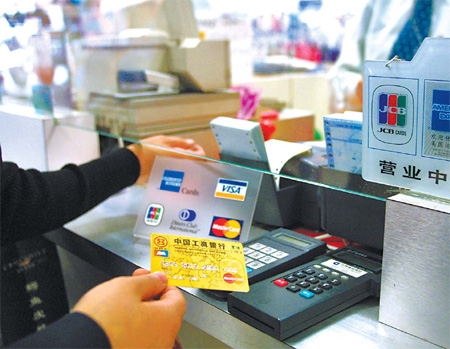
A customer uses an Industrial and Commercial Bank of China credit card at a store in Beijing. Despite slow development of credit cards in China, many shops in major cities issue their own shopping cards as pre-paid cards that consumers inject with funds for convenient payment. The shops said they could make substantial profits from the cards. Bloomberg News |
A thin piece of plastic is reshaping China's consumer spending habits.
The pre-paid consumer smartcard industry, after being outlawed several times by China's financial regulators in the past, now has swept across the nation with billions of dollars in sales each year.
Visit an average store in Shanghai and you will find one or several card logos glued on cashiers' counters. They are shopping cards, which only look like credit cards, that consumers can use to buy anything in the store.
The local media estimated that almost every Shanghai resident holds at least one shopping card, which can be used in department stores, convenience stores, restaurants, gas stations and even hair salons.
The shops themselves issue some of the cards as pre-paid cards consumers inject with funds for convenient payment.
Others are issued by a third party that partners with the shops, with the card issuer earning commissions by selling cards.
The reason so many shops join the smartcard club is that they can make substantial profits.
For example, when clients buy these pre-paid debit cards, there typically will be a substantial amount of cash left over in the cards due to expiration or physical damage to the card.
In June, Shanghai-based National Business Daily reported that the shopping cards generate a huge profit chain.
A large-scale supermarket, for example, issues 1 billion yuan worth of shopping cards every year, and on average there will be 500 million yuan unused. Putting this amount of cash into a bank will earn about 6 percent to 8 percent interest for the issuers.
In addition, there is about 5 percent cash unused in the cards because of damage or expiration dates.
In other words, a card issuer can reap as much as 10 percent in net profits from selling these cards.
It's not just shoppers buying the cards. According to the head of a finance department at a State-owned company in Shanghai, the company each year will spend about 3 million yuan using these cards for different purposes: to acknowledge thanks to customers, to give out as gift cards and to hand to employees as benefits.
In China, sending gifts to friends and acquaintances is an old tradition.
"As people's living standard has greatly improved, it looks better to give a shopping card than a box of moon cakes during the Mid-Autumn Festival," said Sun Lijian, deputy dean of the School of Economics at Fudan University.
"Actually, shopping cards are not rare in Western countries. Some shopping malls and supermarkets, like Wal-Mart, issue shopping cards to strengthen customer loyalty. These cards can only be used in specific or issuer shops, but the card holder will also enjoy some kind of discount or extra benefit," Sun said.
However, the widespread use of shopping cards can create disadvantages, too, such as seeming like bribes, Sun said.
"Shopping cards have money in them, and someone gives it as a present to the department heads or leaders for a promotion or other favorable decision. As the cards are not real money, such a present seems far from a bribe," Sun said.
Shopping cards also can be a way of evading taxes. Some State-owned companies send cards to their employees as a kind of bonus. Such bonuses will not be included into traditional tax calculations.
Once illegal
Pre-paid consumer smartcards were once illegal in China. As early as December 1998, the State Council issued an urgent notice to forbid the print, sale, purchase and use of all kinds of shopping cards.
In January 2001, the Central Government made another announcement to ban all kinds of shopping cards or vouchers.
The revival of shopping cards dates back to early 2003, when the SARS epidemic broke out and spread widely. Sources with knowledge of the matter said regulators didn't ban the reuse of the cards, because the consumer market had been battered hard under SARS hit. After that, the shopping cards again became popular.
Growing demand
Huge demand for shopping cards has also helped generate a new vocation: card broker.
Card brokers do business in shopping malls, supermarkets and other places, buying and selling shopping cards.
A senior card broker told China Business Weekly that card brokers usually make a 3 percent profit by buying and selling consumer cards.
"We only trade cards whose face value is above 1,000 yuan, and we can trade up to 500,000 yuan worth of cards each month," said the broker.
In other word, they can make as much as 15,000 yuan per month by trading cards.
The lack of supervision is leading to some demands for more regulation.
"There should be a regulatory body to monitor how the money deposited into the cards is spent and to protect the legal interests of consumers," said Sun of Fudan University.
The sudden bankruptcy of Shanghai Maya Group four years ago left many "Wansheng Card" holders with cards that were suddenly worthless.
The Maya Group had tried to build China's largest convenient store brand after acquiring the Maya 21 Century convenient store chain. But the supply chain crisis finally forced as many as 500 chain stores to shut down at the beginning of 2005. Cardholders had no luck asking for refunds.
Sun said the government should include the pre-paid consumer cards in the financial regulatory system under the China Banking Regulatory Committee.
"To better protect consumers' rights, the card issuers should meet some basic requirements, including registered capital, a limit on the face value of single cards and where the cards can be used," he said.
"To better manage the deposits in the cards, the card issuers would do better by choosing a bank to manage the capital," Sun added.


(China Daily 12/05/2009 page12)

 Night views of Harbin through the lens
 Tibetans take train home after pilgrimage or travelling
 World's largest shaftless Ferris wheel built in China
 Ancient cities to be connected by Xi'an-Chengdu high-speed railway
 Snow turns Harbin into winter wonderland
 Reed Catkin Festival held in Wuhan
 Is it a building or a bookshelf?
 First flight
 Polar icebreaker Snow Dragon arrives in Antarctic
 Xi's vision on shared future for humanity
 UN's top environmental honors go to three in China
 German trains collide near Duesseldorf, several people injured
 China beats Germany 7-4 in men's curling Olympic qualification
 Bayern beat Paris Saint-Germain 3-1 in UEFA Champions League


Copyright 1995 - . All rights reserved. The content (including but not limited to text, photo, multimedia information, etc) published in this site belongs to China Daily Information Co (CDIC). Without written authorization from CDIC, such content shall not be republished or used in any form. Note: Browsers with 1024*768 or higher resolution are suggested for this site.
License for publishing multimedia online 0108263 Registration Number: 20100000002731