Comments
  Print
Print  Mail
Mail  Large Medium Small
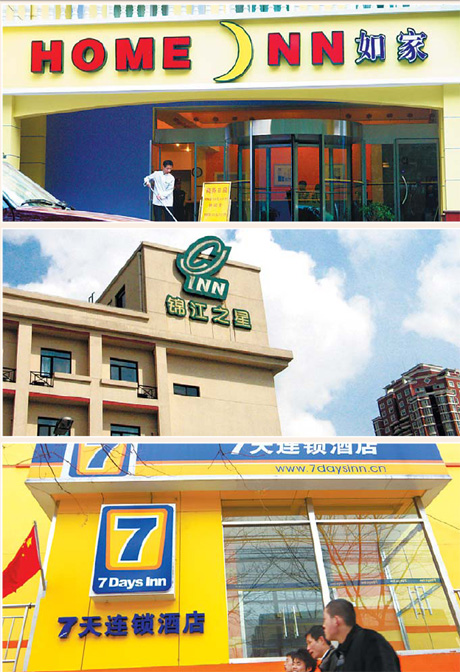
Sector takes custom from more upmarket rivals hit by recession
Exercising a public flotation in the United States is the latest trend in China's budget hotel industry.
Spurred up by the domestic consumption stimulus program launched by the Chinese government and a commitment to boost the tourism industry, China's budget hotel operators have never been hungrier than now for raising money to meet an aggressive expansion plan. And for them, the US stock market is a good choice.
In late November of 2009, Guangzhou-based 7 Days Inn, the third largest budget hotel group nationwide by network, successfully made its debut on the New York Stock Exchange, raising $111 million.
It was the second budget hotel group to list in the United States, following Shanghai-based Home Inn, which was listed in 2006 on the NASDAQ.
The listing by 7 Days Inn is just a beginning, and it is expected to spur a wave of initial public offerings (IPOs) in the US by the industry.
Hanting Inn, another leading budget hotel, is awaiting a listing at the NASDAQ, said industrial insiders. Early in 2008, high-level executives from Green Tree Inn said the company was mulling over an IPO, either on the New York Stock Exchange or the NASDAQ.
Right time for listing

"The time is ripe for Chinese budget hotels to go to the stock market. The earlier the better," said Alex Zheng, CEO of 7 Days Group.
The 7 Days Inn initiated its IPO preparation in late 2007 but the move was delayed by the global financial crisis. However, observers say this was a good thing for the company.
"We planned to list on the NASDAQ but now we are becoming strong enough to list on the main board after a year of expansion and improvement," said Zheng. The listing of 7 Days Inn is typical of moves within the sector.
"Many IPOs were grounded because of the global economic disaster. As the economic recovery for China is under way, the companies are naturally re-launching their IPO plans," said David Sun, chief executive officer of Home Inn.
In addition, their aggressive expansion plans are also forcing the budget hotels to grab as much money as they can.
Sun said Home Inn will have another 200 hotels under operation in 2010, from the current 600-odd properties. The chairman of Green Tree Inn said the portfolio of the brand will rise to 600 next year from 400 now.
Zheng, from 7 Days Inn, told China Business Weekly that the company expected to surpass Home Inn and lead the local budget hotel market within five years. "We expect to have 1,800 hotels nationwide then," he said.
The expansion means handsome investment. "A budget hotel on average requires the injection of 6 to 7 million yuan so an additional 100 hotels will cost us as much as 600 to 700 million yuan," said Sun.
After the global economic doldrums struck, "overseas venture capital or equities, which were active during the past few years in the budget hotel sector, became quiet and are still waiting for better times", Li Xinjian, a professor from the School of Tourism Management at Beijing International Studies University.
"An IPO is a quick way to get money for these leading brands."
Apart from the Shanghai-based Jinjiang Inn, which listed domestically on the Shanghai Stock Exchange, many budget hotels are planning to go for listings in the US. "Listing overseas consumes more time, energy and effort but, if successful, it is a signal of how qualified you are and helps raise funds in a faster and more efficient way," said Sun.
Zheng, from 7 Days Inn, agreed. "Listing in the US will benefit us more in the long term by improving corporate governance and management," he said.
The listings of Chinese budget hotels are also invigorating the US stock market. "We were surprised to be warmly welcomed by the investors there," said Zheng.
On the first trading day, shares of the 7 Days Inn grew by 13.64 percent to $12.5, and Home Inn, the first US-listed budget hotel operator, has witnessed a share rise of nearly 64 percent to $36.18 from the opening price in 2006 of $22.
"We are not concerned about the price. When the network of the 7 Days Inn becomes larger, the price is bound to pick up," said Zheng.
During the past few years, the local budget hotel sector has been a hot spot for overseas venture capital and investors. In 2003, Home Inn raised funds from IDG Capital Partners and Sycamore Ventures, which paved the way for its massive expansion. The 7 Days Inn has received three rounds of injections from a slew of big names including Warburg Pincus, Deutsche Bank and Merrill Lynch.
Expansion, ripe time

The first budget hotel appeared in 1997, with Jinjiang Inn launching in Shanghai. But the industry did not take off until 2003 when a slew of brands were established amid a spree of expansionism.
According to the China Budget Hotel Website, Chinese budget hotels have increased to 2,800 in 2009 from 23 back in 2000 and the room number has surged to 313,000, up from 3,236 nine years ago.
"The industry is maturing, and another wave of expansion is coming," said Sun.
While the high-end hotel sector was badly hurt by the economic recession and is expected to suffer for quite a time, budget hotels have hardly been affected.
"To be frank, we have felt little negative impact," said Zheng.
During the period from 2007 to 2009, the 7 Days Inn's occupancy rate remained at close to "90 percent". "The figure surprised the American investors, but it's true," said Zheng.
As the corporate financial report showed, during the third quarter, Home Inn's revenues grew by 37.9 percent from a year earlier to 727 million yuan, and the performance was "much higher than expectation".
The company also announced the occupancy rate on average reached 97 percent during the third quarter in 2009, 11 percentage higher compared with the previous year.
"The last quarter of 2008 and the first quarter of 2009 were a bit of hard, but everything has turned good since then," said Sun.
The growth momentum for budget hotels will be "sustained", given that business for the high-end hotels including the five- and four-star hotels is "expected to be sluggish for quite a period", said Li.
"Many travelers will be flowing into the budget hotels from the high-end, thanks to the shrinking corporate budget," he added.
During the central government's economic working conference held in early December, President Hu Jintao said the exports would continue to make grim reading because there were no signs that the developed nations and China's trading partners would recover quickly. He also emphasized that the government would make all efforts to stimulate domestic demand for stabilizing the economic growth.
Further, the State Council in December released guidelines on promoting the tourism industry, outlining measures to improve the infrastructure and relevant products and services, and also boost tourism-related spending.
According to estimates in the guidelines, by 2015, the number of domestic travelers will grow by 10 percent annually, and the number of inbound travelers will grow by 8 percent a year. Expenditure on tourism will account for 10 percent of Chinese people's outgoings.
"Expansion and development will be the key words for the budget hotel industry," said Sun.
Looking ahead, Sun said Home Inn will focus on the second- and third-tier cities around China. "We are confident about these areas. More and more Chinese in smaller cities will be able to afford to travel around, encouraged by the government's policy," he said.
The guidelines on tourism also pointed out the government additionally encourages qualified companies in the industry to grow bigger and stronger through mergers and acquisitions.
"There will be more deals in the coming years," predicted Li. "Chinese consumers will be more critical about the service and products as the industry improves. As the Chinese saying goes, 'The fittest will survive'."
(China Daily 12/28/2009 page1)

 Night views of Harbin through the lens
 Tibetans take train home after pilgrimage or travelling
 World's largest shaftless Ferris wheel built in China
 Ancient cities to be connected by Xi'an-Chengdu high-speed railway
 Snow turns Harbin into winter wonderland
 Reed Catkin Festival held in Wuhan
 Is it a building or a bookshelf?
 First flight
 Polar icebreaker Snow Dragon arrives in Antarctic
 Xi's vision on shared future for humanity
 UN's top environmental honors go to three in China
 German trains collide near Duesseldorf, several people injured
 China beats Germany 7-4 in men's curling Olympic qualification
 Bayern beat Paris Saint-Germain 3-1 in UEFA Champions League


Copyright 1995 - . All rights reserved. The content (including but not limited to text, photo, multimedia information, etc) published in this site belongs to China Daily Information Co (CDIC). Without written authorization from CDIC, such content shall not be republished or used in any form. Note: Browsers with 1024*768 or higher resolution are suggested for this site.
License for publishing multimedia online 0108263 Registration Number: 20100000002731