Peace and development are the two outstanding issues in the world today
March 4, 1985
Different people may have different attitudes towards the development of China. They analyse this question from different standpoints, depending on whether they think China's development will or will not be in their own interest. I should like to examine this question from two points of view, one political, the other economic.
From the political point of view, there is one thing that I can state clearly and positively, and that is that China seeks to preserve world peace and stability, not to destroy them. The stronger China grows, the better the chances are for preserving world peace. Some people used to regard China as a warlike country. In reply to that view, not only I but also other Chinese leaders, including the late Chairman Mao Zedong and Premier Zhou Enlai, have stated on many occasions that China desires peace more than anything else. In the days when Chairman Mao and Premier Zhou were leading the country, China was already strongly opposed to superpower hegemony, regarding it as the source of war, by which we meant not local war but potential world war. Only the two superpowers have the capacity to launch world war, while the other countries, such as China, Japan and the European countries, are not in a position to do so. It follows that opposing superpower hegemony means preserving world peace. Since the downfall of the Gang of Four, we too have made it a state policy to oppose superpower hegemony and keep world peace.
Generally speaking, the forces for world peace are growing, but the danger of war still exists. Not much progress has been made in the talks on control of nuclear arms and of weapons in outer space. That's why for many years we emphasized the danger of war. Recently, however, there have been some changes in our views. We now think that although there is still the danger of war, the forces that can deter it are growing, and we find that encouraging. The Japanese people do not want war, nor do the people of Europe. The Third World countries, including China, hope for national development, and war will bring them nothing good. The growing strength of the Third World -- and of the most populous country, China, in particular -- is an important factor for world peace. So from the political point of view, a stronger China will help promote peace and stability in the Asia- Pacific region and in the rest of the world as well.
Some people are talking about the international situation in terms of a big triangle. Frankly, the China angle is not strong enough. China is both a major country and a minor one. When we say it is a major country, we mean it has a huge population and a vast territory, although it has more mountains than arable land. But at the same time, China is a minor country, an underdeveloped or developing country. It is a minor one in terms of its ability to safeguard peace and deter war. When China is fully developed, that ability will be greatly enhanced. I can say with certainty that, as I once told Mr. Masayoshi Ohira, by the end of the century China will have quadrupled its gross national product and reached a level of comparative prosperity. When that time comes, China will surely play a bigger role in maintaining world peace and stability.
From the economic point of view, the two really great issues confronting the world today, issues of global strategic significance, are: first, peace, and second, economic development. The first involves East-West relations, while the second involves North-South relations. In short, countries in the East, West, North and South are all involved, but the North-South relations are the key question. What problems will the developed countries, such as Japan and the countries in Europe and North America, be faced with in their continued development? You will have to seek outlets for your capital and expand your trade and markets. Unless these problems are solved, the growth of the developed countries can only be very limited in the long run. I have discussed this question with many Japanese friends and also with friends from Europe and the United States. They have been preoccupied with it too. There are more than 4 billion people in the world today, about three quarters of whom live in the Third World. The other quarter -- about 1.1 or 1.2 billion -- live in the developed countries, including the Soviet Union, countries in Eastern Europe (which cannot be regarded as fully developed), in Western Europe and in North America, and Japan, Australia and New Zealand. It is not likely that these developed nations, with a combined population of only 1.1 or 1.2 billion, can continue to grow while the developing countries, with a combined population of more than 3 billion, remain in poverty. Of course, some Third World countries are becoming more prosperous, but they cannot yet be considered developed. And many others are still extremely poor. Unless their economic problems are solved, it will be hard for all the Third World countries to develop and for the developed countries to advance further.
The total volume of foreign trade of even so large a country as China was only US$50 billion last year. If China could double that figure, making it $100 billion, the world market would be expanded, wouldn't it? If China could quadruple that figure, making it $200 billion, it would have even more exchanges with other countries. Foreign trade involves both import and export. With a quadrupled volume of foreign trade China would be able to absorb more foreign capital and products. Some developed countries are worried that if China were fully developed and expanded its exports, that would adversely affect their own exports. I agree that it would create competition. But with all their advanced technology and first-rate products, what do the developed countries have to fear? In short, if the countries in the South are not duly developed, the countries in the North will find only very limited outlets for their capital and products; indeed, if the South remains poor, the North will find no outlets at all.
So, I think the decision of Japanese entrepreneurs to take a positive attitude towards economic and technological cooperation with China is of strategic importance.
(Excerpt from a talk with a delegation from the Japanese Chamber of Commerce and Industry.)
(From Selected Works of Deng Xiaoping, Volume III <1982-1992>)



- China issues guidelines to develop 'all-for-one' tourism demonstration zones
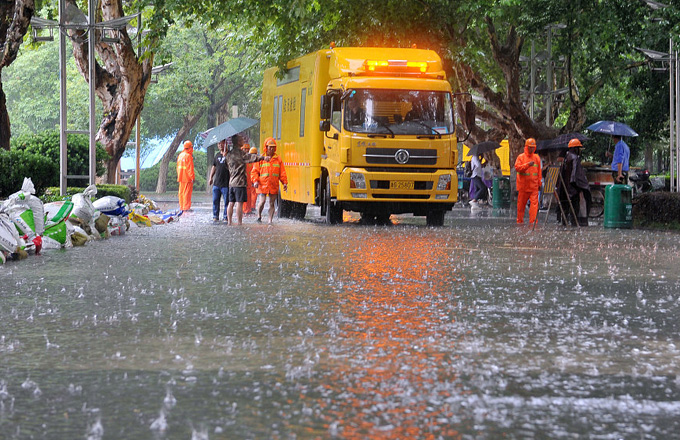
- Torrential rain triggers disaster in Southwest China
- Harvest time for wheat reapers in Shanxi
- Over 200 couples marry in Changchun group wedding
- Calligraphy tops other icons of Chinese culture, WeChat data shows