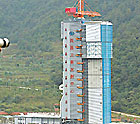
On Nov. 20, 1999, China's first experimental spacecraft "Shenzhou" blasted off from the Jiuquan Satellite Launch Center in Gansu Province, northwestern China, atop a "Long March" II F carrier rocket.
Its re-entry capsule touched down in central Inner Mongolia Autonomous Region the next day after a 21-hour voyage.
Chinese engineers for the first time assembled and tested the rocket and spaceship in its upright position. They also used a newly-established network, covering land and sea, to control and monitor the spacecraft.
On Jan. 10, 2001, China launched, also in Jiuquan, the second unmanned spaceship, "Shenzhou II," which was basically identical to a manned craft.
It landed in central Inner Mongolia on Jan. 16 as scheduled after orbiting Earth 108 times during a seven-day flight.
During the mission, experiments were conducted aboard the craft concerning life sciences, space materials, astronomy and physics under conditions of microgravity in outer space. All the test meters and instruments worked steadily and normally, with a lot of data obtained. The system architecture of the spaceship was expanded and improvement was made in its technical performance, compared with its predecessor.
On March 25, 2002, China's third unmanned craft, "Shenzhou III, " blasted into space from the same launch site, carrying out the functions of a manned craft.
Metabolic simulation equipment, human physical monitoring sensors and dummy astronauts were installed aboard the spaceship.
The orbital module of the craft remained aloft for about 180 days in outer space, circling Earth 2,821 times, with a number of space science experiments successfully conducted.
On Dec. 30, 2002, a "Long March II F" carrier rocket carried the fourth unmanned spacecraft, "Shenzhou IV," into orbit. The craft landed in central Inner Mongolia on Jan. 5 after the completion of a series of tests in space science and technology.
"Shenzhou IV" was identical to manned spaceships except there were no men aboard.
All the systems for manned space flight, including an astronaut system and life-support sub-system, were fitted on the spaceship and tested.
Chinese would-be astronauts entered the spaceship for the first time prior to the launch for training.
A number of research projects were conducted in the spaceship during the flight, involving earth observation, material science, life science and space astronomy.
The four test flights were part of China's manned space program, which began in 1992.