US, China agree to tackle global imbalances
(Reuters)Updated: 2006-12-15 15:26
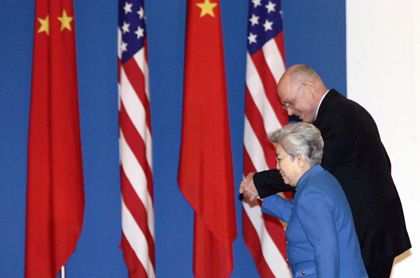 US Treasury Secretary Henry Paulson (R) and China's Vice-Premier Wu Yi hold hands as they arrive for a joint news conference at the Great Hall of People in Beijing December 15, 2006. [Reuters]  |
China and the United States agreed on Friday that Beijing will pursue currency flexibility, while Washington will aim to increase national savings as part of joint efforts to reduce global economic imbalances.
Wrapping up two days of high-level talks with Chinese leaders in Beijing that were part of an inaugural strategic economic dialogue, US Treasury Secretary Henry Paulson said his discussions had been "very frank and productive."


"We will each take measures to address global imbalances, notably through greater national savings in the United States and through increased domestic consumption and exchange rate flexibility in China, and maintaining open investment in both countries," he added.
Chinese Vice-Premier Wu Yi said the talks had been very successful and would help to boost bilateral trade and economic relations.
She said the two sides had not seen eye to eye on every issue, but that was understandable given the economic differences between China and America.
The two governments also pledged to explore how to boost bilateral investment and to ease travel restrictions.
They will also form working groups to discuss how to boost services trade and improve health care. The groups will report to the second session of the dialogue in Washington next May.
The agreements come as US lawmakers stepped up pressure for China to boost the value of its currency, expressing impatience at the idea of waiting for China to let the yuan's exchange rate float in the long term.
"We cannot continue to wait for this longer-term goal and suffer the consequences of insignificant short-term action," Sen. Christopher Dodd, the Connecticut Democrat who will take over as chairman of the Senate Banking Committee in the new year, and Alabama Sen. Richard Shelby, the panel's outgoing Republican chairman, said in a statement.
They said experts estimate that the yuan, also called the renminbi, was undervalued by as much as 15 percent to 40 percent, costing American job losses by making Chinese-made goods unfairly cheap in America's consumer markets.
NO PUNCHING BAG
But China is not ready to be a punching bag.
A day after Wu questioned Americans' "limited knowledge" of China's efforts to give market forces greater sway over the economy, the People's Daily, the official paper of the ruling Communist Party, said the United States had China to thank for a long period of low inflation.
"Without trade with China, since the 1990s the United States would never have experienced a long-term absence of inflationary growth unprecedented in its history," a commentary in the paper's overseas edition said.
Later on Friday, Federal Reserve Chairman Ben Bernanke will speak to a top think-tank, where he is expected to argue that China risks losing control of its own monetary policy unless it moves toward a freer-floating currency.
China freed the yuan from a dollar peg in July 2005, and on Friday the central bank set the currency's mid-point at a new post-reform high, 7.8185 per dollar, for the second day in a row.
A senior US Treasury official said one of the overarching themes of the discussions was how China can sustain balanced growth and how it can integrate into the global economy.
"Greater exchange rate flexibility is a critical part of that. They understand that, and we understand that. The issue is just how quickly they get to where they need to be," said the official, who declined to be identified.
Paulson and the rest of the US delegation hold a concluding news conference late on Friday before heading back to Washington.
|
||
|
||
|
|