House prices 'harm building of harmony'
By Zhao Huanxin (China Daily)Updated: 2007-01-30 07:31
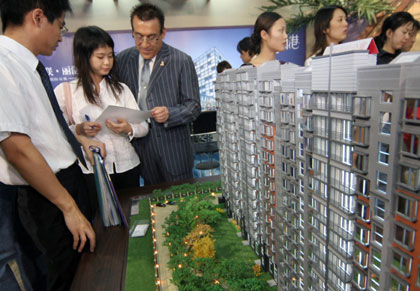 Would-be buyers visit a model of a new housing project in Beijing in this undated file photo. [newsphoto]  |
As the political hub of a country that promotes the strategy of "building a harmonious society", Beijing is among the top Chinese cities with the highest housing rates, a phenomenon which researchers yesterday said harmed harmony.

Prices of commercial houses in Beijing jumped by 16.4 per cent in the third quarter of 2006 year-on- year, compared with 13.7 percent income growth for local residents in the same period.
"The exorbitantly high prices have by far exceeded the purchasing power of most residents and prejudiced their interests," Dai Jianzhong, a researcher with the Beijing Academy of Social Sciences, said yesterday.
In 2005, an average Beijing family would have to use all its income for 11 straight years to pay for a house that could ensure the per capita housing area meet the city's average of nearly 26 square meters, according to Dai, editor-in-chief of the 2007 Social Development Report of China's Capital.
"The housing issue is causing social panic and runs against the efforts of building a harmonious society," he said following the release of the annual report yesterday in Beijing.
The "crazy" price hike has occurred against a backdrop of measures that the central government put into place to cap housing prices over the past two years, and even in Shanghai, whose residents' income is higher than Beijing's, housing prices have begun to plummet, Dai said.
Compared with 2005, the transaction price of land for residential construction in Beijing in fact dropped by 12 percent last year, when there was no marked price rise in building materials, meaning real estate developers were "profiteering", Dai said.
"If the current government policies fail to meet their goal, there will come more stringent regulations, which, instead of curbing the margin of increase as hoped by realty developers, would trigger a drop in housing prices," Dai predicated in his report.
Dai said the government's regulations on the real estate market, enaced two years ago, conforms to the will and interests of the public, but no substantial changes have taken place since then, resulting in a kind of "wrestling match" between property developers, the government and consumers.
The public has pinned their hopes on the central authorities to resolve the housing issue, which is one of their top concerns, he said.
Addressing the most pertinent concerns of the public has been listed as one of the goals of building a harmonious society in China, which also aims to enable all the people to share its social wealth, and forge an ever closer relationship between the people and government.
"I believe there will be an outcome in this wrestling match before the 17th national congress of the Communist Party of China (scheduled for the second half of this year), and Beijing will be the first to react to the outcome," Dai said.
By yesterday, half of online voters participating in a survey on the www.focus.cn, a popular housing information portal, said they believed housing prices would rise this year, compared with nearly 70 percent of voters who thought so three weeks ago.
The housing issue was also a key concern of the Beijing municipal political advisers and law makers during their annual sessions last week and this week.
Liu Yaowei, who was attending the Fifth Session of the 10th Beijing Municipal People's Political Consultative Conference, which concluded yesterday, proposed the government build more cheap houses to be rented by the low income segment.
"If people would not rush to buy new homes, the supply and demand will be balanced, and ultimately the price will be stabilized," he said.
Strikingly, Dai's report listed rental fees as the largest source of investment income for Beijingers last year.
Dai did not specify how much the rentals contributed to the city's per capita urban income of 16,677 yuan ($2,138), earned between January and October last year.
In addition to housing, income disparity is a thorny problem in the capital city of China, according to the report.
The per capita disposable income of the city's low-earners, which accounted for 20 percent of the city's population, was 8,150 yuan ($1,045) last year through October, an increase of 14.9 percent from a year earlier; while that of the high-earning bracket was 30,964 yuan ($3,970), or more than three times as much.
At least half of 92 Beijing government officials, surveyed by the Beijing Municipal Academy of Social Sciences in November, said they believed the problem of the income gap in Beijing had further worsened last year.
Nearly 62 percent of the local officials said they thought the current disparity was not reasonable, according to Gao Yong, another researcher with the social sciences academy.
"The income gap problem has emerged prominently in each of our recent surveys," Gao said. "This is a problem that must be tackled in the city's social development."
An equally pressing problem that will affect the "harmony" in Beijing is about jobs for college graduates and schooling for children of migrant workers.
Beijing had 678,000 college and university students at the end of 2005, at least 70 per cent of them said they hoped to work and live in Beijing after graduation, the Municipal Bureau of Statistics found in a survey last year.
"It is hardly possible for Beijing to create so many jobs for them," Dai said, adding that if they stay in the capital, a large portion of them will join the jobless ranks.
Beijing's registered unemployment rate was 2.11 percent last year, but experts believed the actual jobless rate was far higher, and at least one-third of the jobless were aged below 35, according to Dai.
"The unemployment issue would be further complicated if youngsters with higher education couldn't be employed," Gao said. "This will further add uncertainties to the social harmony and stability."
College and university students aside, Beijing had a 3.6 million migrant population at the end of 2005, or nearly one-fourth of the city's total.
They brought with them 400,000 school-aged children. The figure represented more than one-fourth of the city's total number of elementary and high school students, according to Dai's report.
About 100,000 of the children are attending schools not approved by the government, Dai said.
"The municipal government must guarantee that the children of the migrant workers can get better compulsory education in Beijing, as this is the right of the migrant workers who have contributed so much to (the development of) the capital," Dai said.
Doing a good job in education will lend solid support to the development of the underdeveloped regions, from which the migrant workers come from, he said.
|
||
|
||
|
|