Chinese unfazed as share markets tremble
(AP)Updated: 2007-03-05 16:21
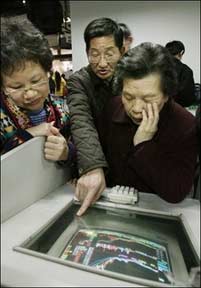 Chinese investors watch stock prices on a computer monitor at a securities firm in Shanghai. [AFP]  |
On a good day, the room buzzes with animated chatter.
There are plenty of ups and downs these days, and more likely to come.
"The Chinese market is now in a correction, so it's normal that prices would be fluctuating now," says Zhang Meizhen, a retired railways bureau worker and veteran stock investor who is nonetheless wary after losing 90 percent of her investment in a crash five years ago.
"My strategy is to avoid risk by not putting much money in the market right now," she says.
It's been a turbulent -- and historic -- week for China's fledging stock market.
With a market capitalization of $1.4 trillion -- a third of the size of the Tokyo Stock Exchange, Asia's biggest -- the Shanghai market rocked global financial markets for the first time in its 15-year existence when it plunged nearly 9 percent on Tuesday.
The drop triggered a chain reaction, sending Wall Street to its worst one-day point loss since the Sept. 11, 2001, terror attacks, and sparking selloffs in European and other Asian markets as well.


Chinese stocks rebounded nearly 4 percent Wednesday before falling back 3 percent again Thursday. On Friday, the Shanghai Composite Index ended 1.2 percent higher to close out the week at 2,831.53, still 5.8 percent higher than it started the year.
"If we viewed Tuesday's drop as a big earthquake, the rest of this week should be something like the aftershocks," said Zhu Haibin, an analyst at Everbright Securities.
Analysts say the sharp drop in Chinese shares provided a perfect trigger for a worldwide correction in stock prices that had climbed too far, too fast. That was particularly true in the Asia-Pacific region, where markets from China to Australia have been on a gravity-defying run over the last several months.
Shanghai's market, for instance, had soared 130 percent last year after being in the doldrums for years, and had surged 13.6 percent since the start of the year through Monday, when it hit a record.
"For four months, it was a one-way ride up. There's been a lot of speculation in the market," says Andy Xie, an independent economist. "This market is driven by sentiment."
Despite its unusually strong impact, the jolt doesn't reflect any big changes in global trading trends -- or a sudden shift in China's economic outlook.
While the global selloff brought to the fore concerns about a slowdown in the US economy, most experts predict China's growth will continue at a 10 percent clip.
The Chinese stock market serves largely as a way to raise money for state-owned companies like Baoshan Iron & Steel Co. and China Life Insurance, rather than the vibrant private sector. As such, it is a poor economic indicator. Stocks' prices often have little to do with corporate fundamentals, analysts say.
Also, mainland markets remain mostly closed to most foreign investors, apart from qualified foreign institutional investors whose holdings are thought to account for only a few percent of total capitalization.
Analysts say the latest correction was inevitable and likely welcomed by regulators as a way of preventing share prices from soaring into a speculative "bubble." If so, there's likely more volatility in store.
"The market could well go down, though I think we're unlikely to see a massive fall from here," Jonathan Anderson, an economist for UBS Securities Asia.
Meanwhile, local investors seem unfazed.
The China Securities Depository and Clearing Corp., the agency responsible for registering stock accounts, reported 188,876 new accounts opened on Tuesday alone.
It is that fever for investment opportunity, in the absence of any other good options, that brought new retail investors into the market at a rate of about 90,000 a day late last year.
The run-up in stocks last year results at least partly from authorities' efforts to cap speculation in the property market. As the government tightened controls and boosted taxes on real estate, investors shifted back into the stock market, expecting that at the very least they'd earn more than bank accounts paying 0.7 percent in interest.
The challenge is how to keep speculation under control, while avoiding a panic, says Anderson.
"The government has no incentive to push up aggressively, or for that matter to push down aggressively," he says. "It's very difficult to cap the downside."
This week's turmoil was a reminder for China's inexperienced retail investors that stock investments involve risk, the state-run China Securities Journal said in a commentary mocking the "The Gramps and Grannies of the Bull Market" who it said were depositing money expecting stock accounts to pay interest.
Even China's top leaders chimed in: "The foundation for the stable operation of the stock market is still not firm," China's premier, Wen Jiabao, said in an article on financial reforms published Thursday in journal, Seeking Truth. "There are still many problems that must be resolved."
China's stock exchanges in Shanghai and the southern city of Shenzhen, set up in the early 1990s mainly as fundraising vehicles for state companies, lack many of the products and safeguards of older markets in the West.
After making some speculators rich in the mid-1990s, stocks plunged in 1997 as corporate profits weakened and officials warned that markets were overvalued. Prices rose again, defying the dot-com bust of 2000, but plunged a year later amid complaints of insider trading and other abuses.
Reforms begun in 2005 shifted huge tranches of government-held, nontradable shares into the market. Those shares were subject to lockup periods, alleviating uncertainties over a possible flood of new shares into the market.
Since then, a parade of top-notch state banks, insurers and other blue chips -- many with shares already traded overseas -- have staged initial public offerings, luring tens of billions of dollars in new investment.
State-backed institutional investors dominate trading, with a handful of big name state companies like Industrial & Commercial Bank of China, China's biggest lender, accounting for a large share of total market capitalization.
Some see that government involvement as a reassurance of support. Others disagree.
"The big institutions are always the winners. It's the retail investors who lose their shirts," said Zhang Longxiang, a young man in his twenties standing outside a bustling downtown brokerage handing out flyers for a company that sells trading software.
Inside, the brokerage has the air of a community center cum casino. Smoke wafts in from the men puffing away as they watch the boards from the open doorway. Ladies in sweat pants and sneakers chatter and trade tips, while elderly men peer at the boards, some taking careful notes.
"Most people don't really know what they're doing," Zhang said. "I only buy stocks a few times a year. I'm not about to buy now."
| ||
|
||
|
||
|
|