Cultural exchanges 'can improve understanding'
By Li Xing (China Daily)Updated: 2007-03-27 06:53
Steady cultural exchanges, such as those during the "Year of China" in Russia this year, will help the two neighbors understand each other better and become "good friends".
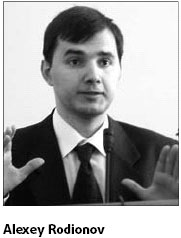
That's what Alexey Rodionov, a promising young Russian scholar on Chinese language and literature, said in an online interview with China Daily.
The St Petersburg State University's Confucius Institute deputy director, whose love of Chinese literature and culture is exemplary, said a three-volume collection of contemporary Chinese writers' works would hit the shelves in Russia in late summer.
 "The collection will be a breakthrough and allow Russians to read the works
of writers other than Zhuang Zi or Li Bai."
"The collection will be a breakthrough and allow Russians to read the works
of writers other than Zhuang Zi or Li Bai."
Such is his understanding of Chinese and his own culture and so vast is his knowledge of literature and communication that he sounds prophetic when he says: "Cultural communication can work as a thermos to maintain the warmth in a relationship and pass it down from one generation to another."
Rodionov attaches high value to continuous cultural dialogue, and considers literature to be an important tool for cultural communication.
"Our world may be more harmonious and peaceful if Russia and other Western countries pay more attention to China and understand more about the Doctrine of Mean and other teachings of Confucius," he said.
He still remembers the time when people-to-people exchanges between Russia and China were disrupted. But for him China has always been close to home because he grew up in Blagoveschensk, with Heihe in Northeast China's Heilongjiang Province just across the Heilongjiang River.
But despite that, "China was also as far as the moon", Rodionov said, because of Russians' baseless fear of their neighbors. He recalls huge posters saying: "Beware, comrades, the border to the country dominated by Mao Zedong Thought is only 1 km away."
He, however, chose his path with conviction, for he wanted a lifelong association with China.
Before 1986, he said, only three or four Chinese were living in his home city. But by the late 1980s, the Chinese had become a part of the local life, encouraging him further to major in Chinese in college.
"The competition (for Chinese language studies) was fierce at the time and it has continued to be the same," he said.
In a year, he discovered that China had more to offer than down jackets, vegetables and chopsticks.
And among the other attractions, Rodionov was drawn to
China's rich literary heritage, especially the Four Classic Books (The Great
Learning, The Doctrine of the Mean, The Analects of Confucius, Mencius), the
Five Classics of Chinese Writing (The Book of Songs, The Book of History, The
Book of Changes, The Book of Rites, The Spring and Autumn Annals) and the Poems
of the Tang (AD 618-907) and Song (960-1279) dynasties. He was drawn, too, to
the great men of letters of the last century, such as Lao She (1899-1966) and
Cao Yu (1910-1996). 
He delved into modern Chinese literature and spent a lot of time studying the life and works of Lao She. "I realized that I must learn about Chinese culture before I could understand and evaluate the behavior of the Chinese and their thoughts," he said.
He also realized that, "although the Russians are psychologically closer to the Chinese than other Westerners, they still weigh China on European cultural standards' scales which may lead to misunderstanding".
Rodionov conceded that the Chinese know much more about Russia than vice versa. "In the 20th century, China was the country that did the most to introduce foreign cultures into its own, and Russian culture was a favorite with Chinese intellectuals, especially in the 1920s-30s and 1950s-60s."
He acknowledged that there was mistrust between the two peoples, especially those doing business across the border. But again, these people lacked cultural education and were unable to understand and accept the other's customs.
"The Chinese working and studying in St Petersburg or Moscow are much more respected," he said.
What do the Chinese think about the Russians? The Chinese he has worked and talked with are very friendly, he said, although he knows many Chinese are not happy with the way they are treated in Russia.
"But I believe Chinese friends will become increasingly satisfied with their studies, life and work in Russia," he said.
"The way to do away with mistrust and overcome injustice is speak out and open the topics for discussion," Rodionov said.
(China Daily 03/27/2007 page2)
|
||
|
||
|
|