Stocks fall as GDP growth, inflation accelerates
By Dong Zhixin (chinadaily.com.cn)Updated: 2007-04-20 17:19
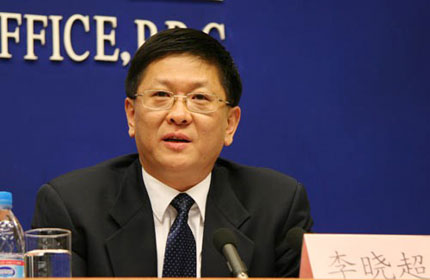 Li Xiaochao, spokesman of the National Bureau of Statistics, speaks at a press conference on China's economy in Beijing, April 19, 2007. [ciic]  |
Chinese stocks nosedived nearly five per cent Thursday amid fears of an interest rate hike to slow down the booming economy and curb inflation.
The benchmark Shanghai Composite Index, the most widely watched indicator of the mainland's stock market, lost 4.52 per cent to end at 3,449.01.
China's gross domestic product surged 11.1 per cent year-on-year, a 0.7 percentage point faster than the same period last year, said Li Xiaochao, spokesman for the National Bureau of Statistics Thursday.
The Consumer Price Index, a barometer of inflation, climbed 3.3 per cent in March, versus a central bank target of three per cent for 2007. That's the highest inflation rate in more than two years. Food stuffs accounted for most of the increase.
The data was originally scheduled for release at 10am Thursday, but was postponed to 3pm after the stock markets closed, fueling speculation that the regulator feared the figures might cause a significant drop in the equity market.
However, Li called the postponement "not a special arrangement' and added there are always ups and downs in the stock market. "That is the charm of stock market," he said.
Meanwhile, the Shenzhen Composite Index fell 4.92 per cent to 960.02, while the Shanghai and Shenzhen 300 Index of major companies went down 4.67 per cent to 3,150.30.
The property sector led the decline, with more than 70 per cent of the stocks falling more than five per cent. China Vanke, the country's biggest publicly traded property developer, declined 7.04 per cent to close at 17.44 yuan per share, while Poly China fell to the daily limit of 10 per cent to 31.49 yuan.
Blue chips continued the downward trend. China Life, the country's biggest life insurer, lost 3.06 per cent to 35.46 yuan following a fall of 3.48 per cent the previous day, while its rival Ping An Insurance slid 3.58 per cent to 51.98 yuan, when it slid down 2.25 per cent on Wednesday.
China Petroleum and Chemical Corporation (Sinopec), Asia's largest refiner, dipped 5.44 per cent to 10.78 yuan, and China United Telecom was also down 5.37 percent to 5.29 yuan.
The declines far outnumbered the advances by a ratio of 15 to 2 in the Shanghai Stock Exchange and by 10 to 1 in Shenzhen.
A risk of an overheated economy
China's GDP totaled 5.03 trillion yuan (US$653 billion) in the first quarter of this year, an increase of 11.1 per cent from the same period last year.
The secondary sector, including manufacturing, mining and construction, posted the fastest year-on-year growth of 13.2 per cent in the January-March period, according to Li.
Fixed-assets investment amounted to 1.75 trillion yuan (US$227.6 billion), up 23.7 per cent. The growth was four percentage points lower than the same period last year.
Retail sales rose 15.3 per cent in the first quarter from 2006, according to Li.
He cited the rapid economic growth was driven by investment, consumption and import and export.
When asked if the Chinese economy is overheated, Li replied it was a comprehensive problem, as the GDP growth indicator alone was not enough to tell if an economy was overheated or not.
But Li warned there is a risk for Chinese economy to evolve from fast growth to overheating.
Inflation accelerating
CPI growth in March is the highest in 25 months after it hit 3.9 per cent in February 2005.
For the first quarter, CPI climbed 2.7 per cent, 1.5 percentage points higher compared with the same period last year, said Li, adding that CPI in March was 0.3 per cent lower compared with February this year.
The Producer Price Index, another indicator of inflation, rose 2.7 per cent in March from the same period in 2006 while the year-on-year growth for the first quarter was 2.7 per cent.
The figures were close to the economists' estimates which have fuelled speculation the central bank might be forced to raise the interest rate as early as May.
Several days after the inflation data was released last month, the central bank raised the benchmark one-year deposit interest rate by 27 basis points to 2.79 per cent.
Besides the anticipated interest rate increase, the People's Bank of China has raised the amount of money lenders must set aside as reserves six times in 10 months and sold bills to reduce cash lending. However, that hasn't cooled lending growth. Banks made 1.4 trillion yuan in new loans in the first quarter of this year, nearly half the total for 2006.
A change in thinking
An interest rate hike could effectively curb the influx of speculative capital, thus deflating the bubble in assets prices, said central bank Vice Governor Hu Xiaolian on April 3.
That was interpreted as a strong signal for another interest rate rise within the year following an increase last month.
It also marked a major shift in the central bank's thinking on the impact of the interest rate on the influx of speculative money.
Previously, the People's Bank of China tried to maintain a three per cent spread between the benchmark interest rates of China and the US for fear that a decrease would result in the increase of more capital into the country, adding to pressure on the yuan to appreciate.
And so the bank was hesitant to hike interest rates. However, the US Federal Reserve ended a series of interest rate rises last August and was expected to lower the rate during the next Federal Open Market Committee meeting next month, making it hard for China to keep the three per cent rate gap.
Moreover, central bank officials began to realize speculative money does not go into deposits as previously thought, but flows highly speculative realty and equity markets.
Another factor is a low interest rate leads to a flood of bank deposits into the equity market, making the market more bullish.
Hu's remark was also noted as a change in the regulator's thoughts on the relationship between interest rate and asset prices.
The central bank paid close attention to asset prices in its decision making, but "asset prices are not the direct basis for monetary policy," said Assistant Governor Yi Gang in February.
An article in the Financial News, sponsored by the central bank, may also reflect a shift in thinking.
The monetary policy should not directly take asset prices as the ultimate goal, but should respond to the changes in assets prices in a correct and timely manner, the newspaper said last Saturday.
According to the article, the central bank will maintain a tight rein on the country's monetary policy, while paying close attention to excess liquidity and asset price.
|
||
|
||
|
|