Remains of giant dinosaur found in China
(AP)Updated: 2007-06-14 04:30 The remains of a giant, birdlike dinosaur as tall as the formidable tyrannosaur have been found in China, a surprising discovery that indicates a more complicated evolutionary process for birds than originally thought, scientists said Wednesday.
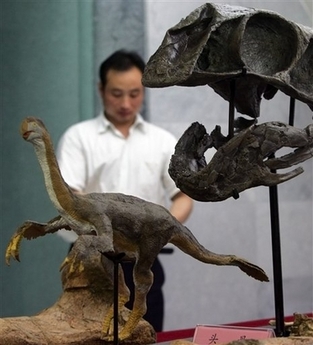 A Chinese man stands near the replica of a fossilized skull and a small scale model depicting the Gigantoraptor erlianensis, whose fossilized bones were uncovered recently in northern China at an unveiling held in Beijing, China, Wednesday, June 13, 2007. The remains of a giant, birdlike dinosaur at least 35 times the weight of similar species have been found in China, a surprising discovery that indicates a more complicated evolutionary process for birds than originally thought, scientists said Wednesday.[AP]  |
Fossilized bones uncovered in the Erlian Basin of northern China's Inner Mongolia region show that the specimen was about 26 feet long, 16 feet tall and weighed 3,000 pounds, said Xu Xing, a paleontologist at the Institute of Vertebrate Paleontology & Paleoanthropology in Beijing.
The height is comparable to the meat-eating tyrannosaurs. But the dinosaur, called Gigantoraptor elrianensis, also had a beak and slender legs and likely had feathers. It was 35 times larger than its likely close relation, the Caudiperyx, a small, feathered dinosaur species, Xu said.
That puts the Gigantoraptor's existence at odds with prevailing theories that dinosaurs became smaller as they evolved into birds and that bigger dinosaurs had less birdlike characteristics, he said.
"This is like having a mouse that is the size of a horse or cow," said Xu, who co-authored a paper on the finding published Thursday in the journal Nature. "It is very important information for us in our efforts to trace the evolution process of dinosaurs to birds. It's more complicated than we imagined."
The Caudiperyx and the Gigantoraptor belong to a group of dinosaurs called oviraptors, which tend to be human-sized or smaller. In recent years paleontologists have found turkey-sized, feathered representatives of the group, but they have never found anything close to the scale of Gigantoraptor.
"It's one of the last groups of dinosaurs that we would expect to be that big," said Mark Norell, curator of paleontology at the American Museum of Natural History in New York City.
But Philip Currie, a paleontologist at the University of Alberta, said the size of the Gigantoraptor would be a natural step in the evolutionary process of the oviraptors.
"Almost every group that has evolved has tended to evolve giant forms," Currie said.
Animals tend to become bigger with evolution because larger creatures have an easier time getting food, impressing potential mates and avoiding predators.
But size has disadvantages, too. Bigger animals need more food and territory. They have fewer offspring and reproduce less frequently than smaller animals do. That means they are particularly vulnerable when environmental conditions change, as they abruptly did about 65 million years ago. Just a few million years after Gigantoraptor evolved, it and every other dinosaur species on Earth became extinct.
On Wednesday, reporters were given a look at the Gigantoraptor's remains ¡ª two yellowing, rough-edged leg bones both a little over 3.2 feet long and believed to be those of a young adult.
It has not been determined whether the Gigantoraptor was a herbivore, which have small heads and long necks, or a carnivore, which have sharp claws. The dinosaur has both, Xu said.
Xu and his team, which discovered three other specimens in the fossil-rich Erlian Basin, were being interviewed by Japanese media in 2005 when they discovered the Gigantoraptor remains.
They had chosen a random site to illustrate how one of the previous fossils had been discovered and hit upon a bone while on camera, Xu said. The team originally thought that it belonged to a tyrannosaur because of its size, but realized upon examination that it was an oviraptor.
"It was an unexpected finding," Xu said.
|
||
|
||
|
|