PBOC's Wu reaffirms China policy on stable yuan
(Reuters)Updated: 2007-06-21 14:20
BEIJING, China -- China's deputy central bank chief on Thursday fended off US pressure for a faster rise in the yuan, saying Beijing would stick to its two-year-old policy of gradual appreciation.
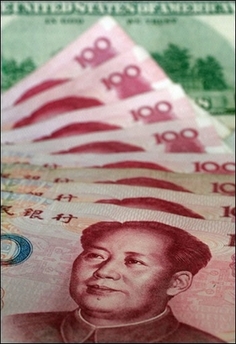 The Chinese currency 100 renminbi (yuan) notes, fronted with an image of former Communist Party chairman Mao Zedong. [AFP]  |
Wu Xiaoling, deputy governor of the People's Bank of China, was speaking a day after US Treasury Secretary Henry Paulson called the yuan clearly undervalued and said it did not reflect the reality of China's breakneck economic growth.
"We will keep a normal floating range for the yuan and keep the rate basically stable at a reasonable level, according to market conditions both at home and abroad based on market supply and demand and with reference to a basket of currencies," Wu told a forum.
The yuan has risen a further 6.4 percent since it was revalued by 2.1 percent against the dollar in July 2005 and untethered from a dollar peg to float within managed bands.
The yuan traded on Wednesday at its highest level against the dollar since the revaluation, but it eased slightly on Thursday.
US lawmakers say the currency remains seriously undervalued, thus handing a big price advantage to Chinese manufactured goods at the expense of American jobs.
But Wu said a stronger exchange rate was no panacea. She cited the examples of Germany and Japan, which both retained big trade surpluses despite powerful rises in their currencies.
Those countries balanced their external accounts by exporting capital, she noted, adding: "Therefore the Chinese government hopes its companies can go out under the capital account."
Beijing was developing a currency regime driven by supply and demand, but outsiders had to realize that China's economic problems were structural and could not be boiled down to its exchange rate.
And with a population of 1.3 billion, China could not rush the required deep-seated changes.
"Therefore the outside world should be patient and believe in the determination of the Chinese government to carry out reforms in a market-oriented direction," Wu said.
Lessons from Asia's crisis
Wu was speaking at a conference on the lessons to be learned from the 1997/98 Asian financial crisis, when China won kudos for not devaluing the yuan after a speculative attack toppled the Thai baht and several other regional currencies.
She said China had recognized that a flexible exchange rate was important for economic growth, hence the decision in 2005 to scrap its dollar peg and the widening on May 18 of the yuan's daily trading band against the dollar to plus or minus 0.5 percent from 0.3 percent.
The government was fully aware of the challenge posed by imbalances in the economy and was implementing a series of polices to tackle the problem, Wu said.
These included a more flexible exchange rate, adjustments to China's trade and foreign investment policies, tweaking taxes, resource pricing reform and environmental protection initiatives.
Other lessons from the crisis included the need for a healthy domestic financial system, the imperative of international cooperation and the capacity to deal with short-term capital flows.
"We should be alert to too much foreign capital chasing domestic assets," Wu said.
The importance of strong financial supervision had led to the establishment of China's banking and insurance regulatory agencies.
Beijing had also speeded up reform of its state-owned banks, including the sale of strategic stakes to foreign investors even though China was awash with foreign currency reserves and wary of more capital inflows, Wu said.
Similarly, the crisis showed the need for properly functioning financial markets, which China was successfully building up.
|
||
|
||
|
|