Peacekeeping - a rising role for China's PLA
By Su Qiang and Le Tian (China Daily)Updated: 2007-07-24 09:50
 On the night of July 25 last year, an Israeli air strike destroyed a UN
observer force base in southern Lebanon near the eastern end of the border with
Israel, killing four UN observers, including one Chinese.
On the night of July 25 last year, an Israeli air strike destroyed a UN
observer force base in southern Lebanon near the eastern end of the border with
Israel, killing four UN observers, including one Chinese.
The body of the Chinese victim, Du Zhaoyu, was found the next day in the rubble, together with three other observers from Finland, Austria and Canada.
Du, 34, a lieutenant colonel in the People's Liberation Army, was killed six months into his tour of duty as a UN observer in the Middle Eastern country.
He was born in Jinan, capital of East China's Shandong Province, and was the father of a 1-year-old son.
Du was the eighth Chinese soldier to be killed on duty on a UN peacekeeping mission since the nation started participating in UN peacekeeping operations in 1990.
Fu Qingli gave his life in the Democratic Republic of the Congo in 2005 when he fainted suddenly while washing the mud from a loader.
In his application to become a peacekeeper, Fu writes: "I was told peacekeeping is a very difficult and risky mission, particularly in a war-torn country like the Democratic Republic of the Congo, but I don't fear that.
"It is worthwhile to devote Chinese servicemen to world peace, even if it means losing my life."
China has contributed about 7,500 peacekeepers to United Nations peacekeeping operations since 1990, according to the Peacekeeping Affairs Office of the Ministry of Defense. Apart from these eight deaths, several dozen others have been injured on peacekeeping missions.
Currently, 1,643 Chinese peacekeepers are serving on UN missions in the countries including the Democratic Republic of the Congo, Liberia, Lebanon and Sudan. The majority of them are engaged in engineering, transportation and medical services.
In Sudan, 435 Chinese peacekeeping troops are in service, including 275 military engineers, 100 transportation staff and 60 doctors.
There are also about 100 Chinese serving as military observers and staff officers in 10 mission areas.
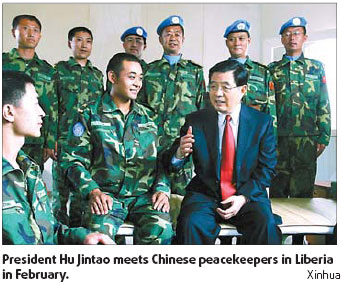
In February, President Hu Jintao met Chinese peacekeeping troops in Liberia and southern Sudan and put forward a four-point principle for the solution of the Darfur issue, which includes a peaceful solution through dialogue on an equal footing, improving living conditions, and respect for sovereignty and territorial integrity.
Hu's visits and proposal indicate that China attaches great importance to the peacekeeping missions, Dai Shao'an, vice-director of the Peacekeeping Affairs Office of the Ministry of Defense, tells China Daily.
In addition to its current commitments, China plans to send a 275-member engineering unit of peacekeepers to Sudan in the near future.
China has strict selection criteria for its peacekeepers. English proficiency and physical stamina are among the basic requirements, along with expertise required for the specific mission.
"Knowing that they are helping to secure peace and a normal life, our soldiers take their peacekeeping duties very seriously. And wherever they go or whatever they do, they always bear in mind that they are messengers of peace, representing China," Dai says. "This sense of responsibility and dignity naturally lead to good deeds."
Chinese peacekeepers have built more than 7,300 kilometers of roads and 200 bridges, treated more than 28,000 patients, performed more than 230 surgical operations, transported materials more than 3 million kilometers and cleared more than 7,500 explosives, according to statistics from Dai's office.
To honor Chinese peacekeepers' contributions, many roads and bridges have been named after the nation in the Democratic Republic of the Congo and Liberia.
But the word "China" is not only to be found on some signs, it is also ringing in the ears of Dai, who frequently visited places where Chinese peacekeeping troops are stationed.
"When local people in Africa see me in uniform, some of them began to shout 'China, China' and gave me the thumbs up," Dai says.
"Some children even salute me the way Chinese soldiers do," he adds.
Dai has visited the Democratic Republic of the Congo, Liberia and Lebanon - three places where China has more than 1,000 peacekeepers.
Dai says he was shocked to see how wars and conflicts have shattered local people's lives and how urgently they needed a helping hand to rebuild their homes.
While dispatching peacekeeping staff, China also offers the facilities and professionals required to meet local people's needs.
Since rebuilding the country after a series of long and destructive conflicts was the top priority in the Democratic Republic of the Congo, China sent an engineering unit and a medical team there to meet the most urgent needs.
In southern Lebanon, where mines are the biggest concern, China has sent demining equipment and a team of demining experts.
"Unlike highways in China, on which your truck can run more than 100 kph without causing any damage, it often takes hours to cover 10 kilometers because of the poor road conditions," Dai points out.
"And any breakdown on the way could probably ruin the whole mission. So, we always purchase state-of-the-art equipment for our peacekeeping missions," he says.
In Africa, one of the biggest challenges is how to prevent and treat malaria - the most common disease on the continent, which claims millions of lives annually.
Thanks to the training programs they must complete before leaving for Africa, Chinese peacekeepers have been able to reduce the possibility of contracting diseases to an absolute minimum.
And most of those who actually fell ill were medical staff who were infected during their exposure to patients. "To ensure the safety of our peacekeepers and increase the effectiveness of the assigned mission, an inspection team will be sent to the target areas to check the working and safety environment before our peacekeeping soldiers go there," Dai says.
"After our peacekeepers arrive there, they will update their information database so they can follow closely the development of the situation," he says.
"To win hearts and minds, you need to devote your own hearts and minds, and that is exactly what our peacekeepers are doing."
China is ready to send as many peacekeeping troops as it can to stop violence or help rebuild those war-torn countries as part of UN peacekeeping operations, Dai says. "We want a world that is free of war or conflict, so people need not experience pain or hatred, and our soldiers don't have to risk their lives overseas," points out Dai. "If requested by the United Nations, and if we find that sending peacekeeping forces will be conducive to the peace and development of local people, we will be glad to play a role in saving people from suffering. And China will continue to strengthen its peacekeeping efforts."
|
||
|
||
|
|