Back to the future
Updated: 2007-09-06 06:34
|
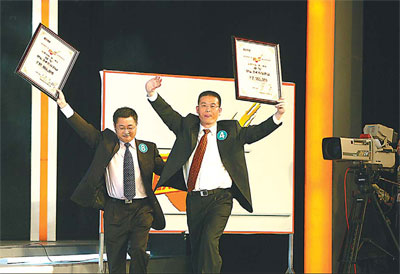
Song Wenming (left) and Zhou Yu celebrate after winning 10 million and 7 million yuan respectively in the Winning in China entrepreneurship contest on China Central Television, to start their own businesses. Entrepreneurial spirit is very prevalent in China. Chinafotopress |
In the 7th and 8th centuries during the heyday of the Tang Dynasty, China was the envy of the world. The capital Chang'an (modern day Xi'an), was the most populous city on the planet and was so filled with riches that Emperor Taizong ordered his municipal authorities to build a private mansion for every visiting official.
Trade along the Silk Road boomed; influences from Central Asia and the Islamic world revolutionized painting; visitors and political emissaries were treated to poetry, acrobatics and music; noblemen (and women) played polo; wine from western Asia along with tea, sugar and spices from India and Southeast Asia transformed the Chinese diet. Indeed, the Tang Dynasty is widely viewed in Chinese history as a period of progress, exchange, openness and stability, a time when China wielded her power and influence to offer a benevolent and welcoming hand to the world.
Today, exactly 1,100 years after the fall of the Tang Dynasty, China again faces similar opportunities. Newspapers, policy papers, legislation and company P&Ls all reflect China's growing prosperity and the global economy's shift to the east. The remarkable re-emergence of China since the reforms of Deng Xiaoping, particularly in the past 10-15 years, will demand significant shifts in the way the world does business everywhere.
To date, doing business has largely meant doing business the "old-fashioned" way, with an attention to hierarchy, position, influence and power. In China, this has meant guangxi (relationships); elsewhere, this has meant an unquestioning adherence to old governance and business frameworks, which explicitly or implicitly are reflective of the post-World War II global order. Yet times are changing. In fact, they have already changed.
Whether in Beijing or Bangalore, London or Lusaka, business is increasingly being driven by a new class of entrepreneurs who operate in a complex, networked, multipolar and interconnected world where one's worth is more likely to be determined by one's social network, flexibility and creativity than by one's pedigree or diploma. Of course, ample cash for investment helps, but no longer is it the case that being born into the "right" circumstances (be it an aristocratic family or the northern hemisphere) is a meal ticket to success. Indeed, the current moment is, in part, an echo of Darwin's observation on the Galapagos islands nearly 200 years ago - "It is not the strongest of the species that survives but the most responsive to change." Today's new leaders are just that - flexible chameleons who have the ability to change depending on the context.
It is in this dynamic context that, for the first time, the organization I work for will come together in China for its third Young Global Leaders Annual Summit. Each year the World Economic Forum recognizes 200 to 300 of the world's most accomplished leaders in the realms of business, politics, academia, the media and civil society as Young Global Leaders.
Robust global network
The purpose of the community is to build a robust global network of decision-makers, improve their knowledge and leadership abilities and serve as a catalyst for initiatives that help address key global issues.
Indeed, these Young Global Leaders are themselves indicative of precisely the kind of change we are witnessing in China and throughout the globe. They personify the increasingly complex, nuanced, networked and multipolar world order. Even more importantly, these leaders share common values - in this case, the belief that by coming together with other individuals from all parts of the globe and by committing themselves to improving their knowledge, judgment and skills, they are uniquely positioned to act as collaborative agents to improve the state of the world - together.

It is this belief - that a (relatively) small community of committed individuals from nearly 100 countries can actually change the status quo - that is the lifeblood of the organization I represent. They are not only a preview of what effective collective leadership in the 21st century might actually look like, but a live snapshot of what it actually is.
Yet these leaders are not infallible. And so I end where I begin - with two very important leadership lessons from Chinese history. The first is from the historian Bo Yang and others, who argued that Emperor Taizong was able to achieve the heights of greatness that he did because he accepted criticism that others would find difficult to accept and because he tried hard not to abuse his absolute power. Bo Yang's words serve as good advice to leaders everywhere and speak to the importance of openness, humility, flexibility, collaboration and learning.
The second is the story of Li Bai, also known as China's "Poet Immortal", and one of the most famous poets of the Tang period. Li is best known for his lyrical style and extravagant imagery brought about by an openness to the world and a life of traveling and, yes, his love of wine.
Legend has it that Li Bai drowned tragically, attempting to embrace the moon's reflection in a river. His is a lesson that, no matter how gifted an individual is, regardless of the extent of one's genius, acting alone can be detrimental. Rather, by acting together, by taking the ingenious, creative spirit that Li Bai and his contemporaries represented and applying it to our interconnected and interdependent world, can we make a difference.
The author is the director of the Forum of Young Global Leaders
(China Daily 09/05/2007 page5)
|
|
|
||
|
||
|
|
|
|