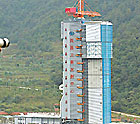
XICHANG, Sichuan: The country took a big step forward in space exploration Wednesday after launching its first lunar orbiter.

China's first lunar orbiter, Chang'e I, blasts off from its launch pad in the Xichang Satellite Launch Center in Southwest China's Sichuan Province, at about 6:05 pm October 24, 2007. [Xinhua] |
At 6:05 pm, Chang'e I blasted off from the Xichang Satellite Launch Center atop a Long March 3-A carrier rocket.
The circumlunar satellite separated from the rocket at 6:29 pm and entered into Earth orbit, where it will travel for seven days, according to the Beijing Aerospace Control Center (BACC).
About an hour after the launch, Li Shangfu, director of the Xichang launch center, declared the endeavor a success after Chang'e I entered the Earth orbit and unfolded its solar panel for energy.
The control of the orbiter was then transferred to BACC.
"It marks another milestone in China's space program," said Vice-Premier Zeng Peiyan at the Xichang center.
Developed with indigenous technology, the 1.4 billion yuan ($186 million) mission is considered the third milestone in the country's space venture, following the launch of the first satellite in 1970 and two manned missions in the past five years.
"This was a truly perfect launch. If I were to rate it, I would give it a hundred out of a hundred," said Zhou Jianliang, a deputy chief engineer at the Beijing center.
Chang'e I, named after a legendary Chinese fairy who flew to the moon, is expected to enter the Earth-moon transfer orbit on October 31 and reach the moon's orbit on November 5.
It will circle around the moon for a year to analyze chemical and mineral composition and to explore the characteristics of the lunar surface.
It will use stereo cameras and X-ray spectrometers to map three-dimensional images of the surface and study the moon's dust.
The satellite is expected to transmit its first photos back to Earth in the second half of next month.
It is the first step of China's three-stage moon mission, which will lead to a moon landing of a rover around 2012. In the third phase, another rover will land on the moon and return to Earth with soil and stone samples for scientific research around 2017.
Complex maneuvers
For scientists involved in yesterday's liftoff, it is too early to relax as they have to adjust the orbiter path from time to time to make sure it enters the preset orbit.
They will maneuver it at least 10 times before it enters the moon's orbit. The Shenzhou VI manned spacecraft in 2005 was maneuvered three times by scientists in the flight control center.
Because of the repeated maneuvers, the fuel that Chang'e I carries accounts for nearly half of the 2,300-kg weight of the satellite, scientists said.
"It will be a very complicated journey," said Li Xiaojin, director of the aerospace department of China Aerospace Science and Technology Corporation, which designed and manufactured Chang'e I and the carrier rocket.
Many factors are critical in the process.
"Before this mission, we have never tried to control and monitor a satellite as far as 380,000 km from Earth. The farthest distance a satellite has gone before is 80,000 km," Li said.
There are also worries whether the orbiter can adjust well to the temperature of the moon - which ranges from -180 C to 130 C - and whether the orbiter can function with the storage battery during two expected lunar eclipses when its solar panel cannot receive sunlight.
Peaceful mission
"Chang'e I is purely a scientific mission; it has no military aim and is carrying no military facilities or equipment," a spokesman for the Commission of Science, Technology and Industry for National Defense said Wednesday.
Luan Enjie, chief commander of the lunar satellite project, said China will not embark on any competition "in any form with any country" and will "share the results of its moon exploration with the whole world", adding that China pursues a policy of peaceful use of space.
"China welcomes international cooperation in space activities," Vice-Minister of Science and Technology Li Xueyong said, adding the country hopes to become the 17th nation to join the International Space Station (ISS) project.
The space station is a joint project of 16 nations including the United States, Russia, Japan, Canada, Brazil and 11 countries from the European Space Agency.
Rene Oosterlinck, director of legal and external relations of the European Space Agency and one of the foreign guests invited to watch the launch, said three of the agency's stations around the world will help monitor the voyage of Chang'e I.
"We are looking forward to cooperate with China in the second and third stages of the lunar probe program," he said.
Stephen Mackwell, head of the Lunar and Planetary Institute, told Xinhua that he believed China's space exploration was more of an opportunity than a "threat".
Mackwell said China boasts rich resources in the field of space technology, from which other countries would find more cooperation opportunities.
Ouyang Ziyuan, chief scientist of the lunar exploration program, said the lunar orbiter project's $186 million price tag is worthwhile as it is the same amount needed for building 2 km of a subway in Beijing.
"It will boost the development of national science and technology and help train a group of talents in the space field," he said.
Chinese scientists started systematic and comprehensive analysis and research about lunar science as early as the mid-1960s, and started a feasibility study on lunar probe plans in the 1990s.