 |
|
|
News
Welcome wind blowing across political horizon
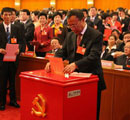
When lakes in western China's Qinghai Province began drying up and the deserts started expanding in the 1990s, local government environmental protection departments were stumped on a course of action. Enter the Jiu San Society, one of China's eight non-Communist political parties. It conducted field research on encroaching desert areas and subsequently devised a grand ecological project that began to reverse environmental deterioration in 2005. The plan, for which the central treasury allocated 7.5 billion yuan ($1.02 billion), sought to protect the source area of China's three most famed rivers - the Yangtze, the Yellow River and the Lancang River - in northwest Qinghai Province. This important contribution is a prime example of China's multi-party cooperation system in action. The system is benefiting from increasing participation of an energetic new breed of non-Communist party members in fields ranging from environmental protection to cultural preservation. The non-Communist parties represent specific interest groups, reflect complaints and suggestions from all walks of life and serve as a mode of supervision of the CPC. Since the 17th National Congress of the Communist Party of China (CPC) in October, the country's eight non-Communist parties have held their national congresses and elected a breed of younger leaders determined to play an even greater role in the country's development. Most of the newly elected chairs have communicated with the people through online interviews, and responded to a flurry of questions on subjects ranging from their personal lives to the history of their parties and the role they hope to play in State affairs. "Many non-Communist Party leaders have used the Internet as a platform to deepen the understanding between the people and non-Communist parties," says You Luoping, vice- president of the Central Institute of Socialism. Another party, the China Association for Promoting Democracy (CAPD), comprises mainly senior and leading intellectuals in the fields of culture, education and publishing. In an online interview, CAPD central committee chairwoman Yan Junqi says her party has submitted many studies and proposals on possible reforms in the publishing industry and education, and that they have influenced government policy-making. The CAPD takes credit for improvements such as the nine-year compulsory education and equitable distribution of teaching resources. "The party is now focusing on how to vigorously develop community and privately run schools, and develop vocational training," says Yan. "I think education is closely related to the country's abundance of human resources and capabilities in scientific innovation. The public has higher expectations of education, too. So the CAPD will conduct more studies and submit more proposals on the issue," she says. The multi-party cooperation system has two basic modes of political dialogue: consultations among the eight non-Communist parties and the CPC and the Chinese People's Political Consultative Conference (CPPCC), attended by representatives of all walks of life. From 1990 to last year, the CPC Central Committee and the State Council organized more than 230 consultations, seminars and briefings, out of which 74 were presided over by President Hu Jintao, who is also general secretary of the CPC Central Committee. The number of non-Communist party members and independent representatives was 1,343, about 60 percent of the total, at the First Session of the 10th National Committee of the CPPCC in March 2003. That should give a fair idea of the importance attached to such parties. Their suggestions "facilitate the scientific and democratic decision-making of the CPC and helped it resist and overcome the bureaucracy and all negative and corrupt phenomena more consciously. This reinforces and improves the CPC's work," says Zhuang Congsheng, spokesman for the United Front Work Department of the CPC Central Committee. Zhuang cites the saving of the Minnan culture, the distinctive customs of southern Fujian Province, from near extinction five years ago as a major achievement of the CPPCC. The Taiwan Democratic Self-Government League submitted a draft proposal to protect Minnan's culture and its unique dialect and art forms. The result was the establishment of China's first State-level cultural ecological protection zone - the Minnan cultural and ecological zone in June this year. At their national congresses earlier this month, the eight non-Communist parties discussed and adopted their own work reports and elect new central committees. Jiang Shusheng, re-elected chairman of the China Democratic League Central Committee, says in his online interview that his predecessors sacrificed their lives along with CPC members for the revolution. Though the younger members of non-Communist parties don't have that experience, they still have common commitments with CPC members, such as the multi-party cooperation system and socialism with Chinese characteristics. The combined membership of the eight parties is more than 700,000, about one percent of the CPC's 73 million. The first CPPCC convention in September 1949 marked the formal establishment of the multi-party cooperation system under the leadership of the CPC. More than 90 percent of the existing non-Communist party members entered politics after the country's reform and opening up in the late 1970s. The system suffered a serious setback during the "cultural revolution" (1966-76) but has since been improved and consolidated, most notably with the appointments of China Zhi Gong (Public Interest) Party's Wan Gang as Minister of Science and Technology in April and Chen Zhu as Minister of Health in June. The first non-Communist party cabinet minister since the late 1970s, Wan was elected the Zhi Gong Party Central Committee chairman last Friday. The 55-year-old minister is an automobile engineer, has worked with Audi Corporation in Germany and was president of Shanghai's Tongji University before assuming the science and technology portfolio. Health Minister Chen Zhu, 54, is a Paris-trained scientist and has no political party affiliation. The white paper on China's political party system, released in November, says a key aspect of the multi-party cooperation system under the leadership of the CPC is that non-Communist party members can take leadership positions in the government. By the end of last year, 31,000 non-Communist party members and non-affiliated people held government posts at or above the county (division) level. They are in posts with decision-making powers and the power to nominate and remove personnel. Since the First Session of the 10th NPC four years ago, 177,000 non-communist and non-affiliated individuals have been elected as deputies to people's congresses, including seven who have served as vice-chairpersons of the NPC Standing Committee. CAPD former chairman Xu Jialu says it's "a manifestation of the CPC's sincerity and determination" to "promote and deepen" the system of multi-party cooperation and political consultation under Communist leadership. Almost all non-Communist leaders have vowed in their online interviews to build their parties into more vigorous units in order to play a bigger role in China's future. One notable development is that the newly elected central committees' members of the non-Communist parties are getting younger, with 50 being the average age of the 209-member central committee of the Revolutionary Committee of the Chinese Kuomintang, three years less than the last central committee's in 2002. The average age of the 265-member China Democratic League (CDL) central committee members is 49, while that of the 225-member Jiu San Society central committee is 50. What's more, half of CDL central committee members are doctorates. The new office-bearers are young, energetic leaders with good academic backgrounds and have a strong desire to participate in State affairs, says You Luoping. As leaders, they will better reflect the opinions of the people they represent and help non-communist parties play a better participatory role in Chinese politics. |
|