
When there's no stock answer to this question
Updated: 2008-04-10 07:27
The stock market boom not long ago not only provided a steady source of funds for thousands of domestic enterprises, but was also a fountain of hope for many aspiring entrepreneurs. Take Qian Yafeng for instance. The 26-year-old NQA Certification Co salesman began buying shares immediately after passing out of graduate school 18 months ago. Initially, he used his own meager savings to do so. But as the benchmark Shanghai Composite Index (SCI) graph continued its northward journey, he began borrowing from his parents to invest. By the time the index touched its highest point, the value of his portfolio had crossed 240,000 yuan ($34,280), a princely sum for a fresh graduate.
But he was not satisfied with what he had. Instead, he longed for more.
"I wanted more, and borrowed even more money from my parents to buy, buy, buy," Qian recalls. He had a reason for throwing a bit of caution to the winds - his dream was to set up a manufacturing plant. With the stock market going on a bull run, he kept laughing his way to the bank.
|
A woman reads in front of an electronic screen displaying stock figures at a brokerage house in Shanghai yesterday. China's main stock index tumbled more than 5 percent yesterday, ending a four-day rebound off 11-month lows as large caps were sold. Reuters |
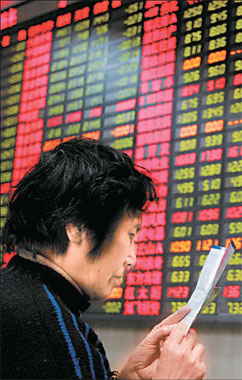
His laugh, however, did not last long. "I have had that haunting feeling that the world is falling apart around me" ever since the market took a nosedive late last year, he says. Despite all this, Qian has outperformed the SCI: the value of his portfolio has shrunk only about 20 percent while the index has slumped more than 35 percent since the beginning of this year. It could be more if yesterday's 5.5 percent slide is taken into account.
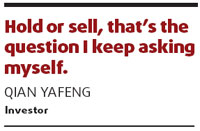
But outperforming the stock market during a slide is small comfort, which cannot motivate disheartened investors like Qian. He is at a loss. He can't figure out what to do next. "Hold or sell, that's the question I keep asking myself."
The market slide has brought down the average multiple to 27 times from 44 late last year. But few investors seem to be in a rush to pick up the bargains while the outlook continues to be clouded by a combination of bearish factors, including fears of a US-led global economic recession that can have far-reaching consequences on the domestic economy. "There are many negative factors, including high inflation, the possible slowing down of corporate earnings and continued price control," says TX Investment Consulting analyst Wu Feng.
Waiting in the public gallery of a Shanghai brokerage firm, 50-year-old retiree Xu Jingjun says: "We never thought the stock market would take such a severe beating." Despite being in the stock business for nearly 10 years, she could not foresee the sharp fall. "I operate in short term and have a detailed investment plan for each of my invested stocks. In such a volatile stock market, only short-term investment can survive." She has set technical selling and buying lines for each of her stocks to avoid losing more than she can sustain.
She has already lost about 17 percent of her money in equity investment this year and is pessimistic about the performance of the stock market for the rest of the year. "The market lacks liquidity as capital continues to flee the stock market with no new funds coming in," says Xu, who had put nearly 1.8 million yuan in the bourse.
The number of A-share accounts being opened daily has shrunk to an average of 90,000 a day, and jittery investors are busy taking out money from the stock market and putting it into banks or other investment channels.
The People's Bank of China figures show savings in February registered an increase of 804.5 billion yuan year on year. Zhou Li is one of those who has withdrawn money from the stock market and invested (or spent) it elsewhere. The 28-year-old office worker says she sold all her stocks in February and used the money to buy an apartment for her parents in Shanghai. "The stock index was too high then, and housing prices had become steadier, even showing a slight decline," she says.
Zhou, her husband and their daughter now live with her parents in a two-bedroom apartment in Pudong, Shanghai. "It would have been hard for me to buy a bigger apartment in my fourth working year, especially because of the high daily family expense." But the stock market boom in the past two years more than doubled her savings. Plus, the cooling down of the Shanghai property market prompted some real estate developers to offer discounts and other incentives to push up their sales.
So she withdrew about 400,000 yuan - on an initial investment of 200,000 yuan - out of the stock market for the down payment of the apartment in Pudong New Area. It cost 720,000 yuan, 30,000 yuan less than a month ago. "For safety's sake I withdrew the money from the high-risk stock market and used to it to buy property, in which value is much better ensured," she says.
Domestic institutional investors, such as mutual funds, have felt the pressure from large redemption. Equity funds had about 17 billion yuan redemption from January to March this year, according to China Securities Regulatory Commission data. No wonder an Orient Securities study shows global investors, too, have begun withdrawing money from the country's stock market because they are worried over the possible knock-on effects of a US recession on the mainland economy.
"Since most negative factors fade (out) towards the middle of the year, investors will get a clear picture (of the situation) in another few months," says UBS Securities Asia economist Jonathan Anderson. "Investors should control their desire to make big money solely through the stock market," analyst Wu Feng said.
The government has taken steps to ensure the stock market grows in a healthy and steady manner. In a set of working priorities for government agencies this year, which was released in April, the State Council (the country's Cabinet) has urged financial regulators to promote stable and healthy development of the country's stock market.
"The fundamentals of the mainland's stock market are still sound," says Essence Securities analyst Zhu Haibin. "The large falls, triggered mainly by weak stock market performance across the world, will probably end soon, and the market is expected to recover in the second quarter of the year."
That should come as some relief to investors, desperate to find a way to save their money and keep the stock market flag flying high.
(China Daily 04/10/2008 page7)
|
||
|
||
|
|
|
|