CHINA> Regional

|
CHINA> Regional
|
|
Beijing imposes car ban to ease traffic jams
(Xinhua)
Updated: 2008-09-28 16:37
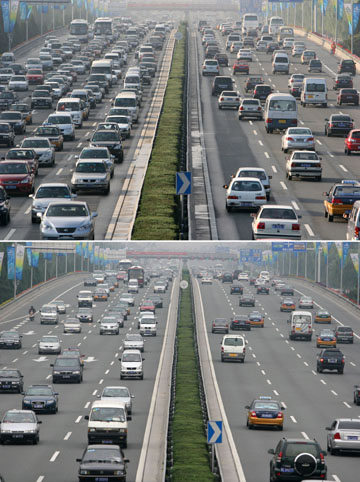
Beijing has announced a series of post-Olympics car restrictions which will take effect next month and hopefully sustain the hard-won smooth traffic and good air quality during the Games. Under the new traffic restrictions, 30 percent of government vehicles will be sealed off as of October 1, said a circular issued by the Beijing municipal government on Saturday.
Cars whose number plates end with 1 or 6 will be taken off roads on Monday, while those ending with 2 or 7 will be banned on Tuesday, 3 or 8 on Wednesday, 4 or 9 on Thursday and 5 or 0 on Friday. The ban does not apply on weekends. The ban will be applicable within the Fifth Ring Road inclusive, from 6 am to 9 pm for private cars and round the clock for government and corporate vehicles. The new restrictions will take effect on a trial basis on October 11 for six months until April 10, but does not apply to police wagons, ambulances, fire engines, buses, taxies and other public service vehicles. "It's expected to reduce Beijing's average road traffic flow by 6.5 percent and speed up traffic within the Fifth Ring by 8 percent at least," said Wang Zhaorong, an official with the Beijing Municipal Committee of Communications, at a press conference on Sunday. In compensation, the restricted vehicles will be exempt from one month of vehicle tax and road maintenance fee a year. Drivers who are caught to have breached the new rule will not enjoy the exemption, according to Wang. While most people applaud the ban on government and corporate vehicles, the ban on private cars, however, has sparked an outcry from car owners, many of whom complain it is "unfair". "I need to take my daughter home from boarding school on Friday night," said Beijing bank clerk Zhang Min, whose number plate ends with "0" and will be banned on Friday. "Probably we need to buy another car." More than 2,400 people posted online comments on China's leading portal website sina.com within two hours after it published the ban. Very few postings were supportive of the ban on private cars. "To ban should not be the ultimate way to ease Beijing's traffic woes," reads one of the postings. "Instead, our city should be better planned and the road network better designed." While most people were tolerant of the two-month ban on vehicles on alternate days during the Olympics and Paralympics, many are now fed up with the idea to take public transport just once every week. But to like it or not, the Olympic traffic ban, which took nearly 2 million cars off the roads, was not only successful in easing congestion but also cleared the skies. During the ban, traffic flow within the Fifth Ring was reduced by an average 21.2 percent and the average speed at rush hours increased by 25.8 percent to 30.2 km per hour, according to the Beijing Municipal Committee of Communications. The city returned to its normal congestion after the ban was lifted on September 21. Urban streets are unbearably jammed in the rush before the week-long National Day holiday set to start on Monday. The debate over whether the ban should stay after the Games has lasted for weeks and Beijing authorities, apparently hard to find a solution that is effective and acceptable to all, are rather late in announcing the new ban. Alongside the ban, city authorities have also encouraged employers to adopt more elastic working hours -- even to work at home, if possible -- in order to ease congestion. Downtown department stores have been advised to open at 10 am instead of 9 am, as of October 11 and close one hour later than before. Except for schools, governments and the public service sector, many Beijing organizations will be advised to readjust their office hours to avoid the rush hour. The government is also considering raising downtown parking fees to ease congestion but no details are available yet. To improve the city's air quality, Beijing plans to ban a total of 357,000 "yellow label" vehicles from entering the Fifth Ring starting on January 1, said Du Shaozhong, deputy chief of the municipal environment protection bureau. By October next year, all the yellow label vehicles, mostly tippers and heavy-duty trucks, will be banned across Beijing, he said. Beijing's vehicles were issued green or yellow labels according to their emission levels and cars with a yellow label were banned from entering the city center during the day since two years ago. Exhaust emission from a yellow label vehicle is equal to that from 28 low-emission vehicles of Euro-IV standards, said Du. |
|||||
主站蜘蛛池模板: 在线播放国产不卡免费视频| 一本伊大人香蕉久久网手机| 亚洲男人AV天堂午夜在| 四虎永久地址WWW成人久久| 水蜜桃视频在线观看免费18| 日韩在线视频一区二区三| 污污污污污污WWW网站免费| 日韩人妻无码精品系列| 日韩一区在线中文字幕| 天堂а√在线中文在线| 在线a人片免费观看| 国产熟女精品一区二区三区| 国产真实乱人偷精品人妻| 亚洲AV毛片无码成人区httP| 五十路久久精品中文字幕| julia无码中文字幕一区| 老师破女学生处特级毛ooo片| 天堂mv在线mv免费mv香蕉| 饥渴的熟妇张开腿呻吟视频| 奇米四色7777中文字幕| 欧美另类亚洲一区二区| 日本黄色三级一区二区三区| 俺来也俺去啦最新在线| 国内精品一区二区不卡| 国产亚洲精品成人aa片新蒲金| 欧美国产视频| 亚洲无av在线中文字幕| 国产av成人精品播放| 日韩欧美aⅴ综合网站发布| 国产福利在线观看免费第一福利| 亚洲一区二区三区成人网站| 亚洲中文字幕一二区日韩| 大香伊蕉在人线国产免费| 精品国产午夜福利在线观看| 色AV专区无码影音先锋| 最近中文字幕高清免费大全1| 国产午夜福利视频合集| 亚洲av永久无码精品天堂久久| 国产精品一区二区插插插| 粉嫩少妇内射浓精videos| 国产午夜在线观看视频|