CHINA> Focus

|
CHINA> Focus
|
|
Creating jobs for migrant workers top govt agenda
By Li Jing and Cui Xiaohuo (China Daily)
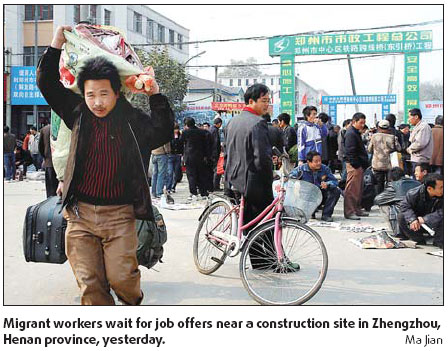
Updated: 2008-11-14 07:24 The government's latest economic stimulus plan could create at least one million jobs by the end of the year, in turn curbing rapid unemployment among migrant workers hit by a looming global recession, a senior researcher has said. The $586-billion stimulus package will help ease unemployment from export-oriented enterprises in the coastal regions shutting down or cutting costs amid the global financial downturn, Liu Junsheng from the labor-wage institute of the Ministry of Human Resources and Social Security said on Tuesday.
The country will invest 100 billion yuan by the end of the year as part of the package, said the National Development and Reform Commission, the country's top economic planner. About one-third of the investment will go into improving infrastructure, boosting agricultural competitiveness and building up the social security network in the rural regions, sources close to the central government have said. "This can directly bring new jobs for surplus labor in the rural regions," Liu said. "All these investments can create new jobs in towns and villages," Liu said. While the number of jobs created by the massive infrastructure projects will be considerable, it is equally important to stem the decline arising from the export sectors, Cai Fang, a labor economics specialist with the Chinese Academy of Social Sciences in Beijing, said yesterday. "The stimulus projects for infrastructure nationwide will bring in a huge army of laborers and I'm sure a large number of migrant workers will return to construction sites for new work," said Cai, who is also a member of the Standing Committee of the National People's Congress. "But the projects are still limited to infrastructure, which is not sufficient." "We believe the stimulus plan will create new jobs, but the government should pay equal attention to laborers in export-oriented enterprises. These enterprises may have been under pressure for a relatively long period of time," Cai said. "The central government's fiscal policy has also stimulated the international community and we hope there will be more policies of the same caliber, both from the central and local governments, to support small businesses focusing on export," he said. The government should also use the momentum to spend more and revamp its social security system, to further help laborers deal with the economic challenges, Cai said. "Most laborers worry about their welfare, retirement funds or unemployment benefits. The government should address these worries," said Cai, who also suggested the government continue to remove the individual income tax from more low-income laborers. Still, Cai said local authorities should not interfere in the job market to deal with unemployment. Some local governments recently raised the standard wage for low-income workers, putting added pressure on enterprises and causing more unemployment, he said. "These enterprises are facing their most difficult time, so the government, the enterprises and the laborers should go through this difficult time together," Cai said. China, which holds the world's largest population of 1.3 billion, stands to face tremendous pressure from the 10 million people entering the workforce every year. The government has set a target of maintaining at least 9 percent economic growth over the next two years, while the country is expected to keep its unemployment rate at about 4 percent, excluding migrant workers. The country has about 200 million migrant workers, of whom 120 million move from rural areas to work in cities, figures from the Ministry of Human Resources and Social Security showed. The largest number of migrant workers comes from Sichuan, Hunan, Hubei and Jiangxi provinces, as well as the Guangxi Zhuang autonomous region. There has been an increasing number of migrant workers heading home to Chongqing municipality and Sichuan, Hunan and Hubei from the major exporting base of Guangdong in the past few weeks, the ministry said. Hubei province alone registered 300,000 migrant workers returning home during the last two months, the Wuhan-based Chutian Metropolis Daily reported. Similarly, the Hunan provincial administration of human resources and social security estimated that 2.8 million migrant workers will return to the province in the coming year, the local Xiaoxiang Morning Post reported. Human Resources and Social Security Minister Yin Weimin said earlier this month that although 57,608 enterprises went bankrupt in Guangdong province, there were still 92,609 newly registered companies in the first three quarters of the year, which helped the province maintain a 10.4-percent growth rate. However, in the third quarter of this year, the number of job vacancies in Guangdong was much lower than the previous year, and growth rate of newly created jobs has slowed down, Yin said. |
主站蜘蛛池模板: 久久影院九九被窝爽爽| 国产精品国产三级欧美二区| 免费看内射乌克兰女| 17岁高清完整版在线观看| 3d无码纯肉动漫在线观看| 精品无码人妻一区二区三区不卡| 猫咪AV成人永久网站在线观看| 麻豆精品在线| 久久www免费人成看片中文| 被黑人巨大一区二区三区| 日韩有码中文字幕一区二区| 国产精品三级中文字幕| 巨爆乳中文字幕爆乳区| 亚洲成人av在线高清| 国产精品区视频中文字幕| 正在播放国产对白孕妇作爱| 乱人伦人妻中文字幕不卡| av在线播放日韩亚洲欧我不卡| 国产精品亚韩精品无码a在线| 久久人妻少妇偷人精品综合桃色 | 男人的天堂av社区在线| 亚洲日韩精品无码一区二区三区| 国产精品自在拍首页视频| 亚洲av色香蕉一区二区三区精品 | 国产精品污双胞胎在线观看| 四虎网址| 色综合久久中文综合久久激情| 亚洲经典千人经典日产| 人妻换人妻仑乱| 视频二区国产精品职场同事| 久久国产精品精品国产色婷婷| 变态另类视频一区二区三区| 成人年无码av片在线观看| 亚洲AV永久无码一区| 无码一区中文字幕| 羞羞色男人的天堂| a网站在线观看| 性色av一区二区三区夜夜嗨| 在线看免费无码的av天堂| 国产愉拍精品手机| 国产成人精品日本亚洲77上位|