China's defense budget to grow 17.6 percent in 2008
(Xinhua)
Updated: 2008-03-04 12:17

|
|
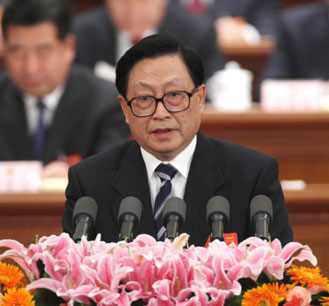
The First Session of the Eleventh National People's Congress (NPC) holds its first press conference at the Great Hall of the People in Beijing March 4, 2008. Jiang Enzhu, spokesman for the NPC session, answered questions of reporters. [Xinhua]
|
China plans to increase its defense budget by 17.6 percent in 2008, a parliament spokesperson said in Beijing on Tuesday.
The planned defense budget for 2008 is 417.769 billion yuan, a rise of 62.379 billion yuan from the actual military spending last year, Jiang Enzhu, spokesman for the annual session of the National People's Congress (NPC), told a press conference.
The budget equals $57.229 billion if converted at the exchange rate by the end of last year, Jiang said.
"The ratio it takes against this year's total fiscal expenditures is slightly lower than those of previous years," he said.
Jiang explained that the defense budget is raised to further increase benefits for military personnel and offset the impact of price hikes to allow more input in oil purchase.
More money will be spent on education and training in army, he said.
The increased budget will also be used to upgrade the military equipment "moderately" so as to enhance the troops' capability of combating a defensive war based on information technologies, he said.
Jiang called the defense budget growth a "compensatory" rise, saying it will help reinforce the originally weak basis of military defense, given the rapid and steady growth of China's economy and fiscal revenues in recent years.
From 1979 to 1989, China's defense expenditure actually registered an average annual decrease of 5.83 percent, and its growth in recent years is still far below the increase of fiscal revenues, he said.
China saw an average annual rise of 15.8 percent in military spending from 2003 to 2007, while the fiscal revenues grew 22.1 percent averagely per year during the same period.
Luo Yuan, a researcher with the Chinese PLA (People's Liberation Army) Military Academy of Sciences, said that Chinese armies, now in a critical "transitional" period, will naturally spend more on high-tech equipment.
Luo mentioned about the US costly B-2 stealth bomber, which was brought under the media spotlight after a recent crash accident. It was reported that each B-2 bomber cost about 1.2 billion U.S. dollars to build.
China's major military equipment still lag behind that of developed countries by "one or two generations". "To shorten the gap, we have to increase input," said Luo, who is here attending the annual session of China's top political advisory body.
He further pointed out that a budget rise will help realize the coordinated development of economy and national defense.
After entering the new century, armies all over the world have expanded their functions. Chinese troops are also burdened with new tasks to contain "unconventional security threats", he said.
"For example, Chinese troops have dispatched a large number of soldiers and officers as well as disaster relief materials for rescue work amid the worst snow havoc in five decades in January," he said.
"Why cannot we raise our defense budget while facing new tasks and missions," he said.
Luo also highlighted the influence of price hikes, especially the surging oil price. "The government has offered other relevant sections subsidies," he said, adding it's also necessary to subsidize the troops.
Jiang noted that China's military spending remains a low level compared with some other countries, especially the big powers, in both ratios against their GDP (gross domestic product) and total fiscal expenditure.
Taking the year 2007 for example, China's military expenditure accounted for only 1.4 percent of its GDP, the lowest compared with 4.6 percent in the United States, 3 percent in Britain, 2 percent in France, 2.63 percent in Russia and 2.5 percent in India.
In terms of proportion of military spending in fiscal expenditure, China reported 7.2 percent in 2007, far lower than 16.6 percent in the United States, 13.5 percent in France, 15.1 percent in Russia and 14.1 percent in India.
Persistent in a defensive policy, China maintains limited military power only to secure the nation's independence, sovereignty and territorial integrity, and won't pose a threat to any country, he said.