|
|
Food imports to stay steady
By Zhao Huanxin (China Daily) Updated: 2008-03-11 07:12 Despite the snowstorms that devastated large swathes of farmland, and an increasing dependence on soybean imports, there will not be a significant jump in food imports, top rural policy-makers have said.
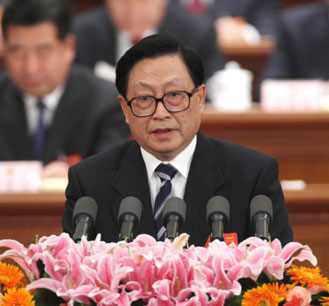
The official said that soybean imports had increased by 2 million tons annually over the past few years to exceed 30 million tons in 2007, when imports of edible oil surged 25 percent year-on-year to 8.4 million tons, driving the country's farm trade deficit to a record $4.08 billion. But overall, China has sufficient supply of a vast range of agricultural products which can well satisfy market demand, Wei told a press conference held on the sidelines of the annual session of the National People's Congress, the legislative body, in Beijing.
In response, the central government has intensified support to rural areas, including a plan to earmark 304.4 billion yuan ($40.6billion) to improve production this year and cut prices of agricultural production materials. The ministry will ensure that the grain acreage is no lower than last year's 105 million hectares, said Chen Mengshan, a director in the ministry. Farmers have been raising crops on ever-shrinking patches of land, with total acreage contracting 8 million hectares over the past decade, making it imperative to implement the "strictest possible" system for protecting farmland, Chen Xiwen, director of the office of the central leading group on rural work, told China Daily. Over the past few years, China has managed to maintain good harvests despite the cropland decline, largely through the application of science and technology which has helped increase per-unit yield, the top rural policy-maker said. For example, per-hectare grain output averaged 4.72 tons last year, up by 450 kg from 2003. Around 45 percent of farmland has adequate access to irrigation; and two-thirds of all farmland is low and medium yielding, Chen said. By vigorously improving agricultural infrastructure, such as developing water-efficient irrigation and upgrading low-yielding land, and spreading technology among farmers, the country can reach the goal of increasing overall grain output by 1 percent a year. "Production growth is by far faster than population growth, which is one of the reasons we'll have no difficulty in feeding ourselves," Chen said. It is unrealistic to reverse price hikes in the short run, but the country may well be able to reach its goal of pegging inflation at around 4.8 percent for 2008 as set forth by Premier Wen Jiabao, Chen said. The higher cost of energy means greater outlays for agricultural production, as transport, fertilizer and agriculture film all use oil, Chen said. Vegetables and fruits, whose production and supply was crippled by the devastating winter snowstorms, will be sold at higher margins for some time. "So it is not viable to hold down the prices at the moment, for external pressures are still at work," said Chen, also a member of the National Committee of the Chinese People's Political Consultative Conference, the political advisory body. "But pork supply has already picked up, and the grain market is stable. Coupled with intensified efforts to buoy production and prevent prices rising too rapidly, inflationary pressures will ease throughout the year," Chen said. Food prices account for one-third in the basket of the consumer price index - a key gauge of inflation, which surged to an 11-year high of 7.1 percent in January, compared with the average 4.8 percent for the whole of 2007. |
|

 After securing grain output at around 500 million tons for four consecutive years, the country is striving for production above that level this year, Vice-Minister of Agriculture Wei Chao'an said on Monday.