CHINA> National

|
CHINA> National
|
|
China may have bigger say in restructured IMF
By Wang Xu (China Daily)
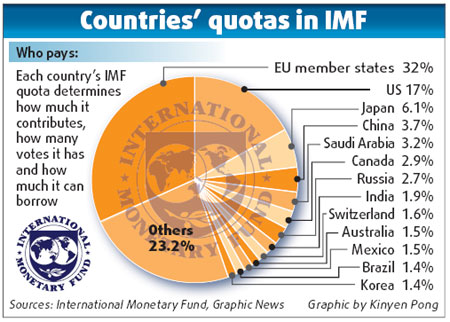
Updated: 2009-05-14 07:36 China may leapfrog Japan to have the most say after the United States in the International Monetary Fund (IMF) after a structural reform of the fund's governance, a senior IMF official said Wednesday. "There is a possibility that China's quota will rise to second, when the reform concludes by 2011," Daisuke Kotegawa, IMF's executive director for Japan, told China Daily. Each member country is assigned a quota, based broadly on its relative size in the global economy; and the quota determines its maximum financial commitment to the IMF as well as its voting power.
China's current IMF quota is 3.72 percent, the sixth largest. The US and Japan hold 17.09 and 6.13 percent. The IMF decided to reform its governance structure in April to reflect the growing economic clout of emerging economies. The review of quotas is expected to be completed by January 2011.
In March, Vice-Premier Wang Qishan wrote in the British newspaper The Times that it is necessary to press ahead with reform of the international financial system, and increase the representation and voice of developing countries in the IMF and the World Bank. Sun Lijian, dean of Fudan University's Economics School, said: "A meaningful reform should not only increase the voting power of developing nations, but also remove America's de facto veto power in the IMF. "If the US continues to dominate IMF decisions, there will be little change in the international financial system." Currently, some major decisions at the IMF need 85 percent of the vote but the US' 17 percent vote gives it effective veto power. IMF Managing Director Dominique Strauss-Kahn said last month that he would support reducing the majority needed to make major decisions at the fund from 85 percent, noting that the US veto power makes some decisions difficult to make. The Group of 20 leaders agreed to triple the IMF's funds to $750 billion from $250 billion in the April summit held in London so it can play a more effective role in tackling the global financial crisis. Hu Xiaolian, a vice-governor of the People's Bank of China, told an April 10 media briefing in London that China is in discussions with the IMF and will contribute to the fund by buying its bonds denominated in special drawing rights (SDRs). The IMF created the SDRs in 1969 to support the Bretton Woods' fixed exchange rate system. Their value is based on a basket of international currencies made up of the dollar, the euro, the Japanese yen and the British sterling. But Liu Jing, associate dean of Cheung Kong Graduate School of Business, is not convinced that China needs a substantially bigger role in the IMF. "It could be difficult for China to make a major increase in its contribution to the IMF. It may be better for the nation to spend its foreign exchange reserves on its own economic development, given its low per capita GDP and status as a developing nation." |
主站蜘蛛池模板: 福利视频一区二区在线| 精品国产一区二区三区2021| 国产亚洲精品日韩av在| 国产高清一区二区不卡| 天天摸天天操免费播放小视频| 无码av永久免费大全| 亚洲国产韩国一区二区| 中文字幕日韩国产精品| 九九久久人妻一区精品色| 九九热在线精品视频观看| 国产成人AV性色在线影院| 亚洲成a人在线播放www| 国产成人精品人人| 最新亚洲人成无码网站欣赏网| 成人无码区在线观看| 丰满的女邻居2| 西西444www高清大胆| 三级网站视频在在线播放| 欧美国产中文| 亚洲av成人一区在线| 亚洲欧洲精品国产区| 日本一区二区三深夜不卡| 国产亚洲日韩在线aaaa| 国产偷自一区二区三区在线| 四虎库影成人在线播放 | 另类 专区 欧美 制服| 成在人线av无码免观看午夜网| 国产av一区二区亚洲精品| 亚洲国产欧美在线人成| 精品国产片一区二区三区| 97久久精品人人做人人爽| 任我爽精品视频在线播放| 一本无码人妻在中文字幕免费| 中文字幕婷婷日韩欧美亚洲| 国产精品中文字幕自拍| 少妇无码吹潮| 色猫咪av在线观看| 国产欧亚州美日韩综合区| 乱码中文字幕| 加勒比中文字幕无码一区| 亚洲欧美在线一区中文字幕|